
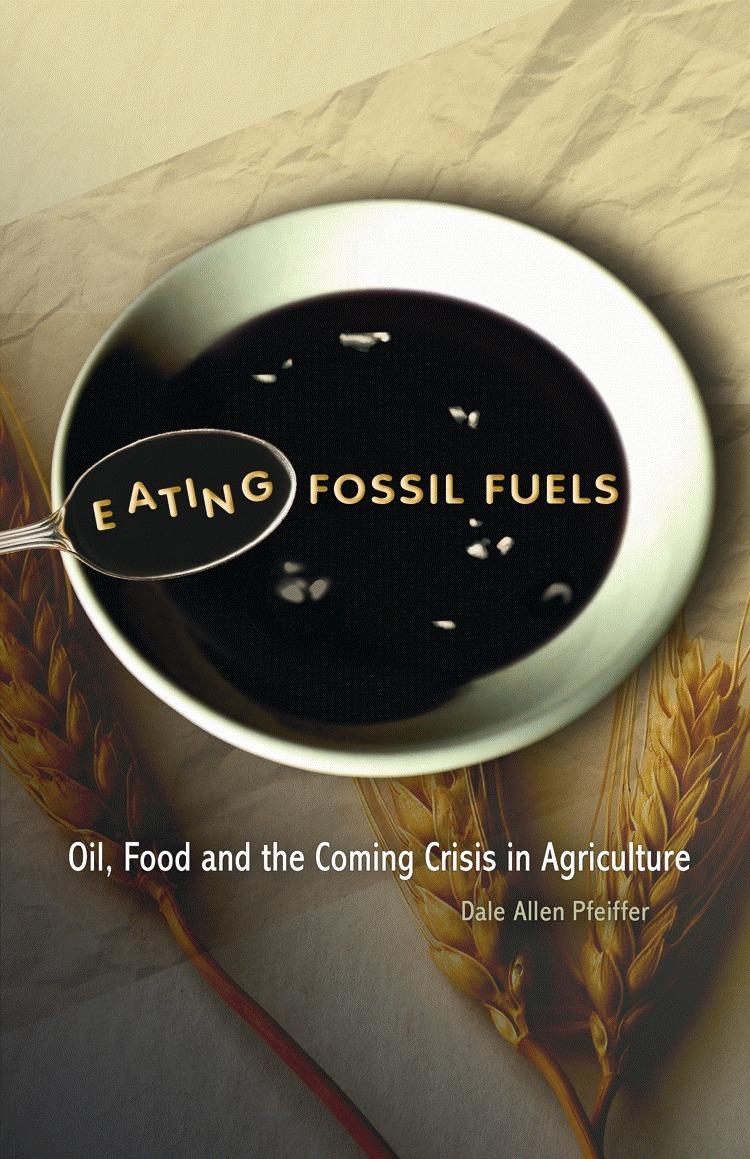
The miracle of the Green Revolution was made possible by cheap fossil fuels to supply crops with artificial fertilizer, pesticides, and irrigation. Estimates of the net energy balance of agriculture in the United States show that ten calories of hydrocarbon energy are required to produce one calorie of food. Such an imbalance cannot continue in a world of diminishing hydrocarbon resources.
Eating Fossil Fuels examines the interlinked crises of energy and agriculture and highlights some startling findings:
• The worldwide expansion of agriculture has appropriated fully 40 percent of the photosynthetic capability of this planet.
• The Green Revolution provided abundant food sources for many, resulting in a population explosion well in excess of the planet’s carrying capacity.
• Studies suggest that without fossil fuel-based agriculture, the United States could only sustain about two-thirds of its present population. For the planet as a whole, the sustainable number is estimated to be about two billion.
Concluding that the effect of energy depletion will be disastrous without a transition to a sustainable, re-localized agriculture, the book draws on the experiences of North Korea and Cuba to demonstrate stories of failure and success in the transition to non-hydrocarbon-based agriculture. It urges strong grassroots activism for sustainable, localized agriculture and a natural shrinking of the world’s population.
Eating Fossil Fuels examines the interlinked crises of energy and agriculture and highlights some startling findings:
• The worldwide expansion of agriculture has appropriated fully 40 percent of the photosynthetic capability of this planet.
• The Green Revolution provided abundant food sources for many, resulting in a population explosion well in excess of the planet’s carrying capacity.
• Studies suggest that without fossil fuel-based agriculture, the United States could only sustain about two-thirds of its present population. For the planet as a whole, the sustainable number is estimated to be about two billion.
Concluding that the effect of energy depletion will be disastrous without a transition to a sustainable, re-localized agriculture, the book draws on the experiences of North Korea and Cuba to demonstrate stories of failure and success in the transition to non-hydrocarbon-based agriculture. It urges strong grassroots activism for sustainable, localized agriculture and a natural shrinking of the world’s population.
Pages: 125
Category: Miljövetenskap & Klimat
e-ISBN: 9781550923766
Shipping weight: 1.2 kg
Ships in: 1-2 days
Pay easily by card, Klarna, Apple Pay or Google Pay. Not happy? You always have a 14-day money-back guarantee. Read more in our terms. If you have any questions, email us at hello@memmo.org.
Memmo makes studying easier – wherever you are in the world. We bring your course books and smart study tools together in one place: summaries, quizzes, podcasts and flashcards. Plus Ted, your study buddy who answers anything you wonder. Over 50,000 students already study here – built to help you learn faster and stress less.
You might also like
Buy the book0