
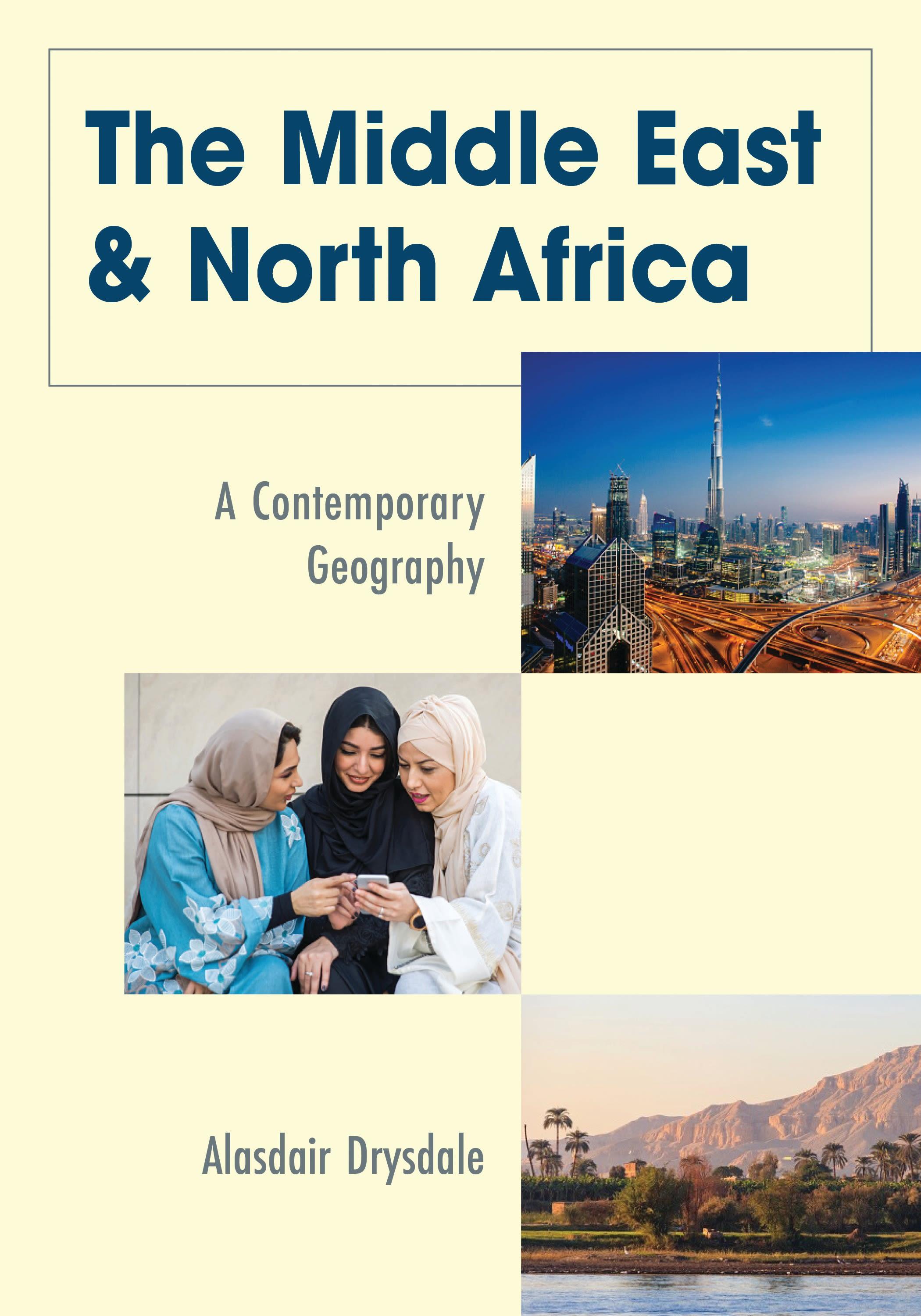
This contemporary text—the first in over a decade on the region—presents the geography of the Middle East and North Africa, defined as the Arab World, Israel, Turkey, Iran, and Afghanistan. Thematically organized, the book’s eleven chapters focus on the region’s physical and climatic setting, demographic characteristics, migration patterns, religious and linguistic diversity, political map, offshore claims, oil and gas resources, and subregions and states.
Within this framework, Drysdale emphasizes pressing current problems: the impact of climate change in a region where some areas already suffer from extreme summer heat and aridity, the challenge of providing additional water in a region where per capita availability of freshwater is already the lowest in the world, the impact of high fertility and rapid population growth in a fragile environment where economies are often unable to absorb young workers entering the labor force, the looming prospect of an aging population, the effects of out- and in-migration, the diverse impact and role of Islam in daily and public life, the integrative consequences of linguistic and ethnic diversity, the evolution and imperfections of the political map, ongoing territorial and boundary disputes that often have global repercussions, external dependence on the region’s prolific oil and gas resources, and the extreme regional inequalities associated with their presence or absence. This timely and insightful analysis is essential reading for students of the region who need a better understanding of key regional characteristics, challenges, and issues.
Within this framework, Drysdale emphasizes pressing current problems: the impact of climate change in a region where some areas already suffer from extreme summer heat and aridity, the challenge of providing additional water in a region where per capita availability of freshwater is already the lowest in the world, the impact of high fertility and rapid population growth in a fragile environment where economies are often unable to absorb young workers entering the labor force, the looming prospect of an aging population, the effects of out- and in-migration, the diverse impact and role of Islam in daily and public life, the integrative consequences of linguistic and ethnic diversity, the evolution and imperfections of the political map, ongoing territorial and boundary disputes that often have global repercussions, external dependence on the region’s prolific oil and gas resources, and the extreme regional inequalities associated with their presence or absence. This timely and insightful analysis is essential reading for students of the region who need a better understanding of key regional characteristics, challenges, and issues.
Pay easily by card, Klarna, Apple Pay or Google Pay. Not happy? You always have a 14-day money-back guarantee. Read more in our terms. If you have any questions, email us at hello@memmo.org.
Memmo makes studying easier – wherever you are in the world. We bring your course books and smart study tools together in one place: summaries, quizzes, podcasts and flashcards. Plus Ted, your study buddy who answers anything you wonder. Over 50,000 students already study here – built to help you learn faster and stress less.