
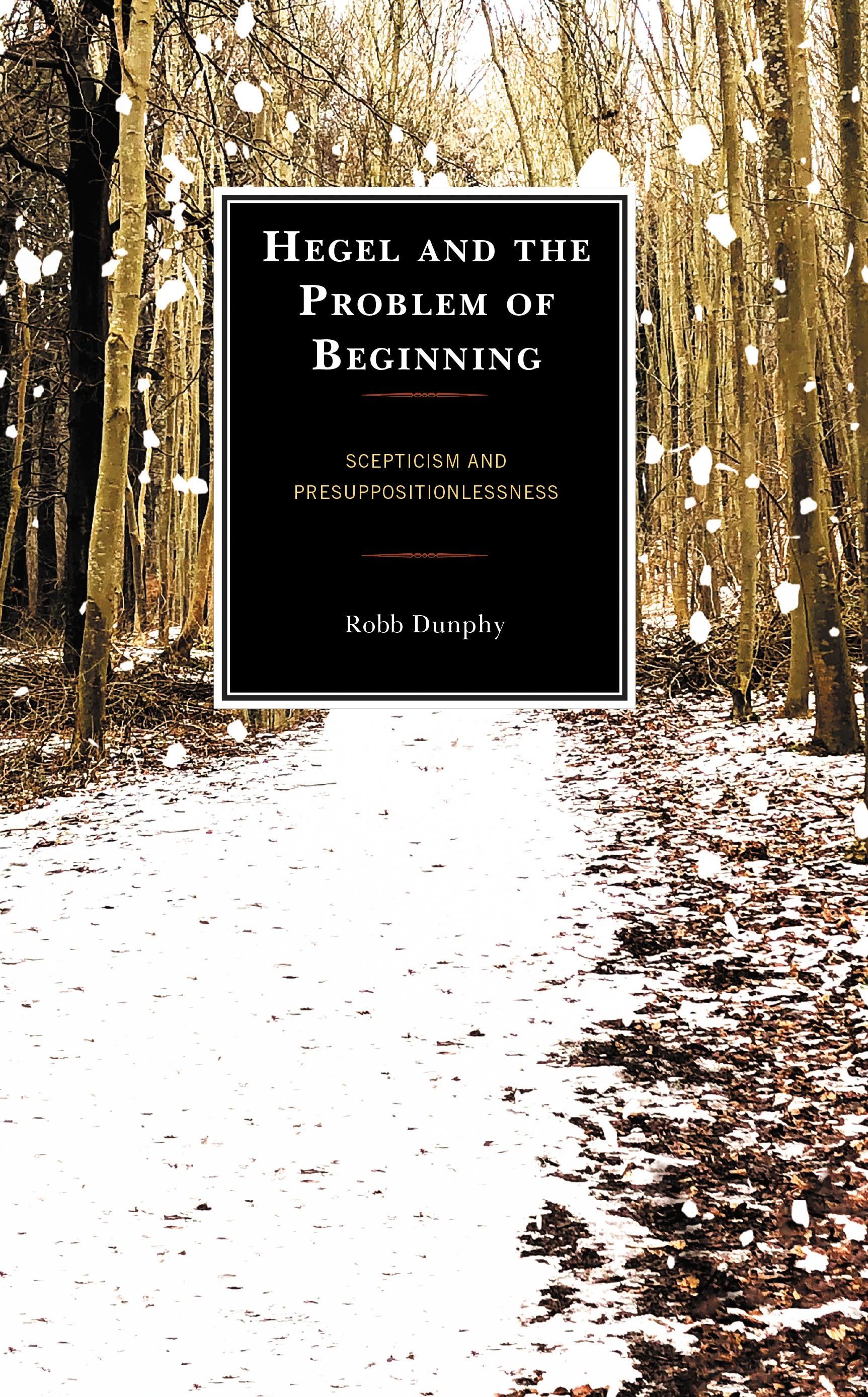
Hegel opens the first book of his Science of Logic with the statement of a problem: “The beginning of philosophy must be either something mediated or something immediate, and it is easy to show that it can be neither the one nor the other, so either way of beginning finds its rebuttal.” Despite its significant placement, exactly what Hegel means in his expression of this problem and exactly what his solution to it is, remain unclear.
In this book, Robb Dunphy provides a detailed engagement with Hegel’s “problem of beginning”, locating it within Hegel’s account of significant approaches to the topic of beginning in the history of Western philosophy, as well as making an extended case for the influence of Pyrrhonian Scepticism on the beginning of Hegel’s Logic. Dunphy’s discussion of the various putative solutions that Hegel might be thought to put forward contributes to debates concerning Hegel’s views on the methodology of logic, the relation between his Logic and his Phenomenology of Spirit, and differences between his Encyclopaedia presentation of logic and that of his greater Science of Logic.
Hegel and the Problem of Beginning also functions as a critical commentary on Hegel’s essay, “With what must the beginning of the science be made?” which should be of interest to both researchers and students working on the opening of Hegel’s Logic.
In this book, Robb Dunphy provides a detailed engagement with Hegel’s “problem of beginning”, locating it within Hegel’s account of significant approaches to the topic of beginning in the history of Western philosophy, as well as making an extended case for the influence of Pyrrhonian Scepticism on the beginning of Hegel’s Logic. Dunphy’s discussion of the various putative solutions that Hegel might be thought to put forward contributes to debates concerning Hegel’s views on the methodology of logic, the relation between his Logic and his Phenomenology of Spirit, and differences between his Encyclopaedia presentation of logic and that of his greater Science of Logic.
Hegel and the Problem of Beginning also functions as a critical commentary on Hegel’s essay, “With what must the beginning of the science be made?” which should be of interest to both researchers and students working on the opening of Hegel’s Logic.
Pay easily by card, Klarna, Apple Pay or Google Pay. Not happy? You always have a 14-day money-back guarantee. Read more in our terms. If you have any questions, email us at hello@memmo.org.
Memmo makes studying easier – wherever you are in the world. We bring your course books and smart study tools together in one place: summaries, quizzes, podcasts and flashcards. Plus Ted, your study buddy who answers anything you wonder. Over 50,000 students already study here – built to help you learn faster and stress less.