
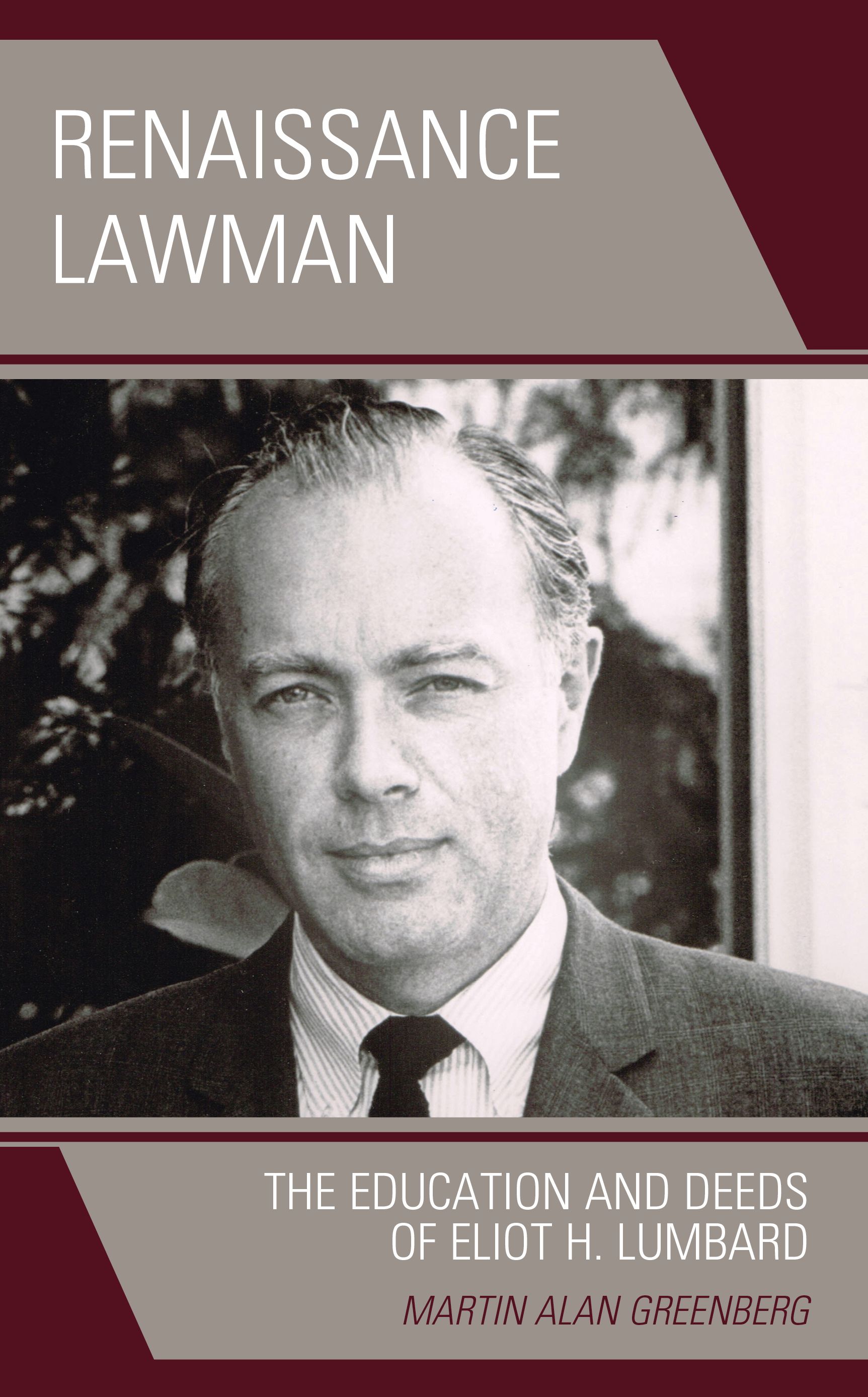
Renaissance Lawman: The Education and Deeds of Eliot H. Lumbard details the life, education, and public service career of Eliot Howland Lumbard. A lawyer, who most of his life, lived and worked in Manhattan and whose legal career spanned more than fifty years beginning in the early 1950s.
Lumbard is easily identified as a renaissance lawman for having gained considerable expertise in the operations of the political and justice systems, and for proceeding to capitalize on this knowledge to become both an advocate and initiator of progressive reforms for criminal justice. His contributions on behalf of public safety have been largely forgotten but throughout this intriguing biography Martin Alan Greenberg successfully juxtaposes many of Lumbard's professional activities with many of the major historical developments and challenges of his time.
The chronicled events emphasize what motivated the people in his generation to behave as they did since the world today is a much different place than what Americans were experiencing in the first three decades after WW II. Cultural and technological changes have combined to make our present-day world quite different from over a half-century ago.
Renaissance Lawman proves to be especially rewarding to a wide-range of readers interested in police work, criminal justice history, public service leadership, and legal ethics. There are no other comparable books on the market. Lumbard certainly had a unique legal career and his impactful contributions have seldom, if ever, been duplicated – even if his contributions, on behalf of public safety, have been largely forgotten.
Lumbard is easily identified as a renaissance lawman for having gained considerable expertise in the operations of the political and justice systems, and for proceeding to capitalize on this knowledge to become both an advocate and initiator of progressive reforms for criminal justice. His contributions on behalf of public safety have been largely forgotten but throughout this intriguing biography Martin Alan Greenberg successfully juxtaposes many of Lumbard's professional activities with many of the major historical developments and challenges of his time.
The chronicled events emphasize what motivated the people in his generation to behave as they did since the world today is a much different place than what Americans were experiencing in the first three decades after WW II. Cultural and technological changes have combined to make our present-day world quite different from over a half-century ago.
Renaissance Lawman proves to be especially rewarding to a wide-range of readers interested in police work, criminal justice history, public service leadership, and legal ethics. There are no other comparable books on the market. Lumbard certainly had a unique legal career and his impactful contributions have seldom, if ever, been duplicated – even if his contributions, on behalf of public safety, have been largely forgotten.
Pay easily by card, Klarna, Apple Pay or Google Pay. Not happy? You always have a 14-day money-back guarantee. Read more in our terms. If you have any questions, email us at hello@memmo.org.
Memmo makes studying easier – wherever you are in the world. We bring your course books and smart study tools together in one place: summaries, quizzes, podcasts and flashcards. Plus Ted, your study buddy who answers anything you wonder. Over 50,000 students already study here – built to help you learn faster and stress less.