
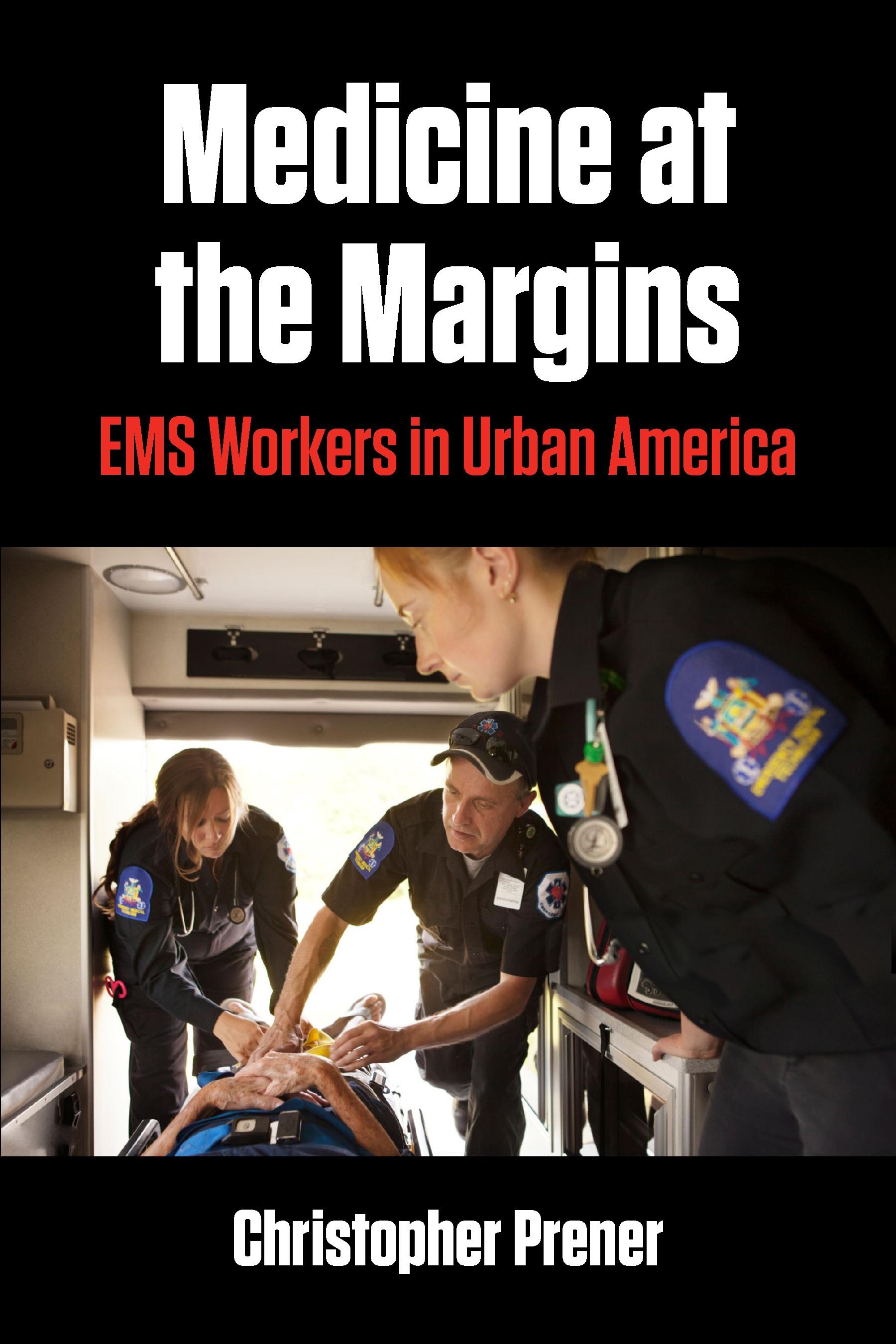
Presents a unique view of social problems and conflicts over urban space from the cab of an ambulance.
While we imagine ambulances as a site for critical care, the reality is far more complicated. Social problems, like homelessness, substance abuse, and the health consequences of poverty, are encountered every day by Emergency Medical Services (EMS) workers. Written from the lens of a sociologist who speaks with the fluency of a former Emergency Medical Technician (EMT), Medicine at the Margins delves deeply into the world of EMTs and paramedics in American cities, an understudied element of our health care system.
Like the public hospital, the EMS system is a key but misunderstood part of our system of last resort. Medicine at the Margins presents a unique prism through which urban social problems, the health care system, and the struggling social safety net refract and intersect in largely unseen ways. Author Christopher Prener examines the forms of marginality that capture the reality of urban EMS work and showcases the unique view EMS providers have of American urban life. The rise of neighborhood stigma and the consequences it holds for patients who are assumed by providers to be malingering is critical for understanding not just the phenomenon of non- or sub-acute patient calls but also why they matter for all patients. This sense of marginality is a defining feature of the experience of EMS work and is a statement about the patient population whom urban EMS providers care for daily. Prener argues that the pre-hospital health care system needs to embrace its role in the social safety net and how EMSs’ future is in community practice of paramedicine, a port of a broader mandate of pre-hospital health care. By leaning into this work, EMS providers are uniquely positioned to deliver on the promise of community medicine.
At a time when we are considering how to rely less on policing, the EMS system is already tasked with treating many of the social problems we think would benefit from less involvement with law involvement. Medicine at the Margins underscores why the EMS system is so necessary and the ways in which it can be expanded.
Pay easily by card, Klarna, Apple Pay or Google Pay. Not happy? You always have a 14-day money-back guarantee. Read more in our terms. If you have any questions, email us at hello@memmo.org.
Memmo makes studying easier – wherever you are in the world. We bring your course books and smart study tools together in one place: summaries, quizzes, podcasts and flashcards. Plus Ted, your study buddy who answers anything you wonder. Over 50,000 students already study here – built to help you learn faster and stress less.