
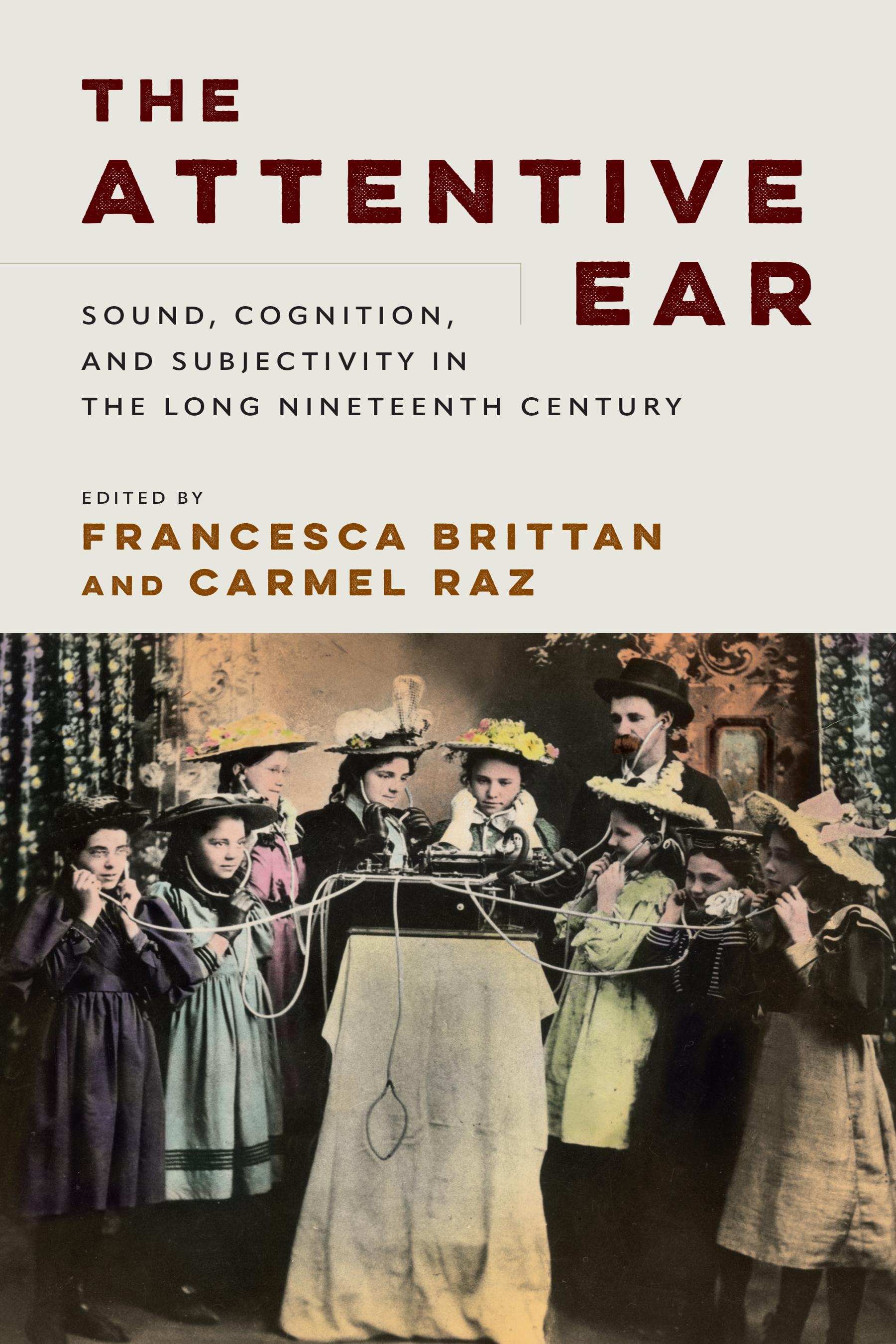
An interdisciplinary history of auditory attention that demonstrates the central role of audition in shaping our conceptions of focus and distraction
Over the past decade, attention and its perceived opposite, distraction, have become sites of sustained anxiety and debate. Questions around attentive economies, histories, and cognitive modes have surfaced across a range of disciplines from cultural studies to computer science, philosophy, and medicine.
The Attentive Ear fills a significant gap in current scholarship, exploring the history of auditory attention between roughly 1800-1930. Across boundaries of time, place, culture, and class, this period witnessed a marked uptick in discourses around attention and inattention, including attempts to define the states of multifocal, singular, spotlighted, intermittent, and distracted forms of focus underpinning perception and cognition. The richness of attention as a site of historical enquiry is indicated by the breadth of the volume’s essays. Spanning aesthetic, scientific, pedagogical, and philosophical pasts, they show how conceptions of focus and unfocus have shaped musical culture, including modes of auditory production, reception, and mediatization.
Featuring case studies from Europe, Asia, and North America by leading scholars of sound studies, the volume’s contributors probe the origins, key theories, and experimental trajectories of attentional discourse around the globe, demonstrating the central role of audition in shaping our conceptions of focus and distraction. Though the groupings sketched above explore distinct arenas of attention’s history, they also intersect, grappling with overlapping questions around the ideological valency of concentrated or distracted listening; the attentional conditioning of listeners, performers, and pedagogues; and the importance of cognitive modalities in shaping auditory subjectivities.
Contributors: Francesca Brittan, D. Graham Burnett, Tony Day, Ewan Jones, Brian Kane, Alexandra Kieffer, Youn Kim, Céline Frigau Manning, Nicholas Mathew, Jacob Olley, Carmel Raz, Benjamin Steege, David Trippett, Sarah Weiss, Richard David Williams.
Pay easily by card, Klarna, Apple Pay or Google Pay. Not happy? You always have a 14-day money-back guarantee. Read more in our terms. If you have any questions, email us at hello@memmo.org.
Memmo makes studying easier – wherever you are in the world. We bring your course books and smart study tools together in one place: summaries, quizzes, podcasts and flashcards. Plus Ted, your study buddy who answers anything you wonder. Over 50,000 students already study here – built to help you learn faster and stress less.