
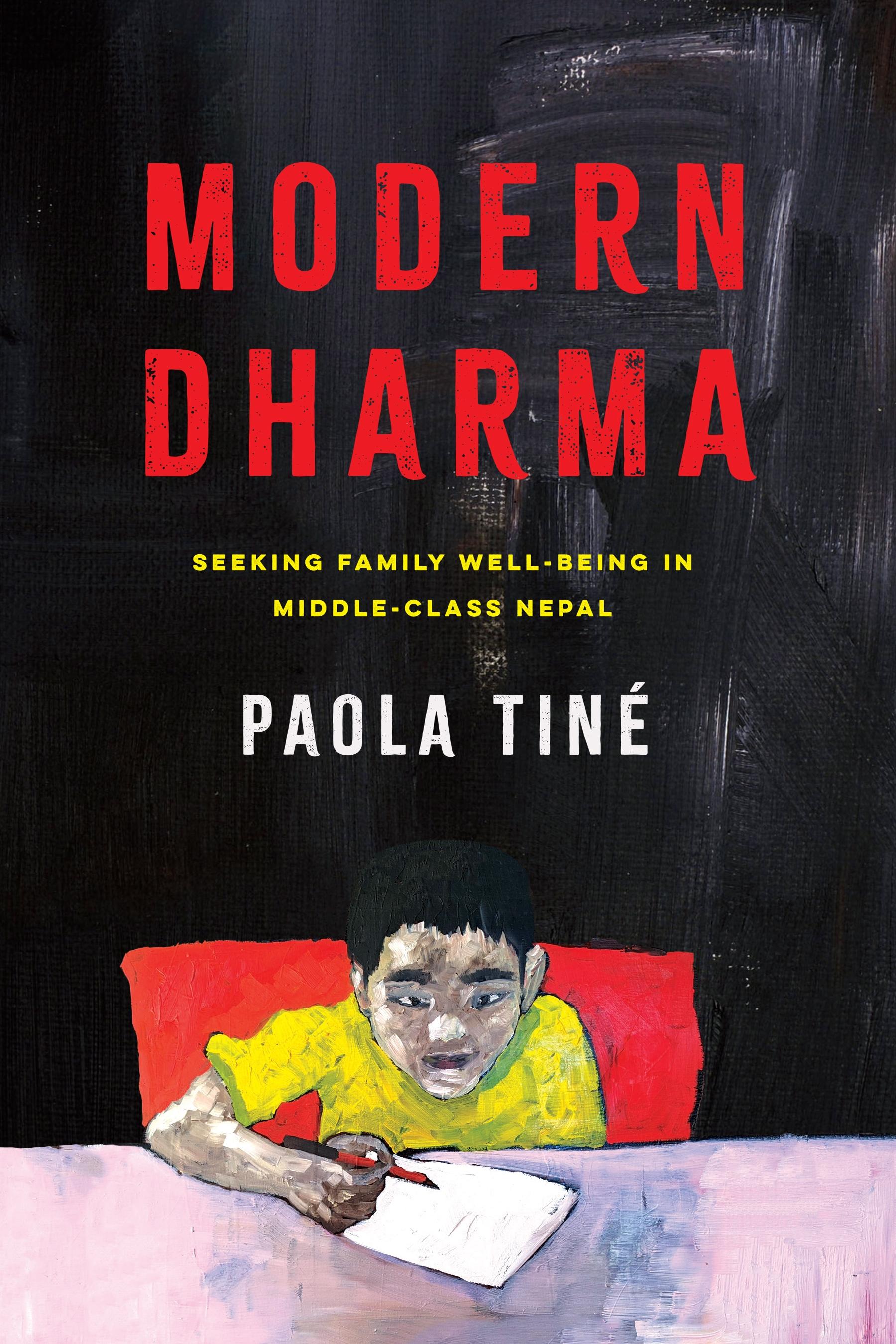
How middle-class families in Nepal pursue “well-being” in a rapidly changing social landscape
Modern Dharma asks how middle-class Nepalis pursue an ethical, good life in a rapidly evolving society. In the aftermath of a decade-long civil war that raged between 1996 and 2006, social change accelerated in Nepal as the shift to a market economy and the spread of education and media built the foundation for a new middle class to form. As it did, tension built between the expression of individual will and the expectation to submit to traditional social hierarchies. Today, people in Nepal are confronted by the need to restructure moral codes and to care for their families, while at the same time, they face intense pressure to keep up with the cost of education and to find work in an increasingly competitive labor market. Amidst these changes, people often describe their choices as falling under the broader goal of pursuing well-being.
Modern Dharma investigates how and why—amidst often conflicting priorities—people make choices in pursuit of well-being. Anthropologist Paola Tiné investigates why many large families separate into smaller nuclei, while others maintain intra-generational homes. She asks why and how young people seek the support of their friends, while often hiding private desires from their parents. And she investigates the ways that marriage choices and friendship relationships help people navigate the ongoing tangible difficulties engendered by socioeconomic change. By delving into the intricacies of domestic lives among a growing middle class, Modern Dharma works to center the household and kinship relationships as the places where broader global transitions are reflected, resisted, and negotiated. Providing a new perspective on moral personhood in South Asia, this book ultimately sheds new light on the centrality of kinship relationships in initiating and shaping social change.
Pay easily by card, Klarna, Apple Pay or Google Pay. Not happy? You always have a 14-day money-back guarantee. Read more in our terms. If you have any questions, email us at hello@memmo.org.
Memmo makes studying easier – wherever you are in the world. We bring your course books and smart study tools together in one place: summaries, quizzes, podcasts and flashcards. Plus Ted, your study buddy who answers anything you wonder. Over 50,000 students already study here – built to help you learn faster and stress less.