
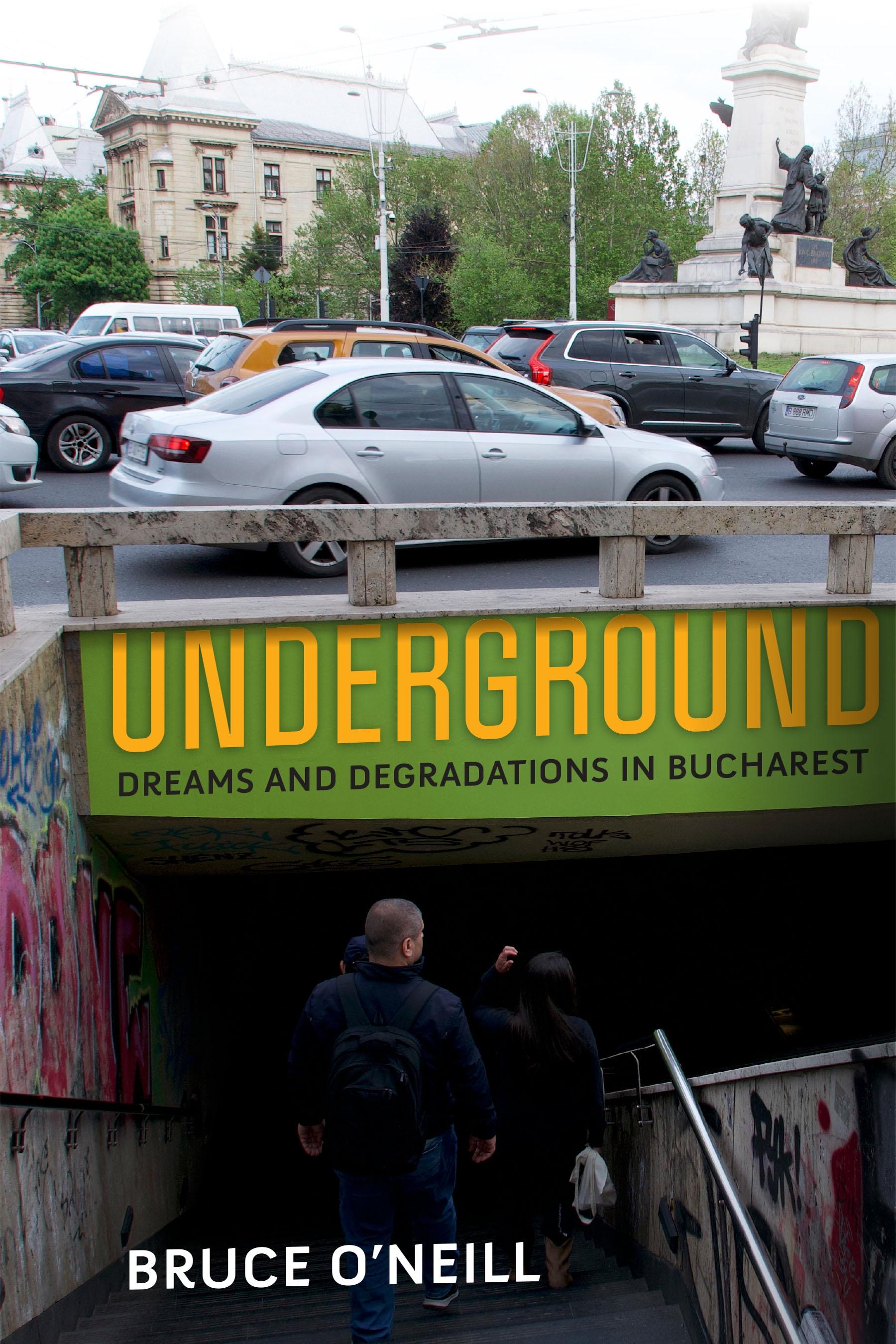
This book gets to the bottom of the twenty-first-century city, literally. Underground moves beneath Romania’s capital, Bucharest, to examine how the demands of global accumulation have extended urban life not just upward into higher skylines, and outward to ever more distant peripheries, but also downward beneath city sidewalks. Underground details how developers and municipal officials have invested tremendous sums of money to gentrify and expand Bucharest’s constellation of subterranean Metro stations and pedestrian pathways, basements and cellars, bunkers and crypts to provide upwardly mobile residents with space to live, work, and play in an overcrowded and increasingly unaffordable city center. In this sense, the repurposed underground facilitates dreams of middle-class ascendancy. This sense of optimism, the book shows, invariably gives way to ambivalence as the middle classes confront the indignities of being incorporated into the city from below.
Bruce O’Neill argues that these loosely coordinated efforts have not only introduced novel forms of social fragmentation but also a new aesthetics of inequality that are fundamentally shaping where and how the middle classes fit in the city. Pushing urban studies beyond a cartographic perspective—with its horizontal focus upon centers and peripheries, walls and gates—O’Neill brings into focus the vertical dynamics of gentrification that place some “on the bottom” and others “on top” of the city. As cities around the world extend further downward in the name of development and sustainability, Underground makes clear that scholars and practitioners of the twenty-first-century city will need to become ever more attuned to the cultural politics of urban verticality, asking not just who is included in the city and who has been pressed outside of it, but also who is on top and who is placed on the bottom.
Pay easily by card, Klarna, Apple Pay or Google Pay. Not happy? You always have a 14-day money-back guarantee. Read more in our terms. If you have any questions, email us at hello@memmo.org.
Memmo makes studying easier – wherever you are in the world. We bring your course books and smart study tools together in one place: summaries, quizzes, podcasts and flashcards. Plus Ted, your study buddy who answers anything you wonder. Over 75,000 students already study here – built to help you learn faster and stress less.