
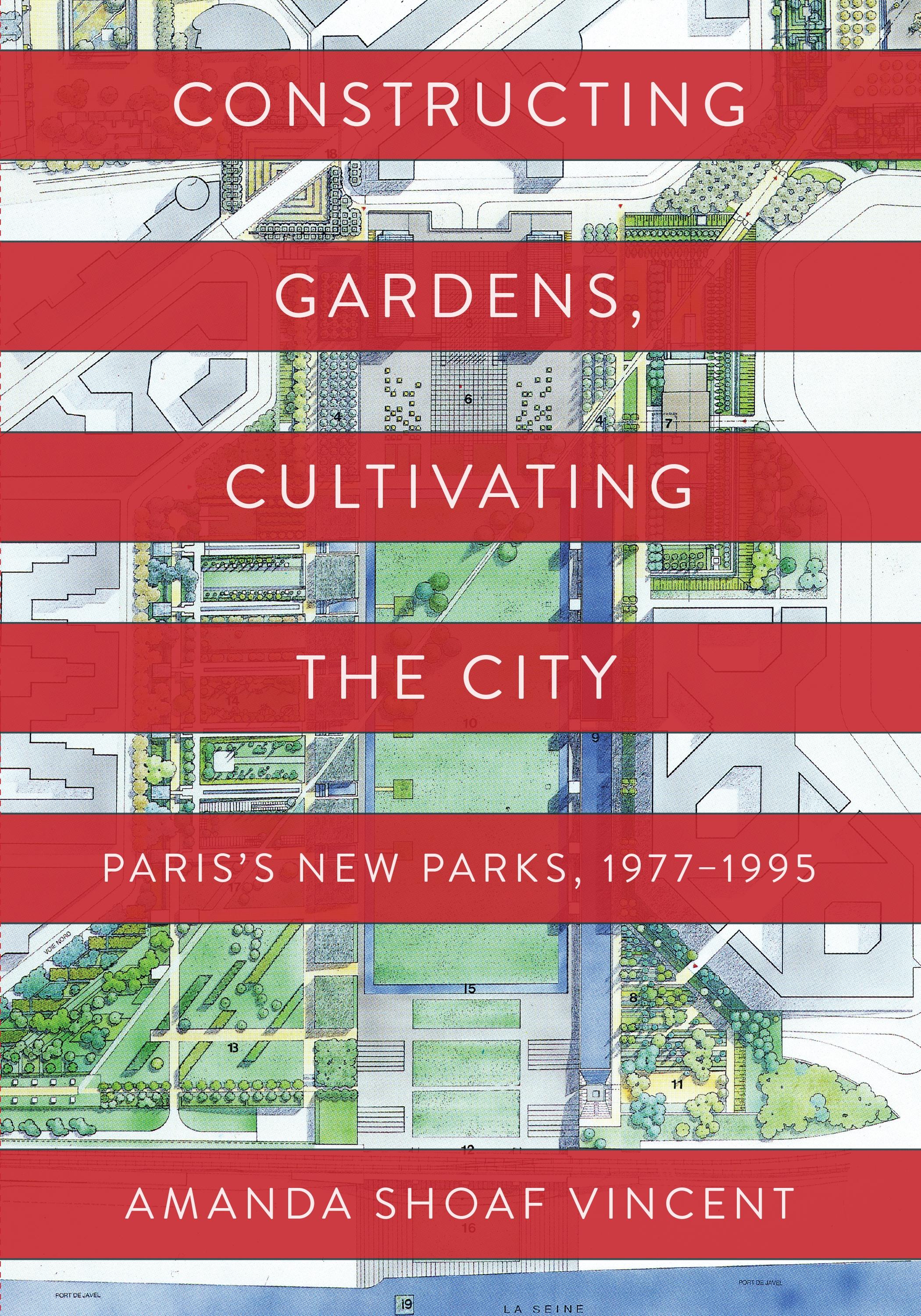
Constructing Gardens, Cultivating the City is the first cultural history of major new parks developed in Paris in the late twentieth century, as part of the city’s program of adaptive reuse of industrial spaces. Thanks to laws that gave the city more political autonomy, Paris’s local government launched a campaign of park creation in the late 1970s that continued to the turn of the millennium. The parks in this book represent this campaign and illustrate different facets of their cultural and historical context.
Archival research, interviews, and analyses of the parks reveal how postmodern debates about urban planning, the historic city, public space, and nature’s presence in an urban setting influenced their designs. In sum, the city adopted the garden as a model for public parks, investing in complex, richly symbolic and representational spaces. These parks were intended to represent contemporary twists on traditional designs and serve local residents as much as they would contribute to Paris’s role as a world city.
The parks’ development process often included points of conflict, pointing to differing views on what Parisian space should represent and fundamental contradictions between the characteristics of public space and the garden as it is traditionally defined. These parks demonstrate the ongoing cultivation of the city over time, in which transformed sites not only fulfil new functions but also engage with history and their surroundings to create new meaning. They stand for landscape as a form of signifying cultural production that directly engages with other art forms and ways of knowing. Just as the Luxembourg Gardens, the Tuileries, and the Buttes-Chaumont parks exemplify their eras’ cultural dynamics, such parks as the Jardin Atlantique, Parc André-Citroën, and the Jardin des Halles express contemporary French culture within the archetypal space of their era, the city. Finally, they point the way to current trends in landscape architecture, such as citizen gardening and ecological initiatives.
Pay easily by card, Klarna, Apple Pay or Google Pay. Not happy? You always have a 14-day money-back guarantee. Read more in our terms. If you have any questions, email us at hello@memmo.org.
Memmo makes studying easier – wherever you are in the world. We bring your course books and smart study tools together in one place: summaries, quizzes, podcasts and flashcards. Plus Ted, your study buddy who answers anything you wonder. Over 75,000 students already study here – built to help you learn faster and stress less.