
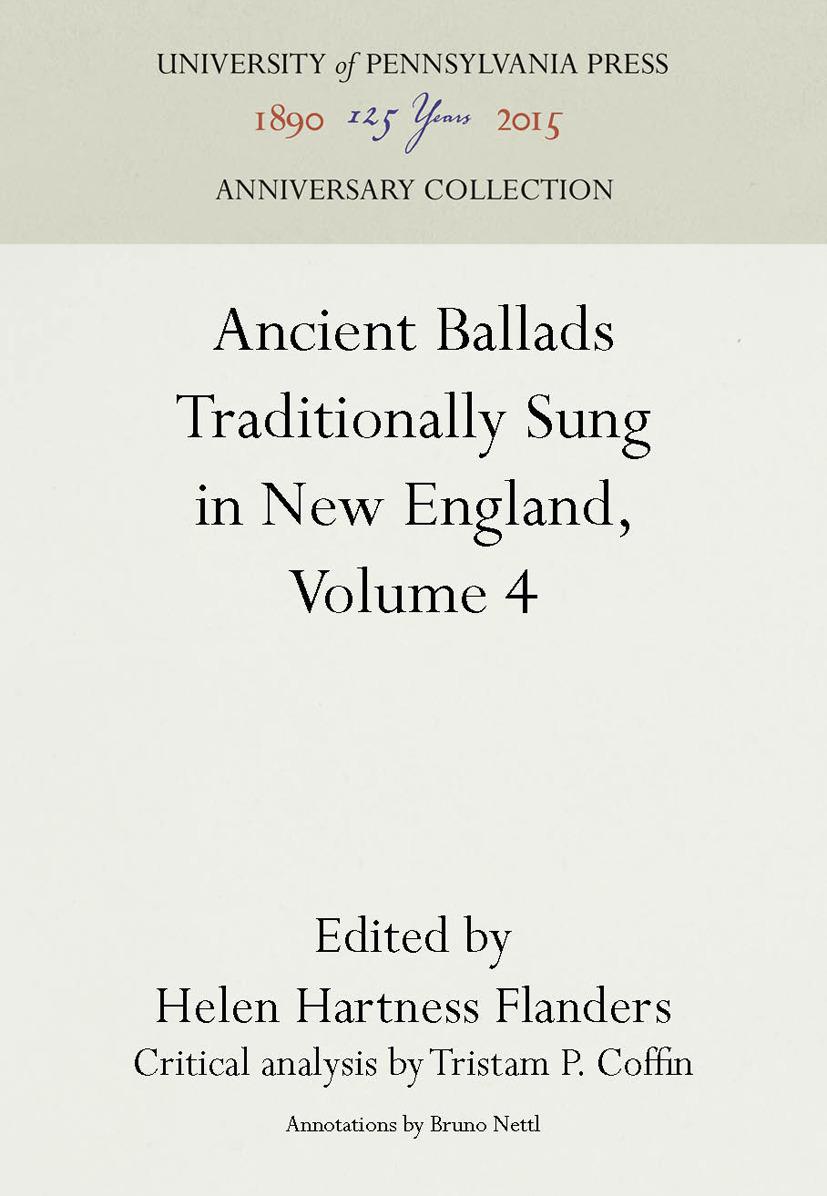
Ballads offer one of the most fascinating and revealing records of humankind—our deepest feelings and most profound experiences, our laughter and joys, our troubles and sorrows. There is no battle, no romance, no escapade, no tragedy recorded in song which is not rich both in historical significance and in contemporary experience. A ballad is a link with past generations, traditions, and the basic character traits of a people, a region, or a country. The associations formed, the recollections stirred make the study of this form of music a rewarding experience.	
The first printed collection of ballads was made in 1723-25 and entitled simply Old Ballads. That it met with warm approval is indicated by the fact that a third edition was published as soon as 1727. Since the publication of that first collection, interest in the ballad and demand for ballad texts have grown constantly. During the eighteenth, nineteenth, and twentieth centuries, several hundred collections were published. Many of these collections have become classics in the field of balladry. With the publication of this fourth and final volume of the Ancient Ballads series, the Helen Hartness Flanders Collection took its place with the other classics in the field.
Volume IV contains child ballads 250-295 with thirty-six versions of "The Sweet Trinity," or "The Golden Vanity," alone. This is representative of the completeness of the series and reflects the years of scholarship that went into the collecting, interviewing, scoring, and editing of the collection.
With analyses by Tristram P. Coffin and musical annotations by Bruno Netti, Helen Hartness Flanders's work constitutes an invaluable source for the student of the ballad, as well as those interested in the related studies of musicology, literature, history, social sciences, and ethnology. Ancient Ballads Traditionally Sung in New England provides endless opportunity for both scholarly study and sheer fascination.
Pay easily by card, Klarna, Apple Pay or Google Pay. Not happy? You always have a 14-day money-back guarantee. Read more in our terms. If you have any questions, email us at hello@memmo.org.
Memmo makes studying easier – wherever you are in the world. We bring your course books and smart study tools together in one place: summaries, quizzes, podcasts and flashcards. Plus Ted, your study buddy who answers anything you wonder. Over 50,000 students already study here – built to help you learn faster and stress less.