
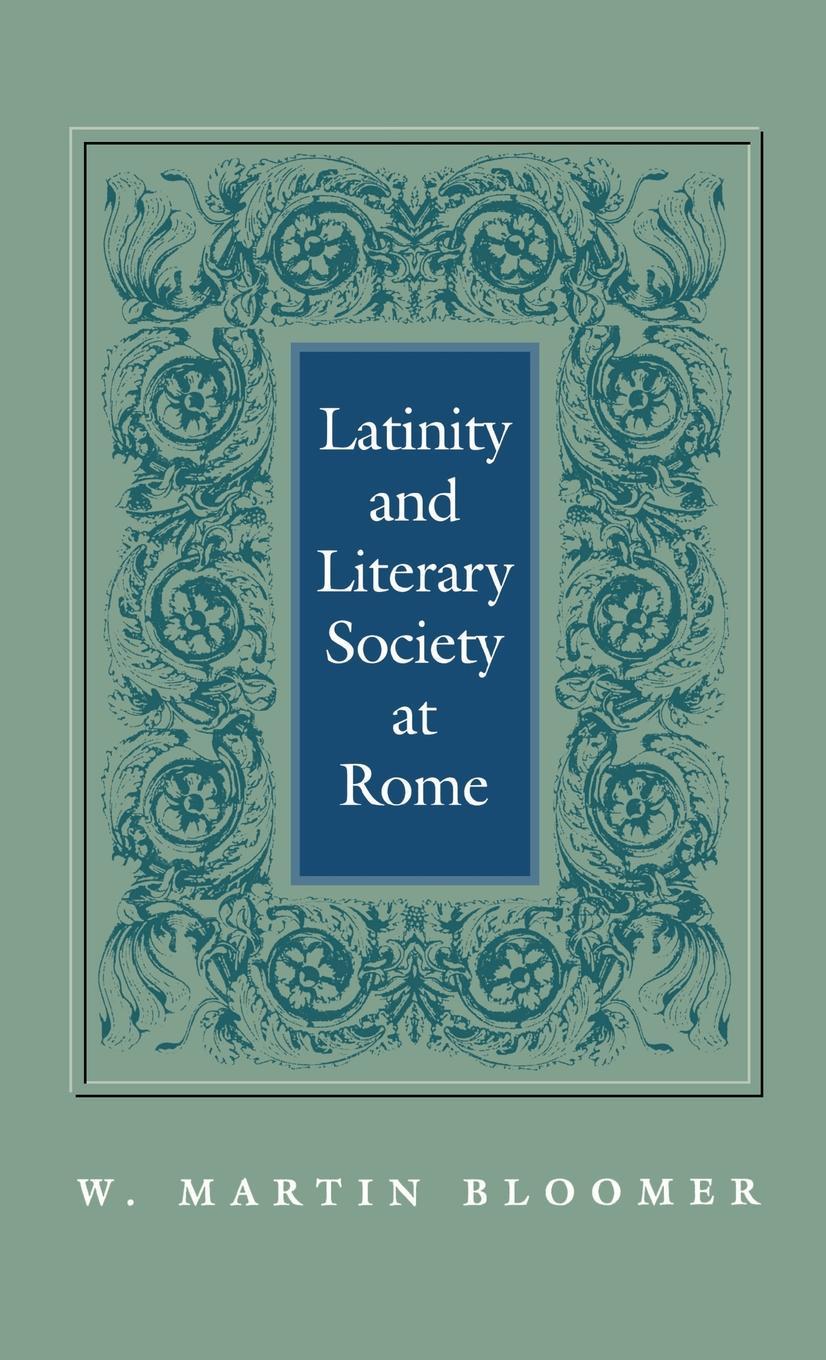
For centuries after the fall of the Roman empire, the ability to write and speak pure Latin was the mark of the true scholar. But although such skill was esteemed in medieval times, the language of ancient Rome was as various as the styles of slaves and masters.
Latinity and Literary Society at Rome reaches back to the early Roman empire to examine attitudes toward latinity, reviewing the contested origins of scholarly Latin in the polemical arena of Roman literature. W. Martin Bloomer shows how that literature's reflections on correct and incorrect speech functioned as part of a wider understanding of social relations and national identity in Rome.
Bloomer's investigation begins with questions about the sociology of Latin literature—what interests were served by the creation of high style and how literary stylization constituted a system of social decorum—and goes on to offer readings of selected texts. Through studies of works ranging from Varro's De lingua latina to the verse fables of Augustine's freeman Phaedrus to the Annals of Tacitus, Bloomer examines conflicting claims to style not simply to set true Latin against vulgarism but also to ask who is excluding whom, why, and by what means.
These texts exemplify the ways Roman literature employs representations of, and reflections on, proper and improper language to mirror the interests of specific groups who wished to maintain or establish their place in Roman society. They show how writers sought to influence the fundamental social issue of who had the power to confer legitimacy of speech and how their works used claims of linguistic propriety to reinforce the definition of "Romanness."
Through Bloomer's study latinity emerges as a contested field of identity and social polemic heretofore unrecognized in classical scholarship. With its fresh interpretations of major and minor texts, Latinity and Literary Society at Rome is a literary history that significantly advances our understanding of the place of language in ancient Rome.
Pay easily by card, Klarna, Apple Pay or Google Pay. Not happy? You always have a 14-day money-back guarantee. Read more in our terms. If you have any questions, email us at hello@memmo.org.
Memmo makes studying easier – wherever you are in the world. We bring your course books and smart study tools together in one place: summaries, quizzes, podcasts and flashcards. Plus Ted, your study buddy who answers anything you wonder. Over 75,000 students already study here – built to help you learn faster and stress less.