
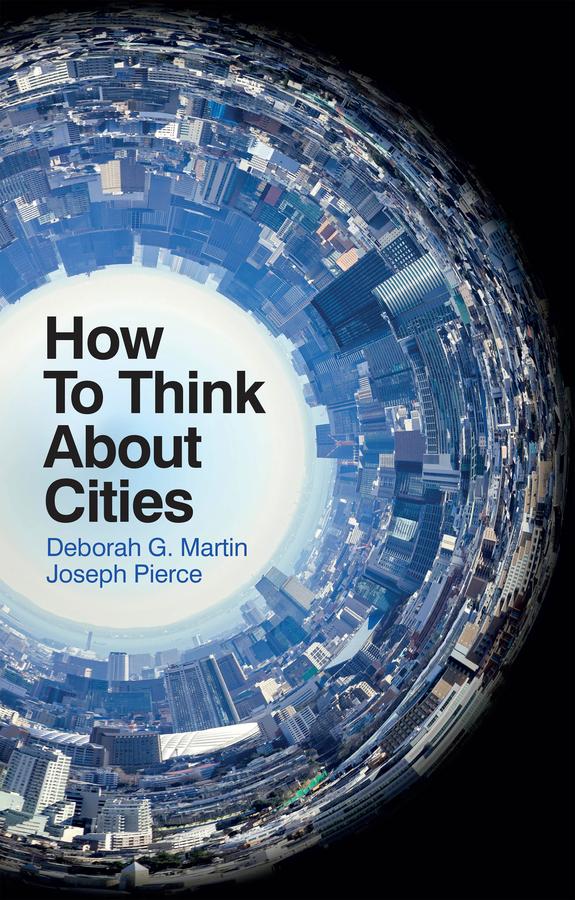
Cities are raucous, cacophonous, and complex. Many dimensions of life play out and conflict across cities’ intricate landscapes, be they political, cultural, economic, or social. Urban policy makers and analysts often attempt to “cut through the noise” of urban disagreement by emphasizing a dominant lens for understanding the key, central logic of the city. How To Think About Cities sees this tendency to selective vision as misleading and ultimately unjust: cities are many things at once to different people and communities.
This book describes the various ways of seeing the functions and landscapes of the city as place frames, and the constant process of negotiating which place frames best explain the city as place-making. Martin and Pierce call for an explicitly hybrid perspective that shifts between many different frames for making sense of cities. This approach highlights how any given stance opens up some lines of inquiry and understanding while closing off others. Thinking of cities as sites of contested perspectives promotes a synthetic approach to urban analysis that emphasizes difference and political possibility.
This mosaic view of the city will be a welcome read for those within urban studies, geography, and social sciences exploring the many faces of urban life.
Pay easily by card, Klarna, Apple Pay or Google Pay. Not happy? You always have a 14-day money-back guarantee. Read more in our terms. If you have any questions, email us at hello@memmo.org.
Memmo makes studying easier – wherever you are in the world. We bring your course books and smart study tools together in one place: summaries, quizzes, podcasts and flashcards. Plus Ted, your study buddy who answers anything you wonder. Over 75,000 students already study here – built to help you learn faster and stress less.