
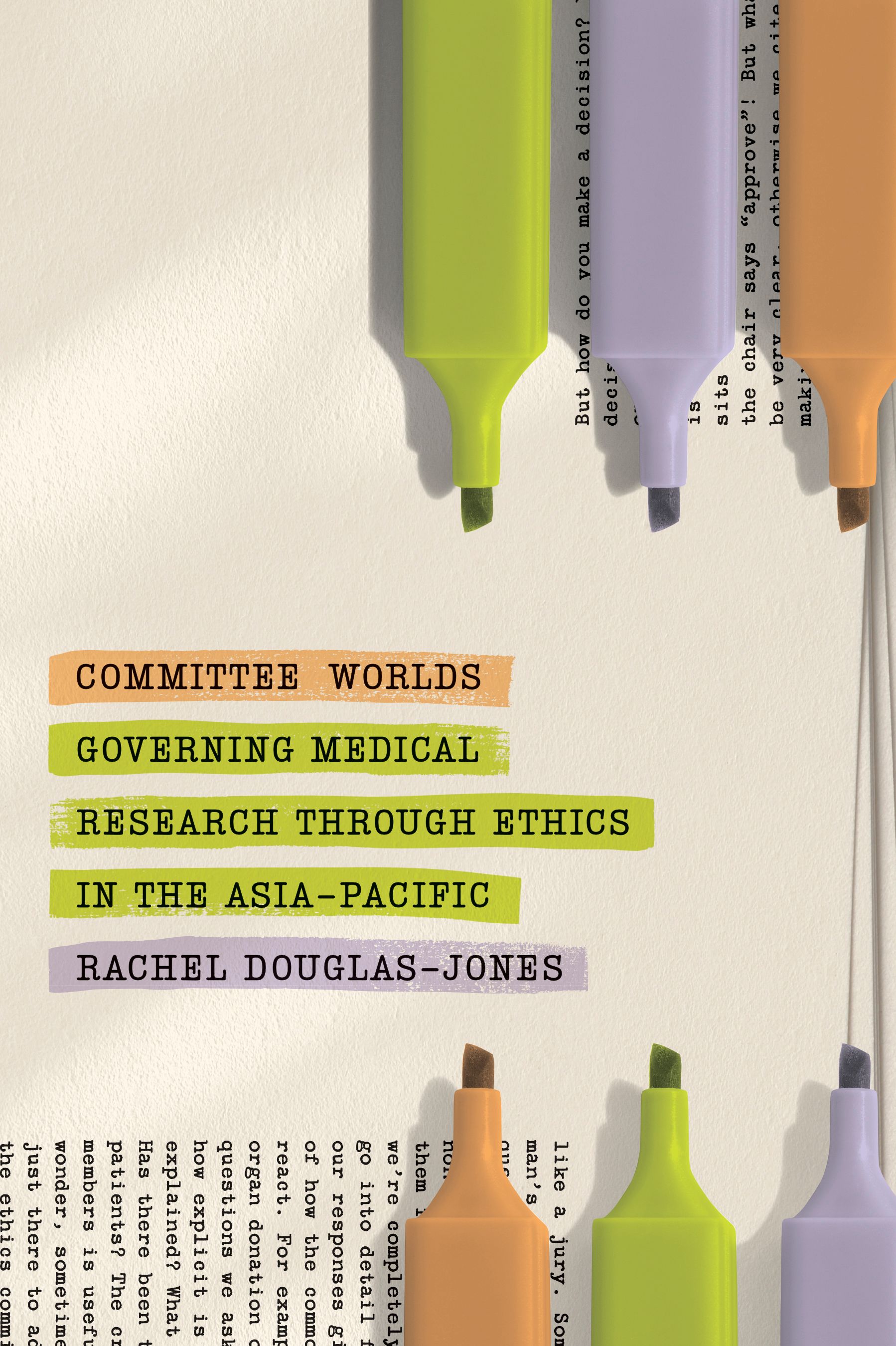
Medical research is a global endeavor; a complex network of international drugs trials and data collection in the pursuit of novel treatments. And the Asia-Pacific region is considered an ideal "market" for such trials, with large populations and good hospitals. However, to become hosts to global trials, and to export valid trial data, researchers are required to engage local research ethics committees. Supported through grants from the World Health Organization, the Forum of Ethics Review Committees of Asia and the Pacific (FERCAP) was established in 2000, and has spent the last twenty years building capacity for ethics assessment in hospitals and universities across the region. They are the translators of global ethics standards and principles for regional audiences.
Through a decade of ethnographic engagement with FERCAP, following members from their base in Thailand to workshops across Sri Lanka, the Philippines, Taiwan, and mainland China, Rachel Douglas-Jones demonstrates that research ethics committees, their material and social form, are spaces of contestation where the futures of global medical research are decided. With this book, Douglas-Jones contributes a key reference for studies of "the committee" upon which future work in the anthropology of policy can build. Understanding how ethics review committees do their work allows anthropologists of policy, global health, and bureaucracy to consider the values embedded in ethics as a bureaucratic practice.
Pay easily by card, Klarna, Apple Pay or Google Pay. Not happy? You always have a 14-day money-back guarantee. Read more in our terms. If you have any questions, email us at hello@memmo.org.
Memmo makes studying easier – wherever you are in the world. We bring your course books and smart study tools together in one place: summaries, quizzes, podcasts and flashcards. Plus Ted, your study buddy who answers anything you wonder. Over 50,000 students already study here – built to help you learn faster and stress less.