
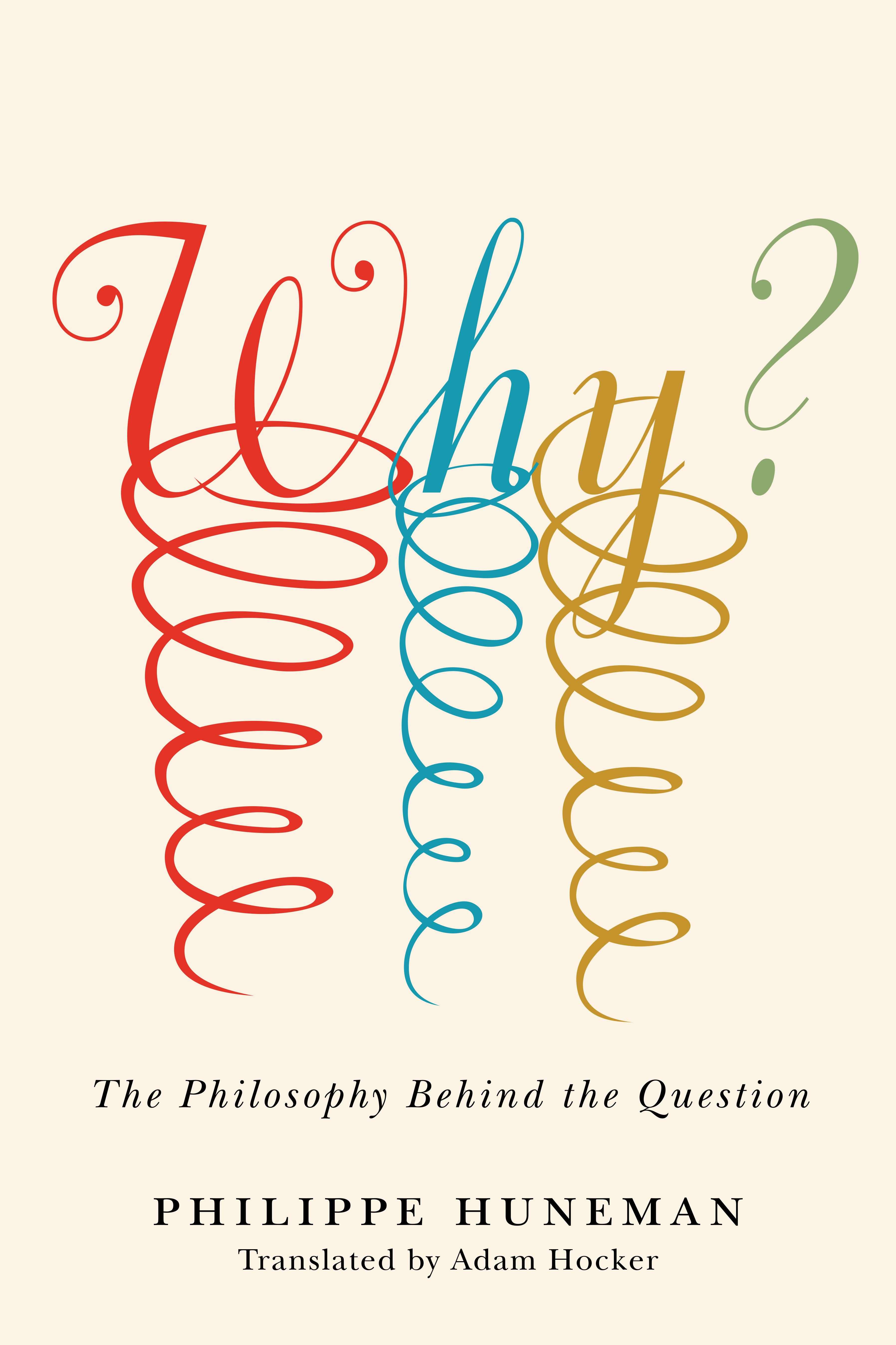
A philosopher explores the many dimensions of a beguilingly simple question.
Why did triceratops have horns? Why did World War I occur? Why does Romeo love Juliet? And, most importantly, why ask why? Through an analysis of these questions and others, philosopher Philippe Huneman describes the different meanings of "why," and how those meanings can, and should (or should not), be conflated.
As Huneman outlines, there are three basic meanings of why: the cause of an event, the reason of a belief, and the reason why I do what I do (the purpose). Each of these meanings, in turn, impacts how we approach knowledge in a wide array of disciplines: science, history, psychology, and metaphysics. Exhibiting a rare combination of conversational ease and intellectual rigor, Huneman teases out the hidden dimensions of questions as seemingly simple as "Why did Mickey Mouse open the refrigerator?" or as seemingly unanswerable as "Why am I me?" In doing so, he provides an extraordinary tour of canonical and contemporary philosophical thought, from Plato and Aristotle, through Descartes and Spinoza, to Elizabeth Anscombe and Ruth Millikan, and beyond.
Of course, no proper reckoning with the question "why?" can afford not to acknowledge its limits, which are the limits, and the ends, of reason itself. Huneman thus concludes with a provocative elaboration of what Kant called the "natural need for metaphysics," the unallayed instinct we have to ask the question even when we know there can be no unequivocal answer.
Pay easily by card, Klarna, Apple Pay or Google Pay. Not happy? You always have a 14-day money-back guarantee. Read more in our terms. If you have any questions, email us at hello@memmo.org.
Memmo makes studying easier – wherever you are in the world. We bring your course books and smart study tools together in one place: summaries, quizzes, podcasts and flashcards. Plus Ted, your study buddy who answers anything you wonder. Over 50,000 students already study here – built to help you learn faster and stress less.