
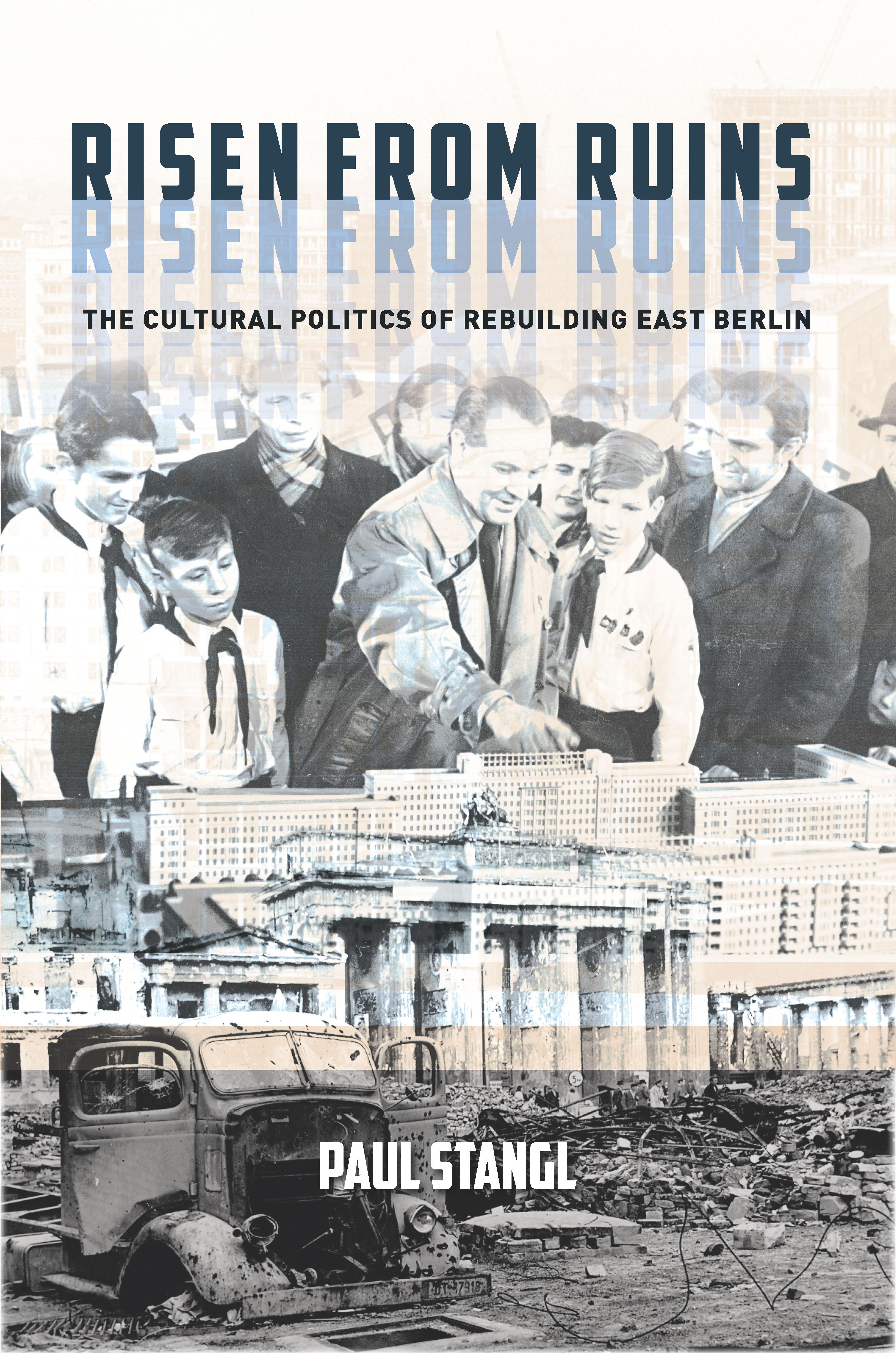
In the aftermath of the Second World War, Berliners grappled with how to rebuild their devastated city. In East Berlin, where the historic core of the city lay, decisions made by the socialist leadership about what should be restored, reconstructed, or entirely reimagined would have a tremendous and lasting impact on the urban landscape. Risen from Ruins examines the cultural politics of the rebuilding of East Berlin from the end of World War II until the construction of the Berlin Wall, combining political analysis with spatial and architectural history to examine how the political agenda of East German elites and the ruling Socialist Unity Party (SED) played out in the built environment.
Following the destruction of World War II, the center of Berlin could have been completely restored and preserved, or razed in favor of a sanitized, modern city. The reality fell somewhere in between, as decision makers balanced historic preservation against the opportunity to model the Socialist future and reject the example of the Nazi dictatorship through architecture and urban design. Paul Stangl's analysis expands our understanding of urban planning, historic preservation, modernism, and Socialist Realism in East Berlin, shedding light on how the contemporary shape of the city was influenced by ideology and politics.
Pay easily by card, Klarna, Apple Pay or Google Pay. Not happy? You always have a 14-day money-back guarantee. Read more in our terms. If you have any questions, email us at hello@memmo.org.
Memmo makes studying easier – wherever you are in the world. We bring your course books and smart study tools together in one place: summaries, quizzes, podcasts and flashcards. Plus Ted, your study buddy who answers anything you wonder. Over 75,000 students already study here – built to help you learn faster and stress less.