
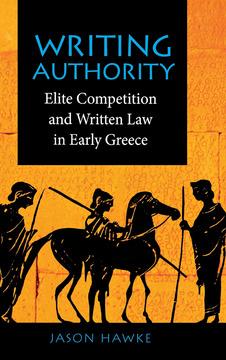
In Writing Authority, Hawke argues that the rapidly changing political and economic landscape of early Greece prompted elites to begin committing laws to written form. The emergence of the polis and its institutions, the demographic growth of Greece, the development of market forces, and the commoditization of wealth all presented new challenges and difficulties for the Greeks of the eighth and seventh centuries B.C.E. Hawke contends that no one felt the attendant anxieties of these changes more acutely than the leading members of early Greek communities—they confronted regulating their intense competition for status and power in an environment where traditional sources of authority, such as Homeric epic, offered no ready solutions for problems arising from the transformation of Greek society. Greek elites enshrined in writing rules aimed at stabilizing their relationships with one another and, by extension, their communities. Challenging both established and emerging orthodoxies about the appearance of written law in ancient Greece, Writing Authority questions the importance of a popular or communal role in the earliest Greek legislation. Approaches from anthropology, legal studies, and sociology are used to situate the emergence of Greek law in the broader context of Greek legal culture in the eighth through early sixth centuries B.C.E. as Hawke describes in rich detail the legal culture of Homer's world, considers the impact of literacy on Greek attitudes about law and authority and its practical consequences for the governing of the Greek polis, and examines the effects of the tumultuous changes in Archaic Greece on the leading members of Greek communities. The result is a compelling monograph that provides an exhaustive and nuanced history of earliest Greek law and the motivations of the elites that brought it into being. It will be of interest to scholars of Greek history, classicists, and early legal historians.
Pay easily by card, Klarna, Apple Pay or Google Pay. Not happy? You always have a 14-day money-back guarantee. Read more in our terms. If you have any questions, email us at hello@memmo.org.
Memmo makes studying easier – wherever you are in the world. We bring your course books and smart study tools together in one place: summaries, quizzes, podcasts and flashcards. Plus Ted, your study buddy who answers anything you wonder. Over 50,000 students already study here – built to help you learn faster and stress less.