
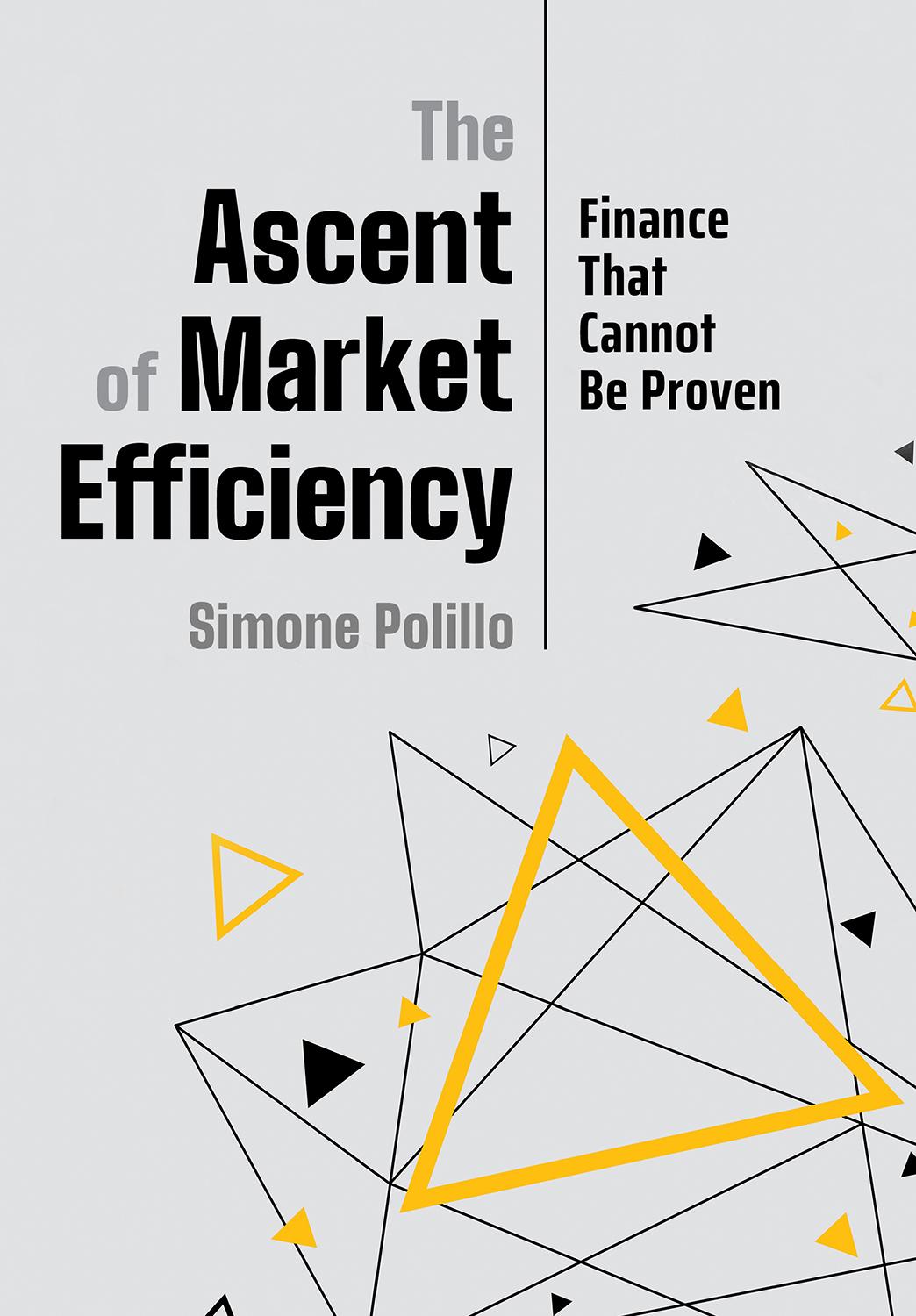
The Ascent of Market Efficiency weaves together historical narrative and quantitative bibliometric data to detail the path financial economists took in order to form one of the central theories of financial economics—the influential efficient-market hypothesis—which states that the behavior of financial markets is unpredictable.
As the notorious quip goes, a blindfolded monkey would do better than a group of experts in selecting a portfolio of securities, simply by throwing darts at the financial pages of a newspaper. How did such a hypothesis come to be so influential in the field of financial economics? How did financial economists turn a lack of evidence about systematic patterns in the behavior of financial markets into a foundational approach to the study of finance?
Each chapter in Simone Polillo's fascinating meld of economics, science, and sociology focuses on these questions, as well as on collaborative academic networks, and on the values and affects that kept the networks together as they struggled to define what the new field of financial economics should be about. In doing so, he introduces a new dimension—data analysis—to our understanding of the ways knowledge advances.
There are patterns in the ways knowledge is produced, and The Ascent of Market Efficiency helps us make sense of these patterns by providing a general framework that can be applied equally to other social and human sciences.
Pay easily by card, Klarna, Apple Pay or Google Pay. Not happy? You always have a 14-day money-back guarantee. Read more in our terms. If you have any questions, email us at hello@memmo.org.
Memmo makes studying easier – wherever you are in the world. We bring your course books and smart study tools together in one place: summaries, quizzes, podcasts and flashcards. Plus Ted, your study buddy who answers anything you wonder. Over 50,000 students already study here – built to help you learn faster and stress less.