
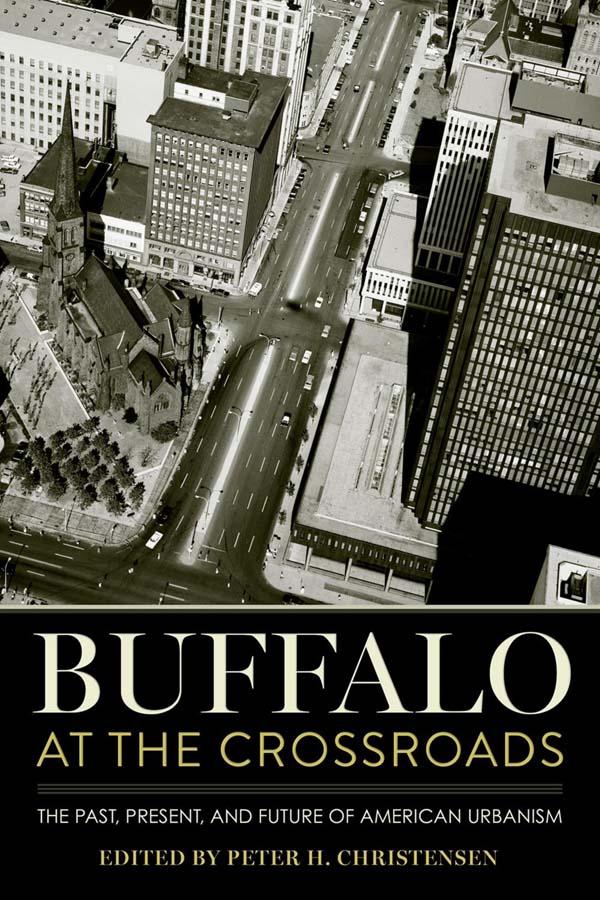
Buffalo at the Crossroads is a diverse set of cutting-edge essays. Twelve authors highlight the outsized importance of Buffalo, New York, within the story of American urbanism. Across the collection, they consider the history of Buffalo's built environment in light of contemporary developments and in relationship to the evolving interplay between nature, industry, and architecture.
The essays examine Buffalo's architectural heritage in rich context: the Second Industrial Revolution; the City Beautiful movement; world's fairs; grain, railroad, and shipping industries; urban renewal and so-called white flight; and the larger networks of labor and production that set the city's economic fate. The contributors pay attention to currents that connect contemporary architectural work in Buffalo to the legacies established by its esteemed architectural founders: Richardson, Olmsted, Adler, Sullivan, Bethune, Wright, Saarinen, and others.
Buffalo at the Crossroads is a compelling introduction to Buffalo's architecture and developed landscape that will frame discussion about the city for years to come.
Contributors: Marta Cieslak, University of Arkansas - Little Rock; Francis R. Kowsky; Erkin Özay, University at Buffalo; Jack Quinan, University at Buffalo; A. Joan Saab, University of Rochester; Annie Schentag, KTA Preservation Specialists; Hadas Steiner, University at Buffalo; Julia Tulke, University of Rochester; Stewart Weaver, University of Rochester; Mary N. Woods, Cornell University; Claire Zimmerman, University of Michigan
Pay easily by card, Klarna, Apple Pay or Google Pay. Not happy? You always have a 14-day money-back guarantee. Read more in our terms. If you have any questions, email us at hello@memmo.org.
Memmo makes studying easier – wherever you are in the world. We bring your course books and smart study tools together in one place: summaries, quizzes, podcasts and flashcards. Plus Ted, your study buddy who answers anything you wonder. Over 75,000 students already study here – built to help you learn faster and stress less.