
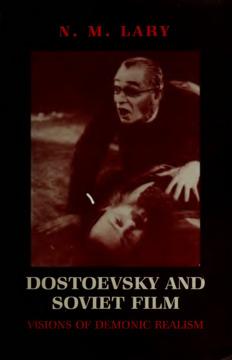
The Soviets have long struggled with the knotty problem of assimilating Dostoevsky into a revolutionary culture. Yet to filmmakers, he has been a continuing inspiration, a novelist of ideas with an unparalleled gift for visualization. The sensitive medium of film, with its popularity and high official status in the Soviet Union, provides a unique opportunity to study the interplay between art and ideology. Offering a vivid picture of Soviet culture, and comparing and contrasting the aesthetics of Socialist Realism and modernism, this book shrewdly demonstrates that film and Dostoevsky have served each other well.
Dostoevsky and Soviet Film blends three major motifs with ease and elegance: an analysis of all films produced in the Soviet Union which used Dostoevsky's fiction, as well as those planned but never realized; a history of the Soviet film industry spanning prerevolutionary days to the present; and an exploration of the dual challenge of art and politics which Soviet film has consistently had to face. N. M. Lary demonstrates the ways in which a number of film artists—Eisenstein, Grigori Kozintsev, Viktor Shklovsky, and Fridrikh Ermler among them—altered and extended the language of film under Dostoevsky's influence. He has included substantial excerpts from Eisenstein's notes from his "Chapter on Dostoevsky," which appear here for the first time in any language, and he also draws upon other theoretical and critical writings, film scripts, project notes, interviews, contemporary reviews, and many autobiographical reminiscences. Besides discussing such Dostoevsky adaptations as Ivan Pyriev's The Brothers Karamazav, Alov and Naumov's suppressed Nasty Story, Kulidzhanov's Crime and Punishment, and Ermler's Great Citizen, Lary offers suggestive critical analyses of Eisenstein's Ivan the Terrible and Kozintsev's King Lear. He provides as well his own provocative readings of Dostoevsky, uncovering new layers of meaning in the texts through his close study of their filmic treatment.
Lary's book tells the fascinating story of Dostoevsky and Soviet film as it unfolds both onscreen and off. It not only reveals some hidden sides of Soviet resistance to Dostoevsky's work, but through its insights contributes toward a new understanding of the uses of literature in film.
Pay easily by card, Klarna, Apple Pay or Google Pay. Not happy? You always have a 14-day money-back guarantee. Read more in our terms. If you have any questions, email us at hello@memmo.org.
Memmo makes studying easier – wherever you are in the world. We bring your course books and smart study tools together in one place: summaries, quizzes, podcasts and flashcards. Plus Ted, your study buddy who answers anything you wonder. Over 50,000 students already study here – built to help you learn faster and stress less.