
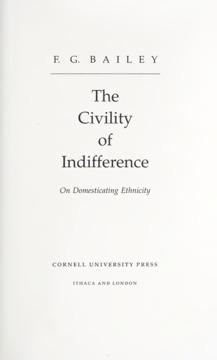
The dissolution of Yugoslavia inspired F. G. Bailey to consider the relations among ethnic groups that had seemed reconciled to living together and then broke into murderous conflicts. For his exploration of the ancient, recurring problem of ethnic strife, Bailey considers the village of Bisipara in the state of Orissa, in eastern India.
Bisipara was a community in which different ethnic groups were seen as distinct breeds of people, arranged in a hierarchy of worthiness. In The Civility of Indifference, Bailey documents a case of ethnic strife that threatened the village forty years ago but did not consume it in bloodshed. The restraint, he suggests, reflected not compassion but a sense of inevitability. The people of Bisipara perceived the world in such a way that violence enacted as ethnic cleansing would have seemed to them a disastrous indulgence and a sure path to self-destruction. Their story serves as a parable of pragmatic indifference, in contrast to the fanaticism that justifies civil war.
A seasoned ethnographer, the author considers the social structure of the community, examining the multiple castes with sensitivity and respect. His detailed description reveals the competing moral visions held by various groups and his conclusions open a new perspective on ethnic violence.
Pay easily by card, Klarna, Apple Pay or Google Pay. Not happy? You always have a 14-day money-back guarantee. Read more in our terms. If you have any questions, email us at hello@memmo.org.
Memmo makes studying easier – wherever you are in the world. We bring your course books and smart study tools together in one place: summaries, quizzes, podcasts and flashcards. Plus Ted, your study buddy who answers anything you wonder. Over 50,000 students already study here – built to help you learn faster and stress less.