
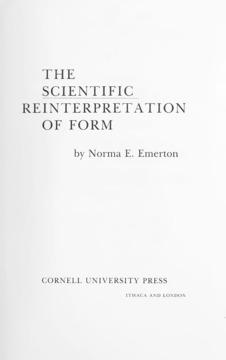
A noteworthy study in the history of ideas, this is the first systematic account of an idea that was born with the concept of science itself in ancient Greece and that has been vital to its evolution ever since. The book traces the development of the concept of form—one of the most important and persistent elements in natural philosophy—from its origins in Plato and Aristotle to the beginnings of the nineteenth century.
Norma Emerton depicts the transformation of the form concept as it was transferred from a philosophical to a scientific context, and she explains how it was reinterpreted and used especially in particle theory, chemical doctrine, and crystallography in the sixteenth, seventeenth, and eighteenth centuries. Throughout she emphasizes the philosophical, linguistic, and theological context of scientific theories, supporting her argument with evidence from a wide variety of primary sources, some of them little known, and many of them specially translated by the author. In form and style her book treats the history of a "unit-idea " in the grand tradition of A. 0. Lovejoy's Great Chain of Being.
''The story is a fascinating one,'' writes L. Pearce Williams in the Foreword. "This is 'internal' history of science which illustrates well the fact that scientific ideas have lives of their own worth investigating, describing, and analyzing. The result is a history that introduces one of the most important and central concerns of modern science."
The Scientific Reinterpretation of Form will be of particular interest to historians and philosophers of science, intellectual historians, and others concerned with the dynamic interaction between philosophy, theology, and science.
Pay easily by card, Klarna, Apple Pay or Google Pay. Not happy? You always have a 14-day money-back guarantee. Read more in our terms. If you have any questions, email us at hello@memmo.org.
Memmo makes studying easier – wherever you are in the world. We bring your course books and smart study tools together in one place: summaries, quizzes, podcasts and flashcards. Plus Ted, your study buddy who answers anything you wonder. Over 50,000 students already study here – built to help you learn faster and stress less.