
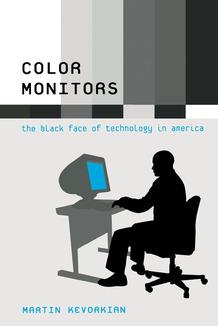
"Color Monitors looks at a particular subset of imagined computer use, focusing on scenarios that demand from the person at the keyboard an intimate technical knowledge. My research has uncovered a peculiar pattern: race comes into sharp relief when computer use is depicted as difficult labor requiring special expertise. Time and again, in such scenarios, the helpful person of color is there to take the call—to provide technical support, to deal with the machines. In interpreting such images, Color Monitors analyzes the computer-fearing strain in American whiteness, an aspect of white identity that defines itself against information technology and the racial other imagined to love it and excel at it."—Martin Kevorkian
Following up on Ralph Ellison's intimation that blacks serve as "the machines inside the machine," Color Monitors examines the designation of black bodies as natural machines for the information age. Martin Kevorkian shows how African Americans are consistently depicted as highly skilled, intelligent, and technologically savvy as they work to solve complex computer problems in popular movies, corporate advertising, and contemporary fiction. But is this progress? Or do such seemingly positive depictions have more disturbing implications? Kevorkian provocatively asserts that whites' historical "fear of a black planet" has in the age of microprocessing converged with a new fear of computers and the possibility that digital imperatives will engulf human creativity.
Analyzing escapist fantasies from Mission: Impossible to Minority Report, Kevorkian argues that the placement of a black man in front of a computer screen doubly reassures audiences: he is nonthreatening, safely occupied—even imprisoned—by the very machine he attempts to control, an occupation that simultaneously frees the action heroes from any electronic headaches. The study concludes with some alternatives to this scheme, looking to a network of recent authors, with shared affinities for Ellison and Pynchon, willing to think inside the black box of technology.
Connecting race, technology, and American empire, Color Monitors will attract attention from scholars working in emerging areas of race theory, African American studies, film studies, cultural studies, and technology and communication studies.
Pay easily by card, Klarna, Apple Pay or Google Pay. Not happy? You always have a 14-day money-back guarantee. Read more in our terms. If you have any questions, email us at hello@memmo.org.
Memmo makes studying easier – wherever you are in the world. We bring your course books and smart study tools together in one place: summaries, quizzes, podcasts and flashcards. Plus Ted, your study buddy who answers anything you wonder. Over 50,000 students already study here – built to help you learn faster and stress less.