
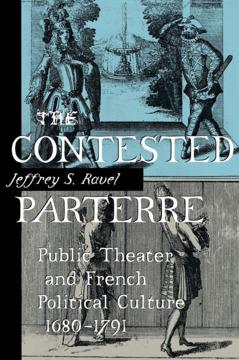
In the playhouses of eighteenth-century France, clerks and students, soldiers and merchants, and the occasional aristocrat stood in the pit, while the majority of the elite sat in loges. These denizens of the parterre, who accounted for up to two-thirds of the audience, were given to disruptive behavior that culminated in full-scale riots in the last years before the Revolution. Offering a commoner's eye view of the drama offstage, this fascinating history of French theater audiences clearly demonstrates how problems in the parterre reflected tensions at the heart of the Old Regime.
Jeffrey S. Ravel vividly depicts the scene in the parterre where the male spectators occupied themselves shoving one another, drinking, urinating, and confronting the actors with critiques of the performance. He traces the futile efforts of the Bourbon Court—and later its Enlightened opponents—to control parterre behavior by both persuasion and force. Ravel describes how the parterre came to represent a larger, more politicized notion of the public, one that exposed the inability of the government to accommodate the demands of French citizens. An important contribution to debates on the public sphere, Ravel's book is the first to explore the role of the parterre in the political culture of eighteenth-century France.
Pay easily by card, Klarna, Apple Pay or Google Pay. Not happy? You always have a 14-day money-back guarantee. Read more in our terms. If you have any questions, email us at hello@memmo.org.
Memmo makes studying easier – wherever you are in the world. We bring your course books and smart study tools together in one place: summaries, quizzes, podcasts and flashcards. Plus Ted, your study buddy who answers anything you wonder. Over 75,000 students already study here – built to help you learn faster and stress less.