
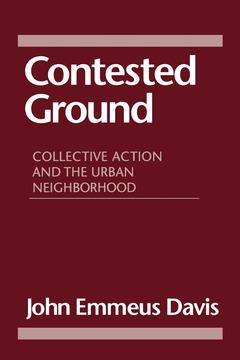
One of the most striking characteristics of urban protest and social conflict in the United States, Britain, and other nations of the West over the last three decades is the frequency with which these political events have been organized not where people work, but where they live. The residential communities in which people have their homes, raise their children, and relate to each other more as neighbors than as co-workers have become veritable seedbeds of collective action. Contested Ground provides a new approach to understanding how and why such community-based action occurs.
Drawing critically and selectively from Marxian theories of conflict and neo-Weberian theories of "housing classes," John Emmeus Davis argues that the political life of residential communities can be explained largely in terms of the competing interests that groups possess by virtue of different and distinctive ways of relating to their community's "domestic property"land and buildings that are used for shelter. In Part I of his book he proposes domestic property interests as the cornerstone of a theoretical framework for exploring the appearance and disappearance, the development and decline, and the cooperation and conflict of the organized groups of the "homeplace."
In Part II he tests the plausibility of this framework against the social and political realities of an inner-city neighborhood known as the West End in Cincinnati, Ohio. A neighborhood shaped by successive waves of priyate investment and disinvestment, city neglect and city planning, urban renewal and gentrification, the domestic property of the West End has been the contested ground from which many community organizations have grown. Using archival records, oral histories, and organizational documents, Davis unfolds the story of the rise and fall of these grassroots groups.
Davis's concluding chapters evaluate the theoretical and practical implications of his approach. He believes that his analysis may complement neo-Marxian theories of urban development and capitalist reproduction and also provide new insight into ways in which planners, activists, and policy makers can influence the internal politics of the urban neighborhood.
Pay easily by card, Klarna, Apple Pay or Google Pay. Not happy? You always have a 14-day money-back guarantee. Read more in our terms. If you have any questions, email us at hello@memmo.org.
Memmo makes studying easier – wherever you are in the world. We bring your course books and smart study tools together in one place: summaries, quizzes, podcasts and flashcards. Plus Ted, your study buddy who answers anything you wonder. Over 50,000 students already study here – built to help you learn faster and stress less.