
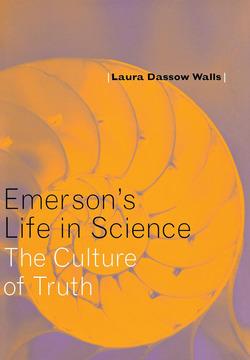
Ralph Waldo Emerson has traditionally been cast as a dreamer and a mystic, concerned with the ideals of transcendentalism rather than the realities of contemporary science and technology. In Laura Dassow Walls's view Emerson was a leader of the secular avant-garde in his day. He helped to establish science as the popular norm of truth in America and to modernize American popular thought. In addition, he became a hero to a post-Darwinian generation of Victorian Dissenters, exemplifying the strong connection between transcendentalism and later nineteenth-century science.
In his early years as a minister, Emerson read widely in natural philosophy (or physics), chemistry, geology, botany, and comparative anatomy. When he left the church, it was to seek the truths written in the book of nature rather than in books of scripture. While visiting the Paris Museum of Natural History during his first European tour, Emerson experienced a revelation so intense that he declared, "I will be a naturalist." Once he was back in the United States, his first step in realizing this ambition was to deliver a series of lectures on natural science. These lectures formed the basis for his first publication, Nature (1836), and his writings ever after reflected his intense and continuing interest in science.
Walls finds that Emerson matured just as the concept of "the two cultures" emerged, when the disciplines of literature and science were divorcing each other even as he called repeatedly for their marriage. Consequently, Walls writes, half of Emerson's thought has been invisible to us: science was central to Emerson, to his language, to the basic organization of his career. In Emerson's Life in Science, she makes the case that no study of literary history can be complete without embracing science as part of literature. Conversely, she maintains, no history of science is complete unless we consider the role played by writers of literature who helped to install science in the popular imagination.
Pay easily by card, Klarna, Apple Pay or Google Pay. Not happy? You always have a 14-day money-back guarantee. Read more in our terms. If you have any questions, email us at hello@memmo.org.
Memmo makes studying easier – wherever you are in the world. We bring your course books and smart study tools together in one place: summaries, quizzes, podcasts and flashcards. Plus Ted, your study buddy who answers anything you wonder. Over 50,000 students already study here – built to help you learn faster and stress less.