
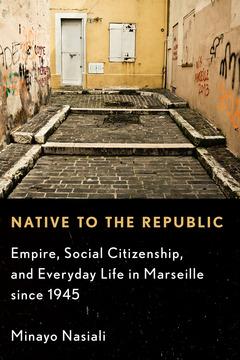
In Native to the Republic, Minayo Nasiali traces the process through which expectations about living standards and decent housing came to be understood as social rights in late twentieth-century France. These ideas evolved through everyday negotiations between ordinary people, municipal authorities, central state bureaucrats, elected officials, and social scientists in postwar Marseille. Nasiali shows how these local-level interactions fundamentally informed evolving ideas about French citizenship and the built environment, namely that the institutionalization of social citizenship also created new spaces for exclusion. Although everyone deserved social rights, some were supposedly more deserving than others.
From the 1940s through the early 1990s, metropolitan discussions about the potential for town planning to transform everyday life were shaped by colonial and, later, postcolonial migration within the changing empire. As a port and the historical gateway to and from the colonies, Marseille's interrelated projects to develop welfare institutions and manage urban space make it a particularly significant site for exploring this uneven process. Neighborhood debates about the meaning and goals of modernization contributed to normative understandings about which residents deserved access to expanding social rights. Nasiali argues that assumptions about racial, social, and spatial differences profoundly structured a differential system of housing in postwar France. Native to the Republic highlights the value of new approaches to studying empire, membership in the nation, and the welfare state by showing how social citizenship was not simply constituted within "imagined communities" but also through practices involving the contestation of spaces and the enjoyment of rights.
Pay easily by card, Klarna, Apple Pay or Google Pay. Not happy? You always have a 14-day money-back guarantee. Read more in our terms. If you have any questions, email us at hello@memmo.org.
Memmo makes studying easier – wherever you are in the world. We bring your course books and smart study tools together in one place: summaries, quizzes, podcasts and flashcards. Plus Ted, your study buddy who answers anything you wonder. Over 50,000 students already study here – built to help you learn faster and stress less.