
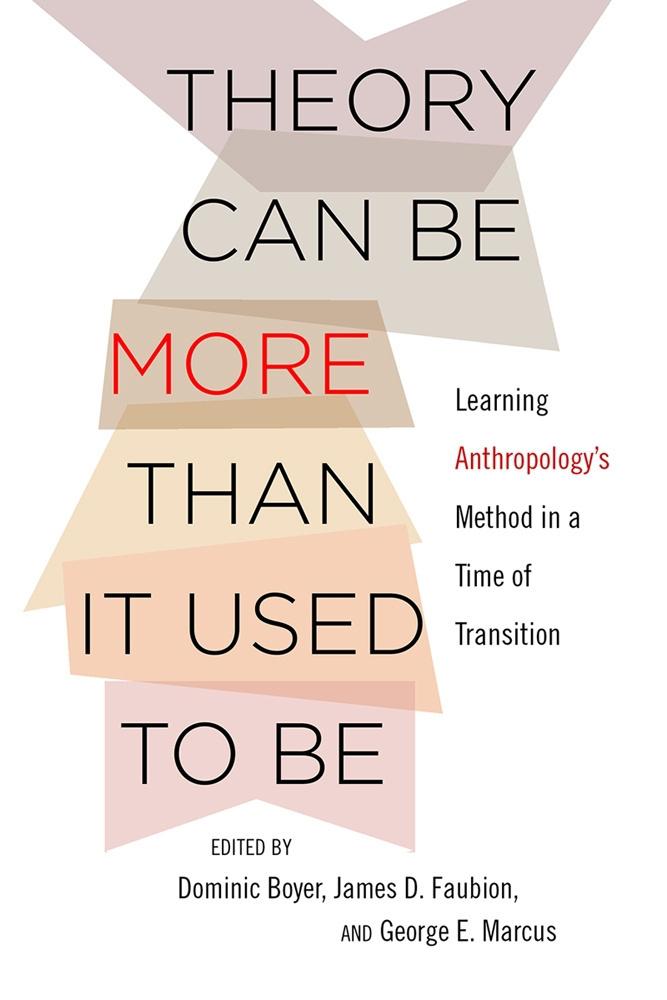
Within anthropology, as elsewhere in the human sciences, there is a tendency to divide knowledge making into two separate poles: conceptual (theory) vs. empirical (ethnography). In Theory Can Be More than It Used to Be, Dominic Boyer, James D. Faubion, and George E. Marcus argue that we need to take a step back from the assumption that we know what theory is to investigate how theory—a matter of concepts, of analytic practice, of medium of value, of professional ideology—operates in anthropology and related fields today. They have assembled a distinguished group of scholars to diagnose the state of the theory-ethnography divide in anthropology today and to explore alternative modes of analytical and pedagogical practice.
Continuing the methodological insights provided in Fieldwork Is Not What It Used to Be, the contributors to this volume find that now is an optimal time to reflect on the status of theory in relation to ethnographic research in anthropology and kindred disciplines. Together they engage with questions such as, What passes for theory in anthropology and the human sciences today and why? What is theory's relation to ethnography? How are students trained to identify and respect anthropological theorization and how do they practice theoretical work in their later career stages? What theoretical experiments, languages, and institutions are available to the human sciences? Throughout, the editors and authors consider theory in practical terms, rather than as an amorphous set of ideas, an esoteric discourse of power, a norm of intellectual life, or an infinitely contestable canon of texts. A short editorial afterword explores alternative ethics and institutions of pedagogy and training in theory.
Pay easily by card, Klarna, Apple Pay or Google Pay. Not happy? You always have a 14-day money-back guarantee. Read more in our terms. If you have any questions, email us at hello@memmo.org.
Memmo makes studying easier – wherever you are in the world. We bring your course books and smart study tools together in one place: summaries, quizzes, podcasts and flashcards. Plus Ted, your study buddy who answers anything you wonder. Over 50,000 students already study here – built to help you learn faster and stress less.