
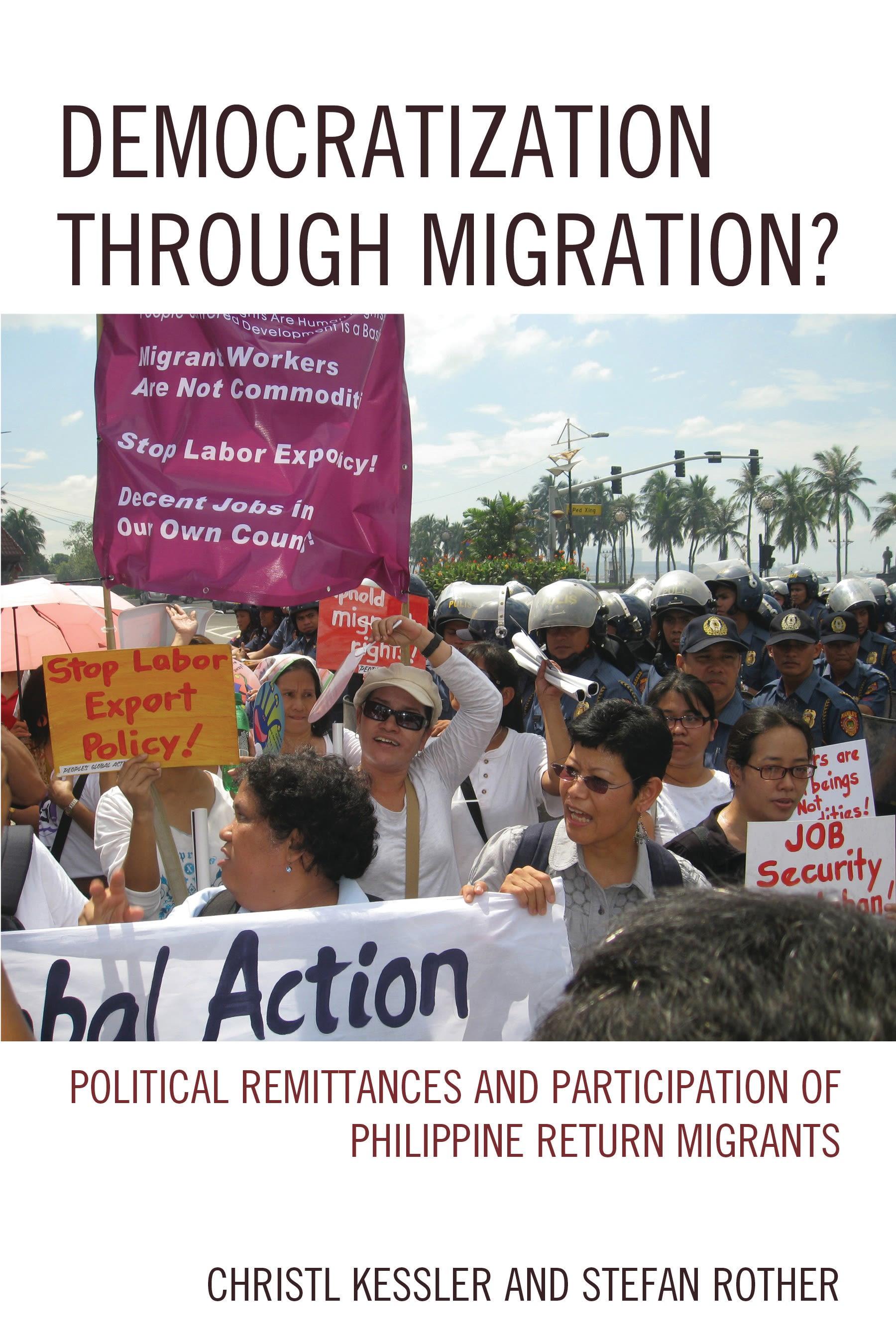
In migration research, studies on the influence of return migrants on the societies in their home countries are still few and predominantly concentrate on the economic dimension of migration. The literature on democratization has likewise paid only scant attention to the external factors that play a role in the transition of states in the process of becoming more democratic. Cognizant of these lacunae in research on migration and democratization, this book sets out to argue that return migrants can play an important role in the consolidation process of young democracies. The goal is therefore to explore the nature of this influence and to discuss its stabilizing as well as destabilizing aspects with regards to democratization. As a case study this book analyzes “labor exporter par excellence,” the Philippines.
Research is based on original data: a survey in the Philippines with 2,000 respondents, 37 in-depth interviews with respondents from the sample, and 45 expert interviews serving as background material. The destinations covered are Saudi Arabia, Qatar, UAE, Taiwan, Japan, and Hong Kong.
This book discusses whether labor migration can affect democratization processes and what impact the political order of the host country has on this potential effect. It attests the potential of the migration experience to affect migrants' attitudes towards democracy, thus playing an important role in the support needed for democracies in the stage of consolidation. Our findings suggest that the migration experience may not only lead to a more critical stance towards the political system of the home country; there are also indicators of lesser support for the principles of democracy when compared to migrants about to leave the country for the first time. The political system of the destination as such seems to be a less decisive factor than the specific freedoms and restrictions experienced by migrants and a potential bias when selecting the destination.
Research is based on original data: a survey in the Philippines with 2,000 respondents, 37 in-depth interviews with respondents from the sample, and 45 expert interviews serving as background material. The destinations covered are Saudi Arabia, Qatar, UAE, Taiwan, Japan, and Hong Kong.
This book discusses whether labor migration can affect democratization processes and what impact the political order of the host country has on this potential effect. It attests the potential of the migration experience to affect migrants' attitudes towards democracy, thus playing an important role in the support needed for democracies in the stage of consolidation. Our findings suggest that the migration experience may not only lead to a more critical stance towards the political system of the home country; there are also indicators of lesser support for the principles of democracy when compared to migrants about to leave the country for the first time. The political system of the destination as such seems to be a less decisive factor than the specific freedoms and restrictions experienced by migrants and a potential bias when selecting the destination.
Pay easily by card, Klarna, Apple Pay or Google Pay. Not happy? You always have a 14-day money-back guarantee. Read more in our terms. If you have any questions, email us at hello@memmo.org.
Memmo makes studying easier – wherever you are in the world. We bring your course books and smart study tools together in one place: summaries, quizzes, podcasts and flashcards. Plus Ted, your study buddy who answers anything you wonder. Over 50,000 students already study here – built to help you learn faster and stress less.