
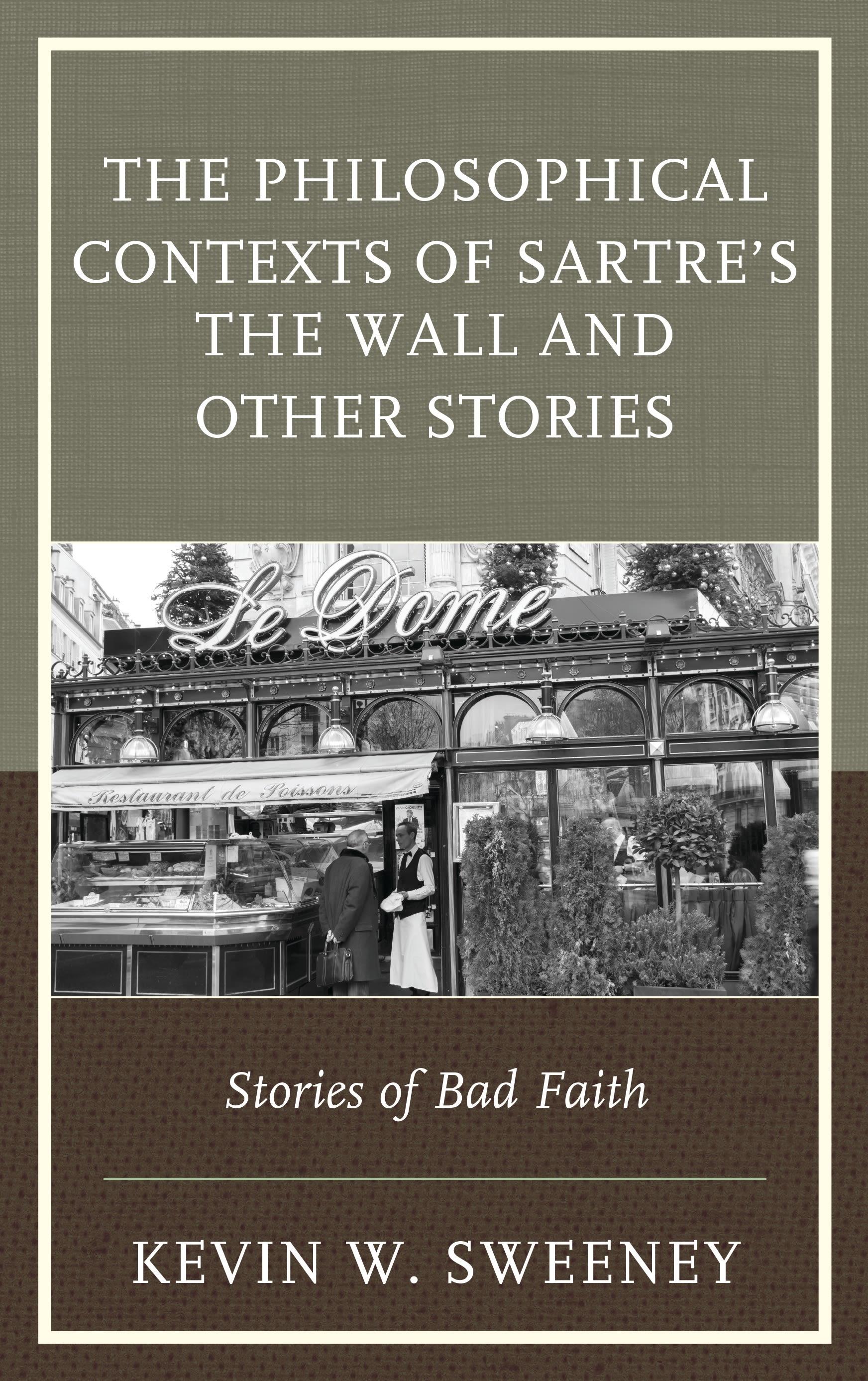
The Philosophical Contexts of Sartre’s The Wall and Other Stories: Stories of Bad Faith presents a philosophical analysis of all five stories in Sartre’s short-story collection. Kevin W. Sweeney argues that each of the five stories has its own philosophical idea or problem that serves as the context for the narrative. Sartre constructs each story as a reply to the philosophical issue in the context and as support for his position on that issue. In the opening story, “The Wall,” Sartre uses the Constant-Kant debate to support his view that the story’s protagonist is responsible for his ally’s death. “The Room” presents in narrative form Sartre’s criticism that the Freudian Censor is acting in bad faith. In “Erostratus,” Sartre opposes Descartes’s claim in his “hats and coats” example that we recognize the humanity of others by using our reason. In “Intimacy,” Sartre again opposes a Cartesian position, this time the view that our feelings reveal our emotions. Sartre counters that Cartesian view by showing that the two women in the story act in bad faith because they do not distinguish their feelings from their emotions. The last story, “The Childhood of a Leader,” shows how the protagonist acts in bad faith in trying to resolve the question of who he is by appealing to the view that one’s roots in nature can provide one with a substantial identity. The stories are unified by showing the characters in all five narratives engaged in different acts of bad faith.
The Philosophical Contexts of Sartre’s The Wall and Other Stories is written for scholars interested in Jean-Paul Sartre’s early literary and philosophical work, as well as for students interested in Sartre and twentieth-century French literature.
The Philosophical Contexts of Sartre’s The Wall and Other Stories is written for scholars interested in Jean-Paul Sartre’s early literary and philosophical work, as well as for students interested in Sartre and twentieth-century French literature.
Pay easily by card, Klarna, Apple Pay or Google Pay. Not happy? You always have a 14-day money-back guarantee. Read more in our terms. If you have any questions, email us at hello@memmo.org.
Memmo makes studying easier – wherever you are in the world. We bring your course books and smart study tools together in one place: summaries, quizzes, podcasts and flashcards. Plus Ted, your study buddy who answers anything you wonder. Over 50,000 students already study here – built to help you learn faster and stress less.