
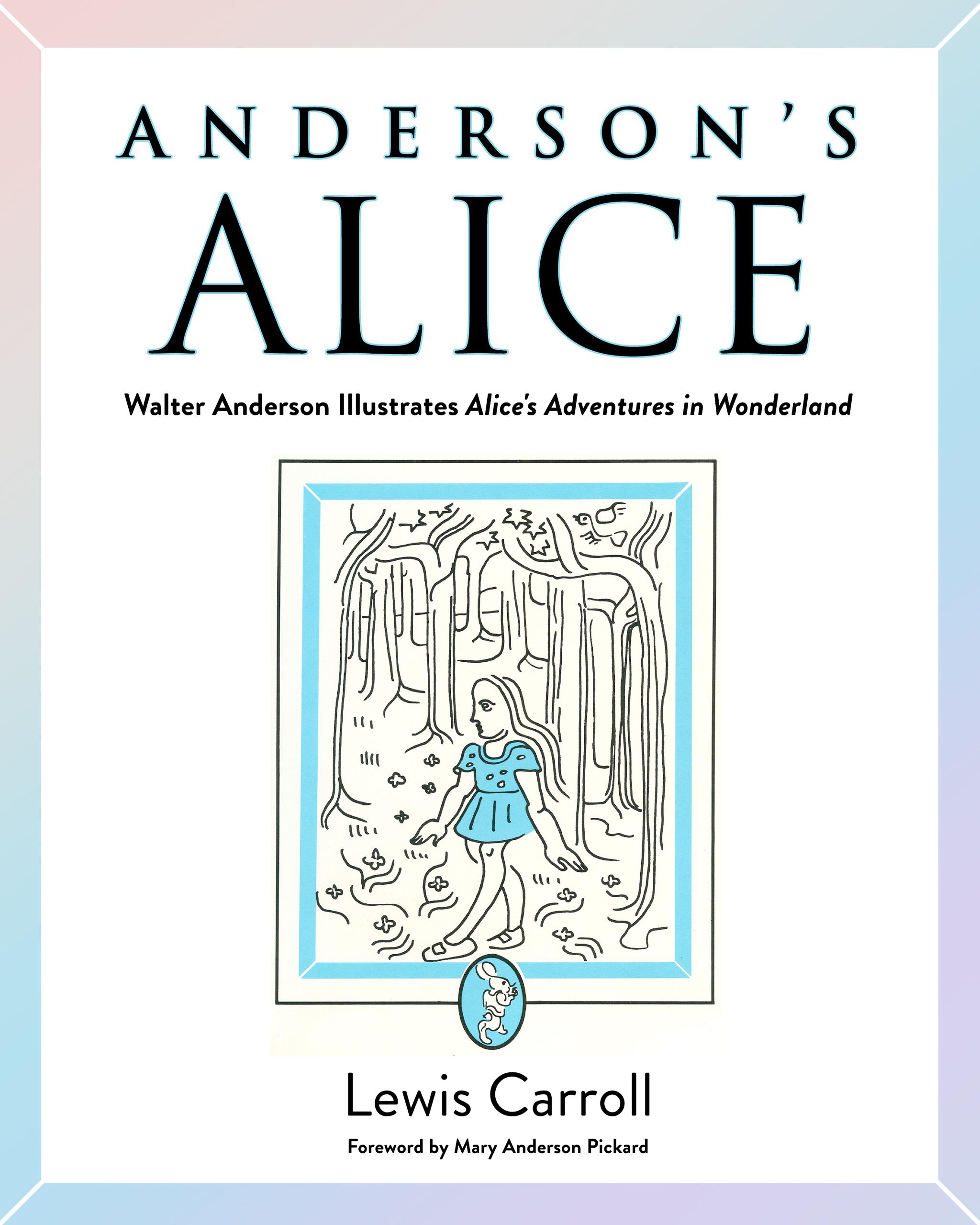
Among Walter Anderson's best-loved books, An Alphabet and Robinson: The Pleasant History of an Unusual Cat are much admired by children and parents, and have long been given as special gifts emblazoned with Anderson's unique art. In that vein and long in demand is this revived edition of Anderson’s Alice, which carries the renowned artist's visual translation of Lewis Carroll's classic story, Alice’s Adventures in Wonderland.
Anderson's Alice, though, is no Victorian doll as she is in the famous illustrations by Sir John Tenniel, Arthur Rackham, and elsewhere. Instead, Anderson represents Alice as an adventurer, capturing her spirit and her energy in bold lines. In Anderson's Alice: Walter Anderson Illustrates “Alice’s Adventures in Wonderland,” ninety-two pen-and-ink drawings accompany the complete text of Lewis Carroll's original narrative. Anderson (1903–1965) drew them alone late at night as he recovered from an illness, and he considered them to be translations of words into visual images rather than illustrations. The story of Alice brought him comfort and inspiration, and he placed her wonderland close to his own homeland by localizing Alice's environment with backgrounds featuring the kinds of wildflowers and crabs that are native to the Gulf Coast.
Walter Anderson, often intensely private within his community of Ocean Springs, Mississippi, observed and wrote about nature and produced thousands of drawings and watercolors of the plant and animal life on the Mississippi Coast. These show his strangely beautiful style and a rich and unchecked imagination. With these artistic gifts, Anderson infuses new life into Lewis Carroll's well-loved characters, who have delighted generations of children and adults.
Anderson's Alice, though, is no Victorian doll as she is in the famous illustrations by Sir John Tenniel, Arthur Rackham, and elsewhere. Instead, Anderson represents Alice as an adventurer, capturing her spirit and her energy in bold lines. In Anderson's Alice: Walter Anderson Illustrates “Alice’s Adventures in Wonderland,” ninety-two pen-and-ink drawings accompany the complete text of Lewis Carroll's original narrative. Anderson (1903–1965) drew them alone late at night as he recovered from an illness, and he considered them to be translations of words into visual images rather than illustrations. The story of Alice brought him comfort and inspiration, and he placed her wonderland close to his own homeland by localizing Alice's environment with backgrounds featuring the kinds of wildflowers and crabs that are native to the Gulf Coast.
Walter Anderson, often intensely private within his community of Ocean Springs, Mississippi, observed and wrote about nature and produced thousands of drawings and watercolors of the plant and animal life on the Mississippi Coast. These show his strangely beautiful style and a rich and unchecked imagination. With these artistic gifts, Anderson infuses new life into Lewis Carroll's well-loved characters, who have delighted generations of children and adults.
Pay easily by card, Klarna, Apple Pay or Google Pay. Not happy? You always have a 14-day money-back guarantee. Read more in our terms. If you have any questions, email us at hello@memmo.org.
Memmo makes studying easier – wherever you are in the world. We bring your course books and smart study tools together in one place: summaries, quizzes, podcasts and flashcards. Plus Ted, your study buddy who answers anything you wonder. Over 50,000 students already study here – built to help you learn faster and stress less.
You might also like
Buy the book0