
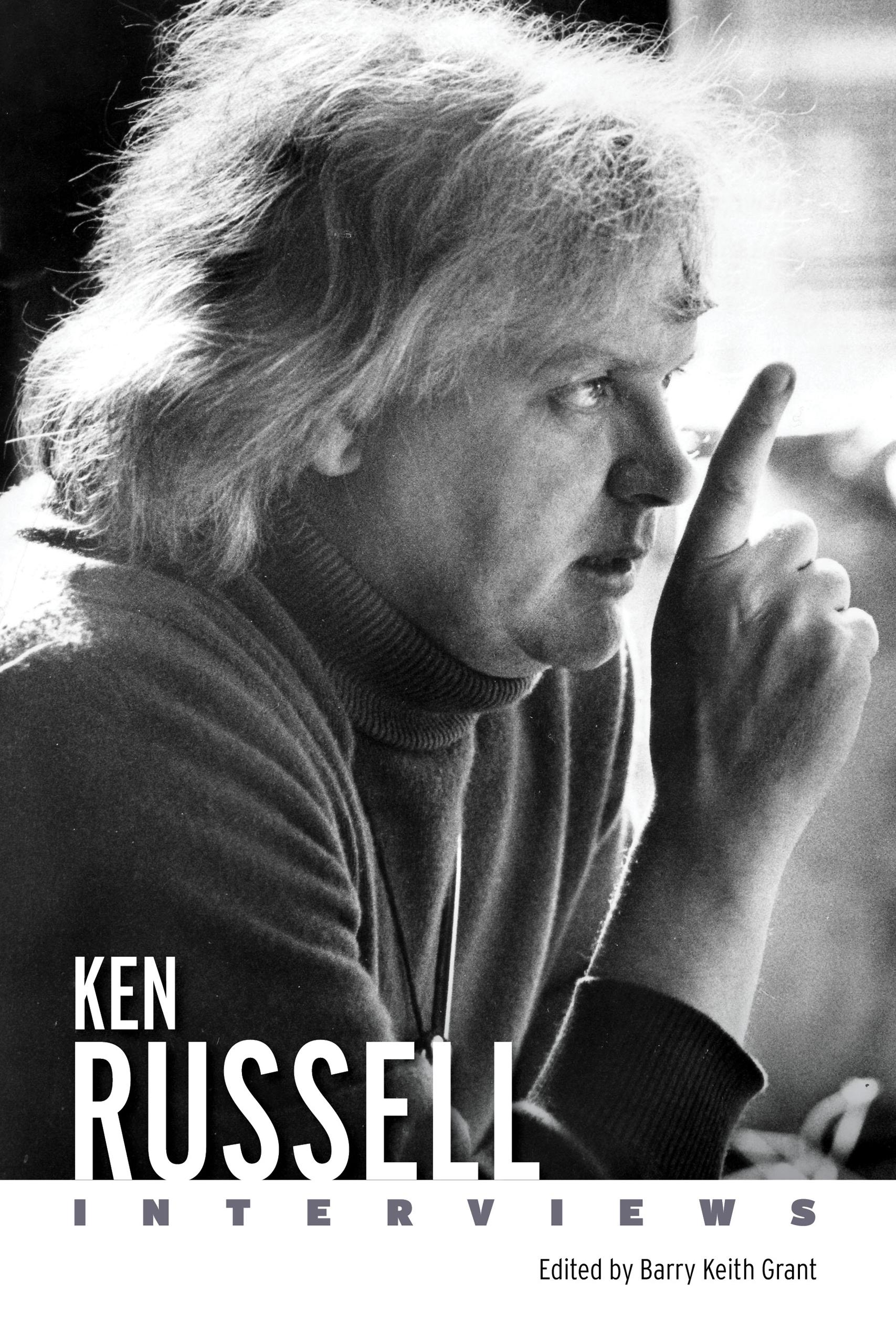
In the 1970s, British filmmaker Ken Russell (1927–2011) quickly gained a reputation as the enfant terrible of British cinema. His work, like the man himself, was regarded as flamboyant, excessive, and unrestrained. Inheriting and yet subverting the venerable mantle of British documentary, Russell did not fit comfortably in the context of a national cinema dominated by sober realism. His distinct style combined realism with fictional devices, often in audacious ways, to create the biographical “docudrama.” In Ken Russell: Interviews, the filmmaker discusses his colorful life and career, from his youth fascinated by movies to his early work in television through his feature films and his retreat to home movies.
Russell first drew notice in the early 1960s for a series of unorthodox biographical films about artists and composers. In these early television films, Russell was already exhibiting an unconventional approach to biography that combined historical fact, aesthetic interpretation, and outlandish personal vision. After the critical and commercial success of his adaptation of D. H. Lawrence’s Women in Love, Russell continued to explore the related themes of art, sexuality, and music in The Music Lovers, The Boy Friend, Mahler, Tommy, and Lisztomania. His career foundered after Valentino, however, and he found it increasingly difficult to get funding. Toward the end of his career, Russell was restricted to making movies with his own equipment, using family and friends as actors, with virtually no budget.
Throughout the ups and downs of his career, Russell alternately embraced and resented his characterization as an enfant terrible. While Russell’s comments are often meant to provoke and shock, he is articulate when discussing his films, his approach to cinema, music and composers, and, of course, his critics.
Russell first drew notice in the early 1960s for a series of unorthodox biographical films about artists and composers. In these early television films, Russell was already exhibiting an unconventional approach to biography that combined historical fact, aesthetic interpretation, and outlandish personal vision. After the critical and commercial success of his adaptation of D. H. Lawrence’s Women in Love, Russell continued to explore the related themes of art, sexuality, and music in The Music Lovers, The Boy Friend, Mahler, Tommy, and Lisztomania. His career foundered after Valentino, however, and he found it increasingly difficult to get funding. Toward the end of his career, Russell was restricted to making movies with his own equipment, using family and friends as actors, with virtually no budget.
Throughout the ups and downs of his career, Russell alternately embraced and resented his characterization as an enfant terrible. While Russell’s comments are often meant to provoke and shock, he is articulate when discussing his films, his approach to cinema, music and composers, and, of course, his critics.
Pages: 222
Category: Film- & Medievetenskap
e-ISBN: 9781496851826
Shipping weight: 1.2 kg
Ships in: 1-2 days
Pay easily by card, Klarna, Apple Pay or Google Pay. Not happy? You always have a 14-day money-back guarantee. Read more in our terms. If you have any questions, email us at hello@memmo.org.
Memmo makes studying easier – wherever you are in the world. We bring your course books and smart study tools together in one place: summaries, quizzes, podcasts and flashcards. Plus Ted, your study buddy who answers anything you wonder. Over 50,000 students already study here – built to help you learn faster and stress less.
You might also like
Buy the book0