
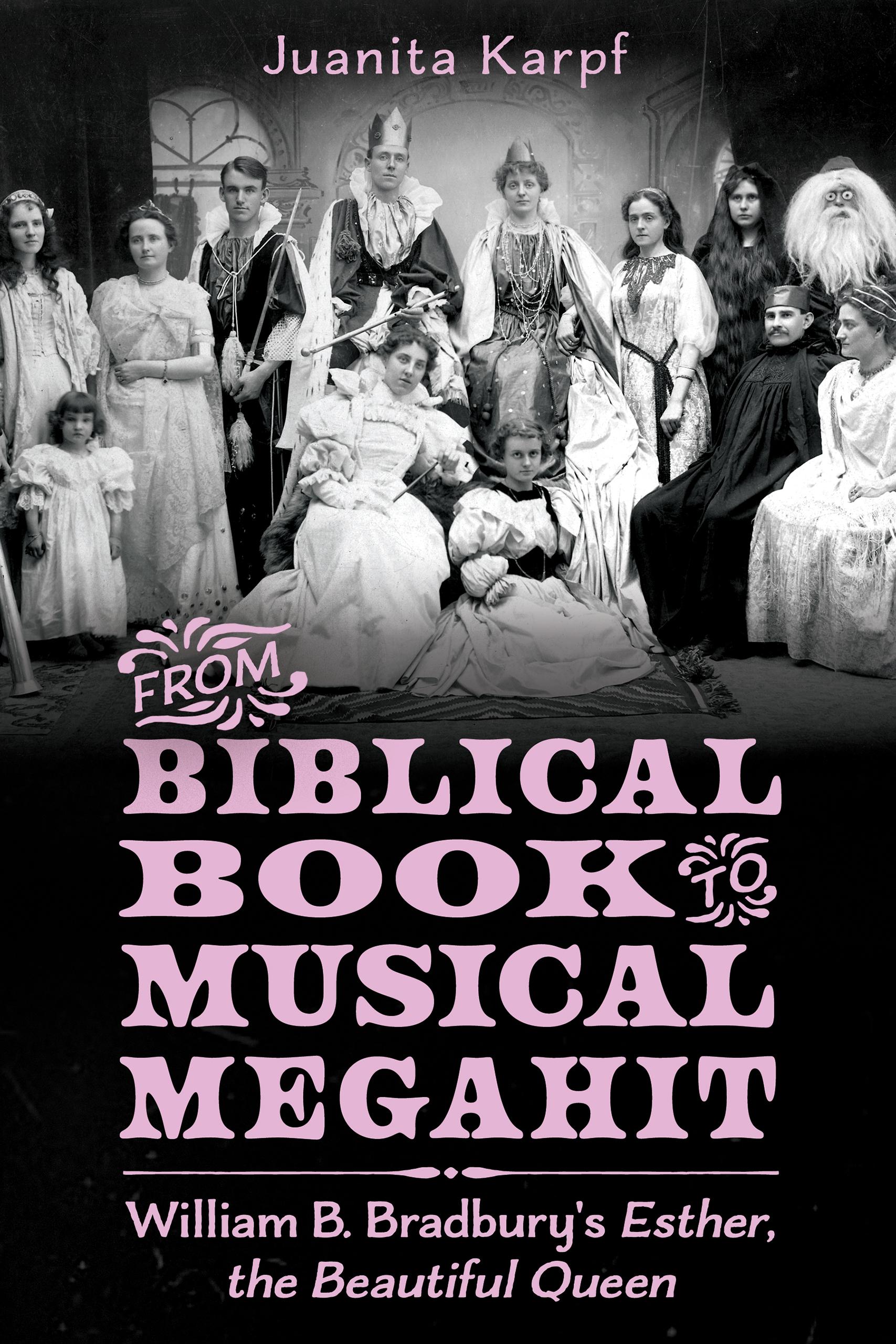
Many churchgoers will recognize the name William Bradbury, a nineteenth-century American composer of popular hymns still sung at Sunday services. Bradbury’s name may also bring to mind Esther, the Beautiful Queen, his choral setting of a text based on the biblical Book of Esther. The uncomplicated score became enormously popular almost immediately after its initial publication in 1856. In From Biblical Book to Musical Megahit: William B. Bradbury’s “Esther, the Beautiful Queen,” Juanita Karpf traces the work’s rich performance and reception history.
Bradbury emphatically stated that he intended Esther to be sung as an unadorned religious and educational piece. Yet many music directors exploited the potential for his score, producing elaborately staged events with costumes, scenery, and acting. Although directors retained Bradbury’s original music, they nonetheless facilitated Esther’s rapid entrée into the realm of music theater. This stylistic transformation ignited a firestorm of controversy. Some clergy and religiously pious citizens condemned theatrical representations of biblical texts as the epitome of debauchery, sacrilege, and sin. In contrast, more tolerant and open-minded theater enthusiasts welcomed the dramatic staging of Esther as wholesome entertainment and as evidence of a refreshingly enlightened approach to biblical interpretation.
However heated this debate seemed at times, it did little to quell the continued rise in popularity of Esther. In fact, by the late 1860s, Bradbury’s score had worked its way across the continent, north to Canada and, eventually, to Great Britain, Australia, Asia, and Africa. With performances recorded over a century after Bradbury published his score, Esther became, by any measure, an international megahit.
Bradbury emphatically stated that he intended Esther to be sung as an unadorned religious and educational piece. Yet many music directors exploited the potential for his score, producing elaborately staged events with costumes, scenery, and acting. Although directors retained Bradbury’s original music, they nonetheless facilitated Esther’s rapid entrée into the realm of music theater. This stylistic transformation ignited a firestorm of controversy. Some clergy and religiously pious citizens condemned theatrical representations of biblical texts as the epitome of debauchery, sacrilege, and sin. In contrast, more tolerant and open-minded theater enthusiasts welcomed the dramatic staging of Esther as wholesome entertainment and as evidence of a refreshingly enlightened approach to biblical interpretation.
However heated this debate seemed at times, it did little to quell the continued rise in popularity of Esther. In fact, by the late 1860s, Bradbury’s score had worked its way across the continent, north to Canada and, eventually, to Great Britain, Australia, Asia, and Africa. With performances recorded over a century after Bradbury published his score, Esther became, by any measure, an international megahit.
Pay easily by card, Klarna, Apple Pay or Google Pay. Not happy? You always have a 14-day money-back guarantee. Read more in our terms. If you have any questions, email us at hello@memmo.org.
Memmo makes studying easier – wherever you are in the world. We bring your course books and smart study tools together in one place: summaries, quizzes, podcasts and flashcards. Plus Ted, your study buddy who answers anything you wonder. Over 50,000 students already study here – built to help you learn faster and stress less.
You might also like
Buy the book0