
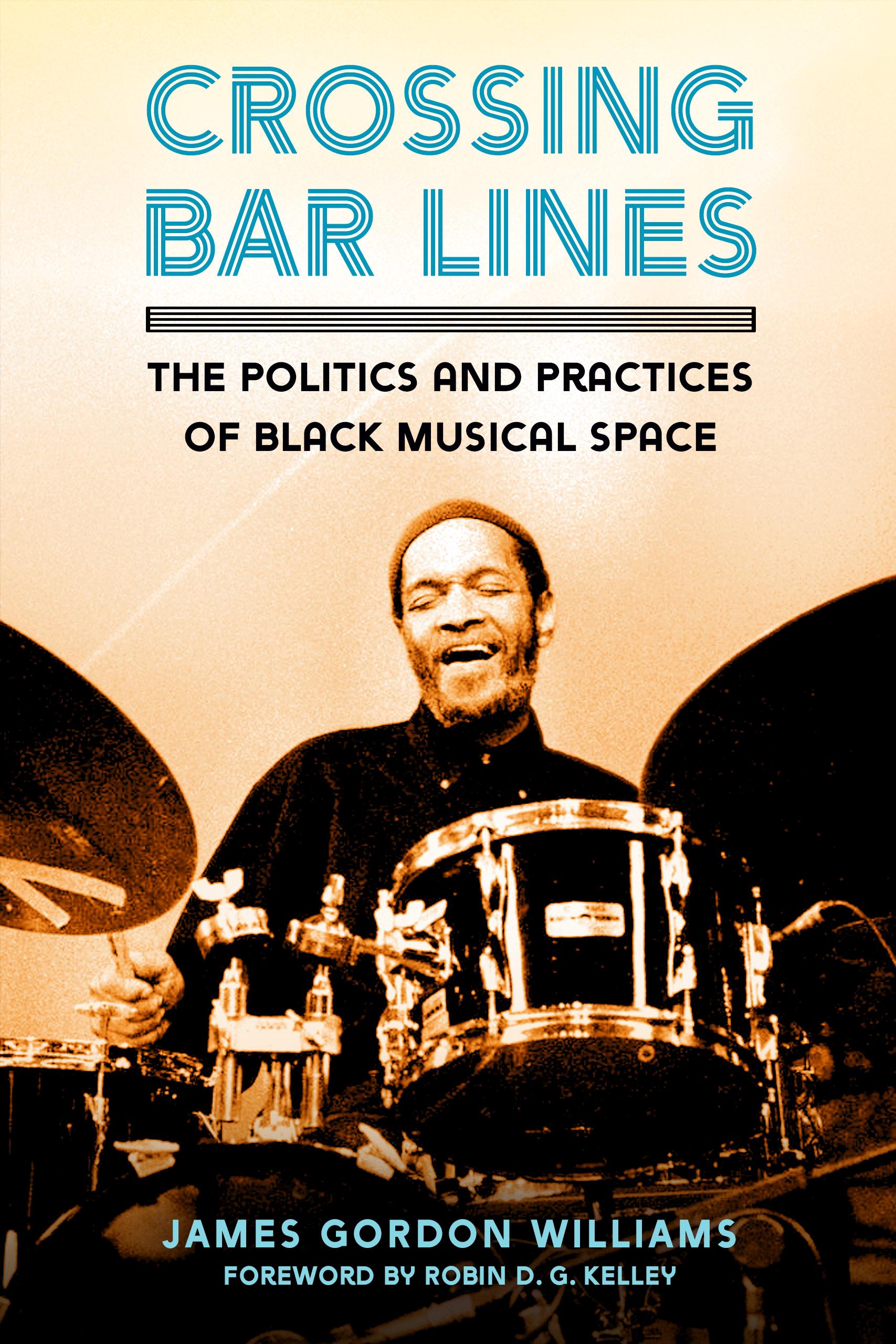
In Crossing Bar Lines: The Politics and Practices of Black Musical Space James Gordon Williams reframes the nature and purpose of jazz improvisation to illuminate the cultural work being done by five creative musicians between 2005 and 2019. The political thought of five African American improvisers—trumpeters Terence Blanchard and Ambrose Akinmusire, drummers Billy Higgins and Terri Lyne Carrington, and pianist Andrew Hill—is documented through insightful, multilayered case studies that make explicit how these musicians articulate their positionality in broader society.
Informed by Black feminist thought, these case studies unite around the theory of Black musical space that comes from the lived experiences of African Americans as they improvise through daily life. The central argument builds upon the idea of space-making and the geographic imagination in Black Geographies theory. Williams considers how these musicians interface with contemporary social movements like Black Lives Matter, build alternative institutional models that challenge gender imbalance in improvisation culture, and practice improvisation as joyful affirmation of Black value and mobility. Both Terence Blanchard and Ambrose Akinmusire innovate musical strategies to address systemic violence. Billy Higgins’s performance is discussed through the framework of breath to understand his politics of inclusive space. Terri Lyne Carrington confronts patriarchy in jazz culture through her Social Science music project. The work of Andrew Hill is examined through the context of his street theory, revealing his political stance on performance and pedagogy. All readers will be elevated by this innovative and timely book that speaks to issues that continue to shape the lives of African Americans today.
Informed by Black feminist thought, these case studies unite around the theory of Black musical space that comes from the lived experiences of African Americans as they improvise through daily life. The central argument builds upon the idea of space-making and the geographic imagination in Black Geographies theory. Williams considers how these musicians interface with contemporary social movements like Black Lives Matter, build alternative institutional models that challenge gender imbalance in improvisation culture, and practice improvisation as joyful affirmation of Black value and mobility. Both Terence Blanchard and Ambrose Akinmusire innovate musical strategies to address systemic violence. Billy Higgins’s performance is discussed through the framework of breath to understand his politics of inclusive space. Terri Lyne Carrington confronts patriarchy in jazz culture through her Social Science music project. The work of Andrew Hill is examined through the context of his street theory, revealing his political stance on performance and pedagogy. All readers will be elevated by this innovative and timely book that speaks to issues that continue to shape the lives of African Americans today.
Pay easily by card, Klarna, Apple Pay or Google Pay. Not happy? You always have a 14-day money-back guarantee. Read more in our terms. If you have any questions, email us at hello@memmo.org.
Memmo makes studying easier – wherever you are in the world. We bring your course books and smart study tools together in one place: summaries, quizzes, podcasts and flashcards. Plus Ted, your study buddy who answers anything you wonder. Over 50,000 students already study here – built to help you learn faster and stress less.
You might also like
Buy the book0