
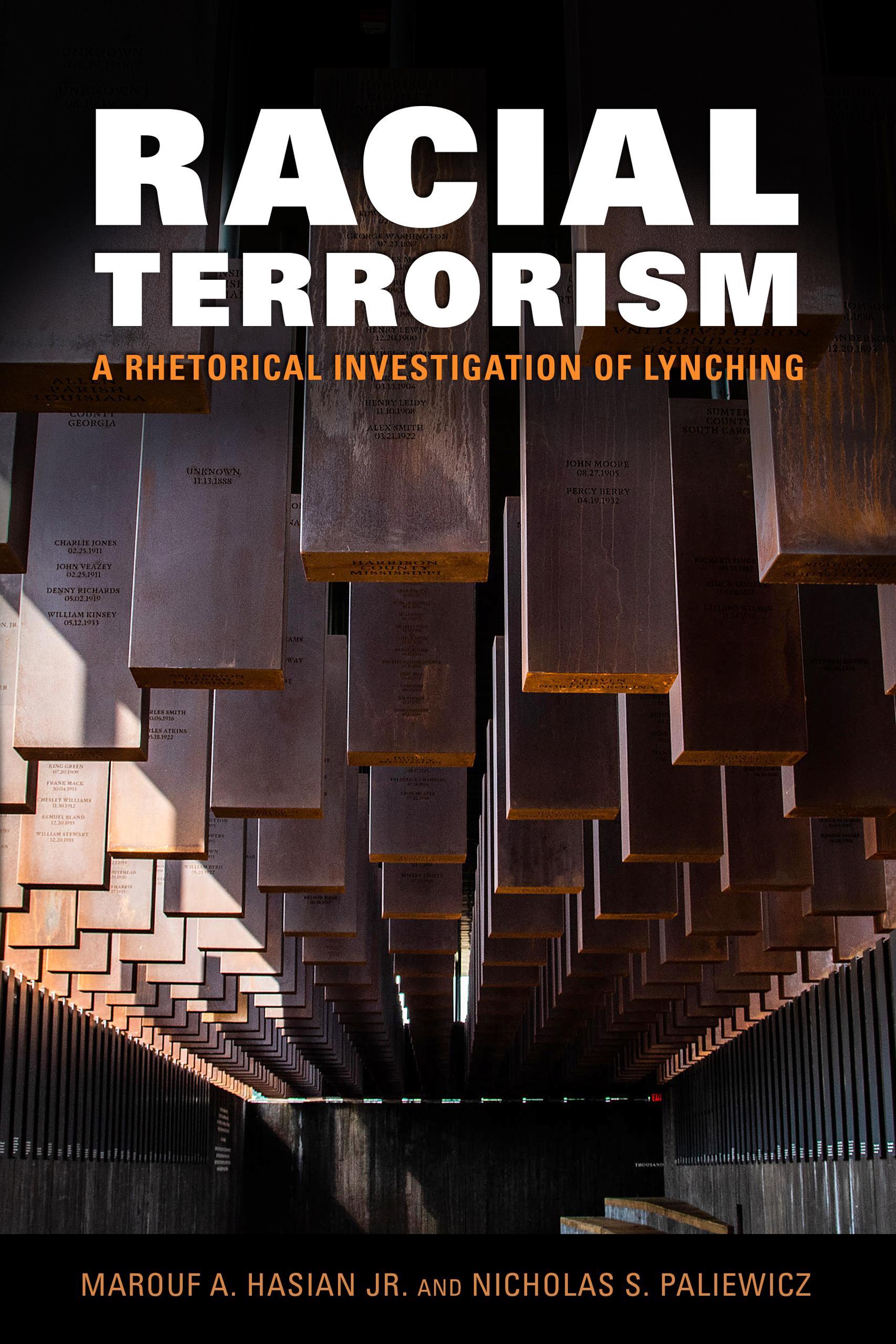
In December 2018, the United States Senate unanimously passed the nation’s first antilynching act, the Justice for Victims of Lynching Act. For the first time in US history, legislators, representing the American people, classified lynching as a federal hate crime.
While lynching histories and memories have received attention among communication scholars and some interdisciplinary studies of traditional civil rights memorials exist, contemporary studies often fail to examine the politicized nature of the spaces. This volume represents the first investigation of the National Memorial for Peace and Justice and the Legacy Museum, both of which strategically make clear the various links between America’s history of racial terror and contemporary mass incarceration conditions, the mistreatment of juveniles, and capital punishment.
Racial Terrorism: A Rhetorical Investigation of Lynching focuses on several key social agents and organizations that played vital roles in the public and legal consciousness raising that finally led to the passage of the act. Marouf A. Hasian Jr. and Nicholas S. Paliewicz argue that the advocacy of attorney Bryan Stevenson, the work of the Equal Justice Initiative (EJI), and the efforts of curators at Montgomery’s new Legacy Museum all contributed to the formation of a rhetorical culture that set the stage at last for this hallmark lynching legislation. The authors examine how the EJI uses spaces of remembrance to confront audiences with race-conscious messages and measure to what extent those messages are successful.
While lynching histories and memories have received attention among communication scholars and some interdisciplinary studies of traditional civil rights memorials exist, contemporary studies often fail to examine the politicized nature of the spaces. This volume represents the first investigation of the National Memorial for Peace and Justice and the Legacy Museum, both of which strategically make clear the various links between America’s history of racial terror and contemporary mass incarceration conditions, the mistreatment of juveniles, and capital punishment.
Racial Terrorism: A Rhetorical Investigation of Lynching focuses on several key social agents and organizations that played vital roles in the public and legal consciousness raising that finally led to the passage of the act. Marouf A. Hasian Jr. and Nicholas S. Paliewicz argue that the advocacy of attorney Bryan Stevenson, the work of the Equal Justice Initiative (EJI), and the efforts of curators at Montgomery’s new Legacy Museum all contributed to the formation of a rhetorical culture that set the stage at last for this hallmark lynching legislation. The authors examine how the EJI uses spaces of remembrance to confront audiences with race-conscious messages and measure to what extent those messages are successful.
Pay easily by card, Klarna, Apple Pay or Google Pay. Not happy? You always have a 14-day money-back guarantee. Read more in our terms. If you have any questions, email us at hello@memmo.org.
Memmo makes studying easier – wherever you are in the world. We bring your course books and smart study tools together in one place: summaries, quizzes, podcasts and flashcards. Plus Ted, your study buddy who answers anything you wonder. Over 50,000 students already study here – built to help you learn faster and stress less.
You might also like
Buy the book0