
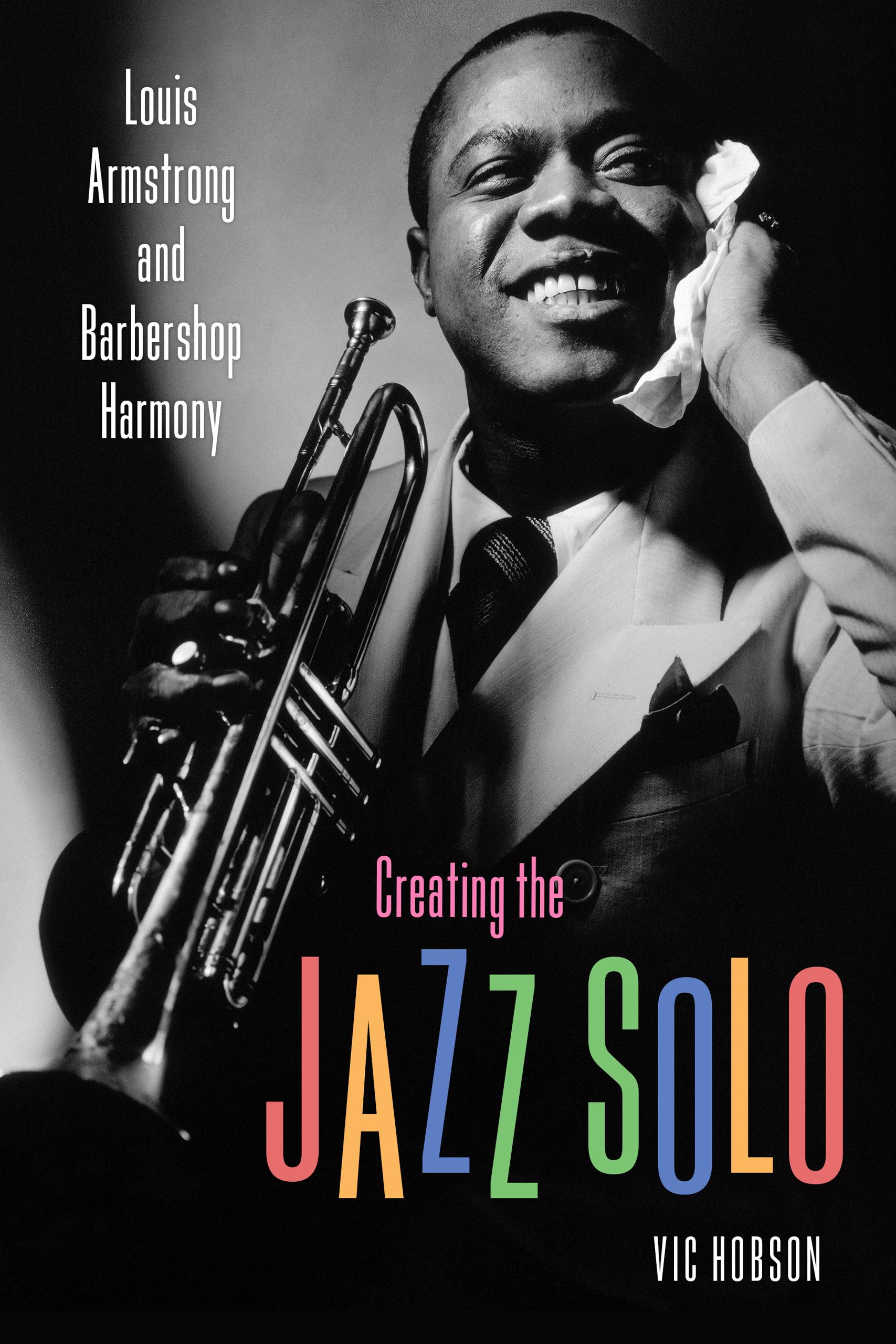
Throughout his life, Louis Armstrong tried to explain how singing with a barbershop quartet on the streets of New Orleans was foundational to his musicianship. Until now, there has been no in-depth inquiry into what he meant when he said, “I figure singing and playing is the same,” or, “Singing was more into my blood than the trumpet.” Creating the Jazz Solo: Louis Armstrong and Barbershop Harmony shows that Armstrong understood exactly the relationship between what he sang and what he played, and that he meant these comments to be taken literally: he was singing through his horn.
To describe the relationship between what Armstrong sang and played, author Vic Hobson discusses elements of music theory with a style accessible even to readers with little or no musical background. Jazz is a music that is often performed by people with limited formal musical education. Armstrong did not analyze what he played in theoretical terms. Instead, he thought about it in terms of the voices in a barbershop quartet.
Understanding how Armstrong, and other pioneer jazz musicians of his generation, learned to play jazz and how he used his background of singing in a quartet to develop the jazz solo has fundamental implications for the teaching of jazz history and performance today. This assertive book provides an approachable foundation for current musicians to unlock the magic and understand jazz the Louis Armstrong way.
To describe the relationship between what Armstrong sang and played, author Vic Hobson discusses elements of music theory with a style accessible even to readers with little or no musical background. Jazz is a music that is often performed by people with limited formal musical education. Armstrong did not analyze what he played in theoretical terms. Instead, he thought about it in terms of the voices in a barbershop quartet.
Understanding how Armstrong, and other pioneer jazz musicians of his generation, learned to play jazz and how he used his background of singing in a quartet to develop the jazz solo has fundamental implications for the teaching of jazz history and performance today. This assertive book provides an approachable foundation for current musicians to unlock the magic and understand jazz the Louis Armstrong way.
Pay easily by card, Klarna, Apple Pay or Google Pay. Not happy? You always have a 14-day money-back guarantee. Read more in our terms. If you have any questions, email us at hello@memmo.org.
Memmo makes studying easier – wherever you are in the world. We bring your course books and smart study tools together in one place: summaries, quizzes, podcasts and flashcards. Plus Ted, your study buddy who answers anything you wonder. Over 50,000 students already study here – built to help you learn faster and stress less.
You might also like
Buy the book0