
Contributions by Taunya Lovell Banks, Devon W. Carbado, Robert S. Chang, Cheryl Greenberg, Tanya Katerí Hernández, Amanda O. Jenssen, Scott Kurashige, Greg Robinson, Stephen Steinberg, Clarence Walker, and Eric K. Yamamoto
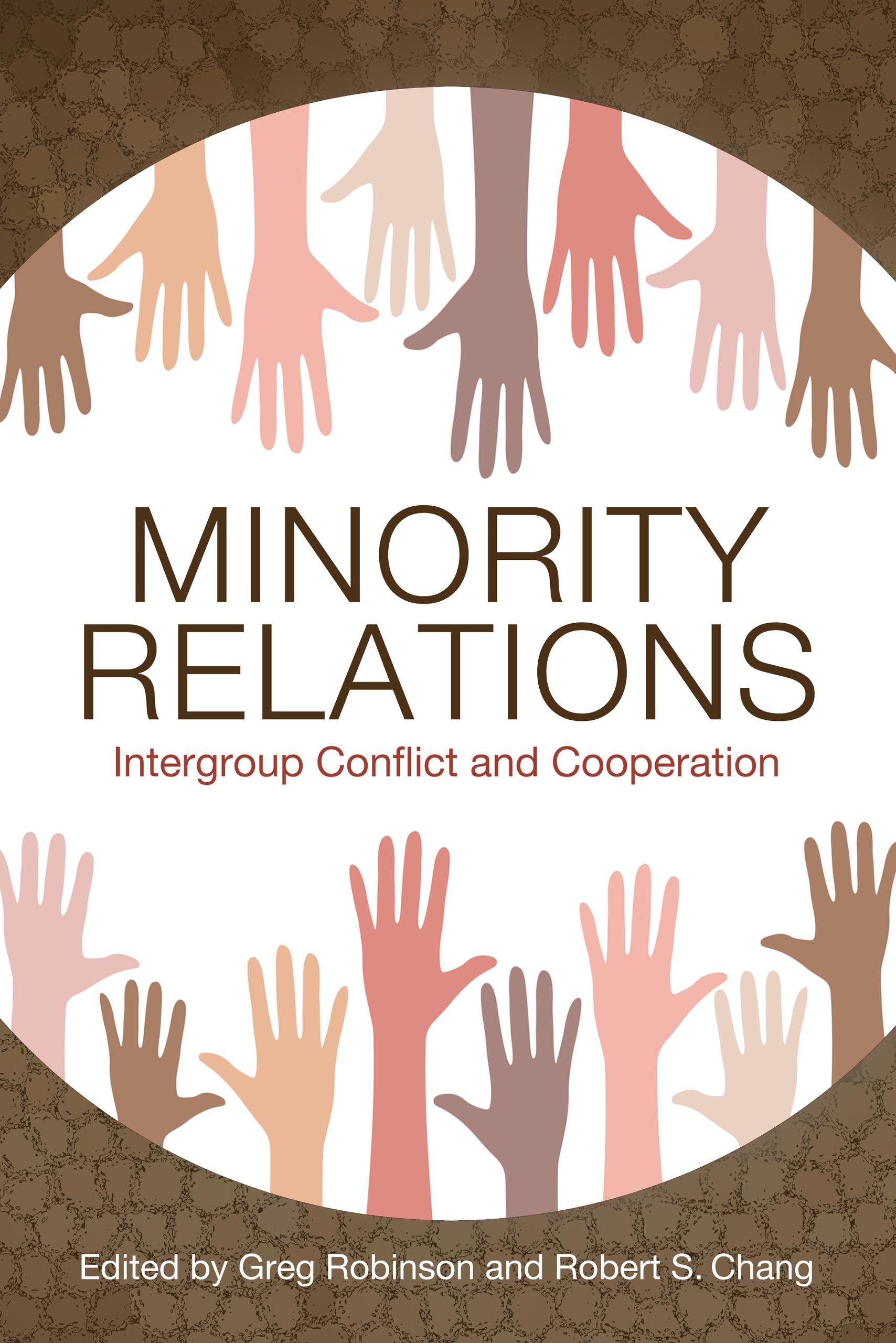
The question of how relations between marginalized groups are impacted by their common and sometimes competing search for equal rights has become acutely important. Demographic projections make it easy now to imagine a future majority population of color in the United States. Minority Relations: Intergroup Conflict and Cooperation sets forth some of the issues involved in the interplay among members of various racial, ethnic, and sexual minorities.
Robert S. Chang initiated the Intergroup Conflict and Cooperation Project and invited historian Greg Robinson to collaborate. The two brought together scholars from different backgrounds and disciplines to engage a set of interrelated questions confronting groups generally considered minorities.
This collection strives to stimulate further thinking and writing by social scientists, legal scholars, and policymakers on inter-minority connections. Particularly, scholars test the limits of intergroup cooperation and coalition building. For marginalized groups, coalition building seems to offer a pathway to addressing economic discrimination and reaching some measure of justice with regard to opportunities. The need for coalitions also acknowledges a democratic process in which racialized groups face significant difficulty gaining real political power, despite such legislation as the Voting Rights Act.
The question of how relations between marginalized groups are impacted by their common and sometimes competing search for equal rights has become acutely important. Demographic projections make it easy now to imagine a future majority population of color in the United States. Minority Relations: Intergroup Conflict and Cooperation sets forth some of the issues involved in the interplay among members of various racial, ethnic, and sexual minorities.
Robert S. Chang initiated the Intergroup Conflict and Cooperation Project and invited historian Greg Robinson to collaborate. The two brought together scholars from different backgrounds and disciplines to engage a set of interrelated questions confronting groups generally considered minorities.
This collection strives to stimulate further thinking and writing by social scientists, legal scholars, and policymakers on inter-minority connections. Particularly, scholars test the limits of intergroup cooperation and coalition building. For marginalized groups, coalition building seems to offer a pathway to addressing economic discrimination and reaching some measure of justice with regard to opportunities. The need for coalitions also acknowledges a democratic process in which racialized groups face significant difficulty gaining real political power, despite such legislation as the Voting Rights Act.
Pay easily by card, Klarna, Apple Pay or Google Pay. Not happy? You always have a 14-day money-back guarantee. Read more in our terms. If you have any questions, email us at hello@memmo.org.
Memmo makes studying easier – wherever you are in the world. We bring your course books and smart study tools together in one place: summaries, quizzes, podcasts and flashcards. Plus Ted, your study buddy who answers anything you wonder. Over 50,000 students already study here – built to help you learn faster and stress less.
You might also like
Buy the book0