
Winner, 2017 American Society of Criminology's Division on Critical Criminology and Social Justice Best Book Award
An examination of the neoliberal politics of incarceration
The growth of mass incarceration in the United States eludes neat categorization as a product of the political Right. Liberals played important roles in both laying the foundation for and then participating in the conservative tough on crime movement that is largely credited with the rise of the prison state. But what of those politicians and activists on the Left who reject punitive politics in favor of rehabilitation and a stronger welfare state? Can progressive policies such as these, with their benevolent intentions, nevertheless contribute to the expansion of mass incarceration?
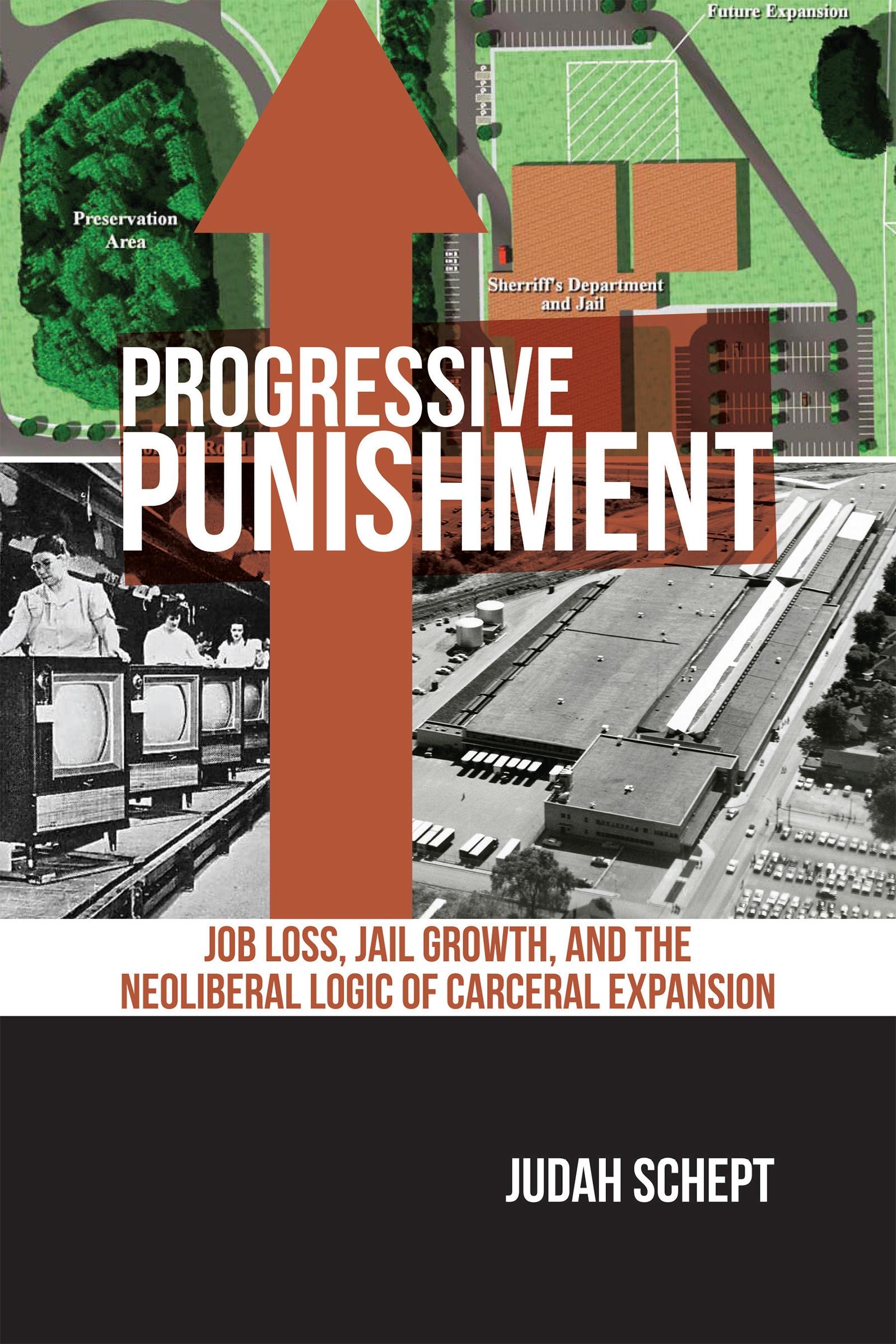
In Progressive Punishment, Judah Schept offers an ethnographic examination into the politics of incarceration in Bloomington, Indiana in order to consider the ways that liberal discourses about therapeutic justice and rehabilitation can uphold the logics, practices and institutions that comprise the carceral state. Schept examines how political leaders on the Left, despite being critical of mass incarceration, advocated for a “justice campus” that would have dramatically expanded the local criminal justice system. At the root of this proposal, Schept argues, is a confluence of neoliberal-style changes in the community that naturalized prison expansion as political common sense among leaders negotiating crises of deindustrialization, urban decline, and the devolution of social welfare. In spite of the momentum that the proposal gained, Schept uncovers resistance among community organizers, who developed important strategies and discourses to challenge the justice campus, disrupt some of the logics that provided it legitimacy, and offer new possibilities for a non-carceral community.
A well-researched and well-narrated study, Progressive Punishment offers a novel perspective on the relationship between liberal politics, neoliberalism, and mass incarceration.
Pay easily by card, Klarna, Apple Pay or Google Pay. Not happy? You always have a 14-day money-back guarantee. Read more in our terms. If you have any questions, email us at hello@memmo.org.
Memmo makes studying easier – wherever you are in the world. We bring your course books and smart study tools together in one place: summaries, quizzes, podcasts and flashcards. Plus Ted, your study buddy who answers anything you wonder. Over 50,000 students already study here – built to help you learn faster and stress less.