
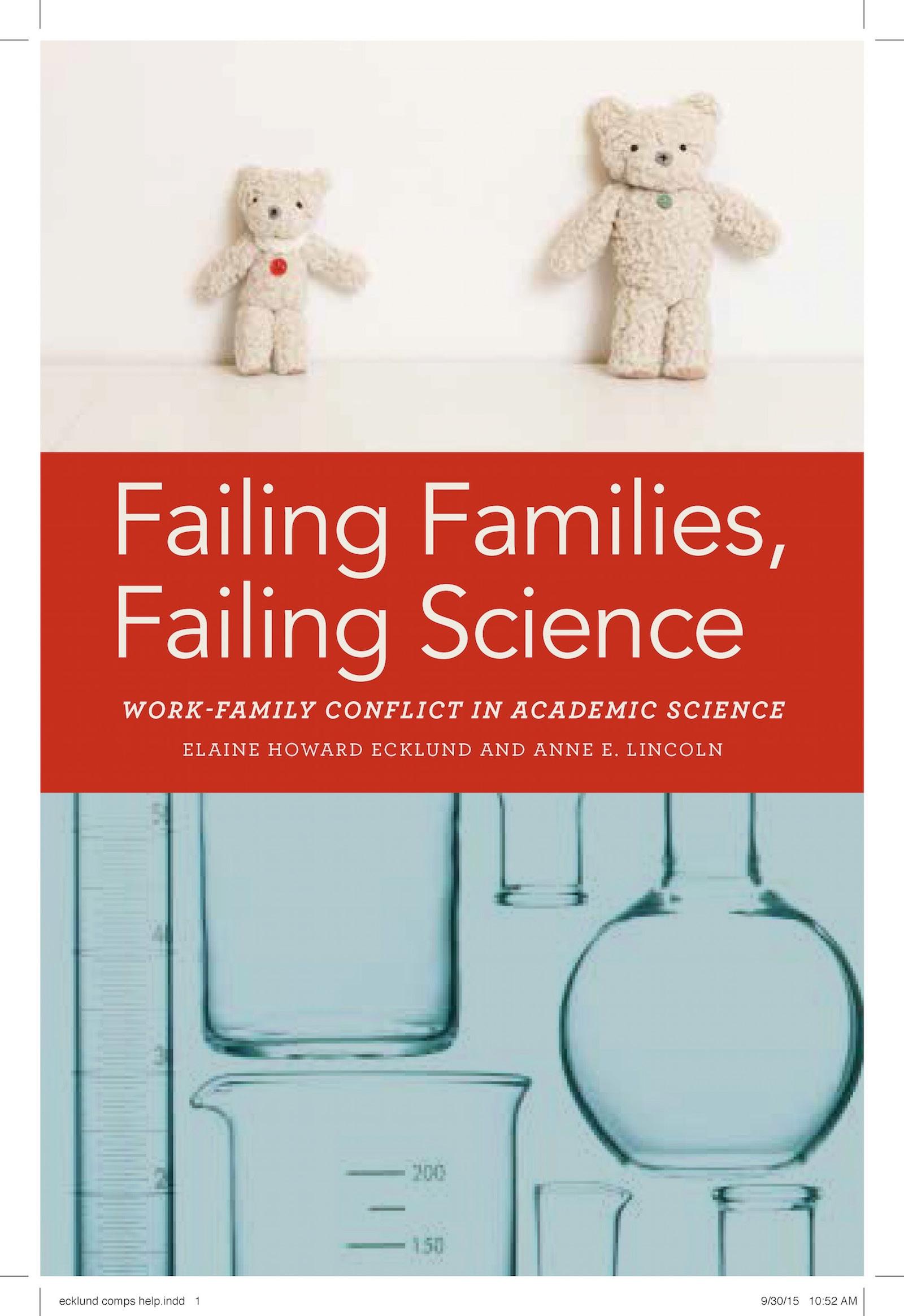
Work life in academia might sound like a dream: summers off, year-long sabbaticals, the opportunity to switch between classroom teaching and research. Yet, when it comes to the sciences, life at the top U.S. research universities is hardly idyllic. Based on surveys of over 2,000 junior and senior scientists, both male and female, as well as in-depth interviews, Failing Families, Failing Science examines how the rigors of a career in academic science makes it especially difficult to balance family and work.
Ecklund and Lincoln paint a nuanced picture that illuminates how gender, individual choices, and university and science infrastructures all play a role in shaping science careers, and how science careers, in turn, shape family life. They argue that both men and women face difficulties, though differently, in managing career and family. While women are hit harder by the pressures of elite academic science, the institution of science—and academic science, in particular—is not accommodating, possibly not even compatible, for either women or men who want to raise families. Perhaps most importantly, their research reveals that early career academic scientists struggle considerably with balancing their work and family lives. This struggle may prevent these young scientists from pursuing positions at top research universities—or further pursuing academic science at all— a circumstance that comes at great cost to our national science infrastructure. In an era when advanced scientific research and education is more important than ever, Failing Families, Failing Science presents a compelling inside look at the world of the university scientists who make it possible—and what universities and national science bodies can do to make a difference in their lives.
Pay easily by card, Klarna, Apple Pay or Google Pay. Not happy? You always have a 14-day money-back guarantee. Read more in our terms. If you have any questions, email us at hello@memmo.org.
Memmo makes studying easier – wherever you are in the world. We bring your course books and smart study tools together in one place: summaries, quizzes, podcasts and flashcards. Plus Ted, your study buddy who answers anything you wonder. Over 50,000 students already study here – built to help you learn faster and stress less.