
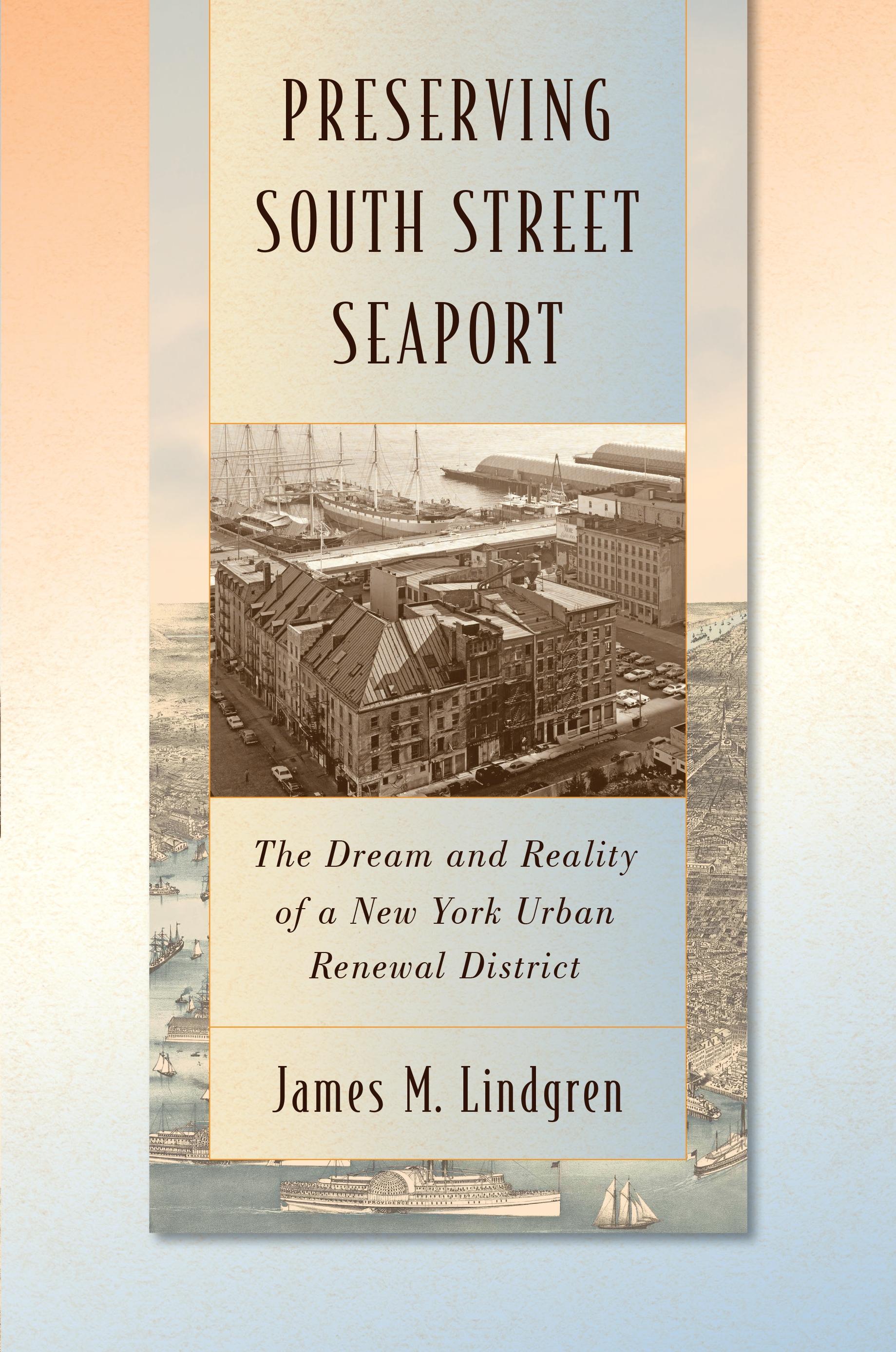
Preserving South Street Seaport tells the fascinating story, from the 1960s to the present, of the South Street Seaport District of Lower Manhattan. Home to the original Fulton Fish Market and then the South Street Seaport Museum, it is one of the last neighborhoods of late 18th- and early 19th-century New York City not to be destroyed by urban development. In 1988, South Street Seaport became the city's #1 destination for visitors. Featuring over 40 archival and contemporary black-and-white photographs, this is the first history of a remarkable historic district and maritime museum.
Lindgren skillfully tells the complex story of this unique cobblestoned neighborhood. Comprised of deteriorating, 4-5 story buildings in what was known as the Fulton Fish Market, the neighborhood was earmarked for the erection of the World Trade Center until New Jersey forced its placement one mile westward. After Penn Station’s demolition had angered many New York citizens, preservationists mobilized in 1966 to save this last piece of Manhattan’s old port and recreate its fabled 19th-century “Street of Ships.” The South Street Seaport and the World Trade Center became the yin and yang of Lower Manhattan’s rebirth. In an unprecedented move, City Hall designated the museum as developer of the twelve-block urban renewal district.
However, the Seaport Museum,whose membership became the largest of any history museum in the city, was never adequately funded, and it suffered with the real estate collapse of 1972. The city, bankers, and state bought the museum’s fifty buildings and leased them back at terms that crippled the museum financially. That led to the controversial construction of the Rouse Company's New Fulton Market (1983) and Pier 17 mall (1985). Lindgren chronicles these years of struggle, as the defenders of the people-oriented museum and historic district tried to save the original streets and buildings and the largest fleet of historic ships in the country from the schemes of developers, bankers, politicians, and even museum administrators.
Though the Seaport Museum’s finances were always tenuous, the neighborhood and the museum were improving until the tragedy of 9/11. But the prolonged recovery brought on dysfunctional museum managers and indifference, if not hostility, from City Hall. Superstorm Sandy then dealt a crushing blow. Today, the future of this pioneering museum, designated by Congress as America’s National Maritime Museum, is in doubt, as its waterfront district is eyed by powerful commercial developers. While Preserving South Street Seaport reveals the pitfalls of privatizing urban renewal, developing museum-corporate partnerships, and introducing a professional regimen over a people’s movement, it also tells the story of how a seedy, decrepit piece of waterfront became a wonderful venue for all New Yorkers and visitors from around the world to enjoy. This book will appeal to a wide audience of readers in the history and practice of museums, historic preservation, urban history and urban development, and contemporary New York City.
This book is supported by a grant from Furthermore: a program of the J.M. Kaplan Fund.
Pay easily by card, Klarna, Apple Pay or Google Pay. Not happy? You always have a 14-day money-back guarantee. Read more in our terms. If you have any questions, email us at hello@memmo.org.
Memmo makes studying easier – wherever you are in the world. We bring your course books and smart study tools together in one place: summaries, quizzes, podcasts and flashcards. Plus Ted, your study buddy who answers anything you wonder. Over 75,000 students already study here – built to help you learn faster and stress less.