
*** Winner of the2019 Flaiano Prize in the category Italian Studies ***
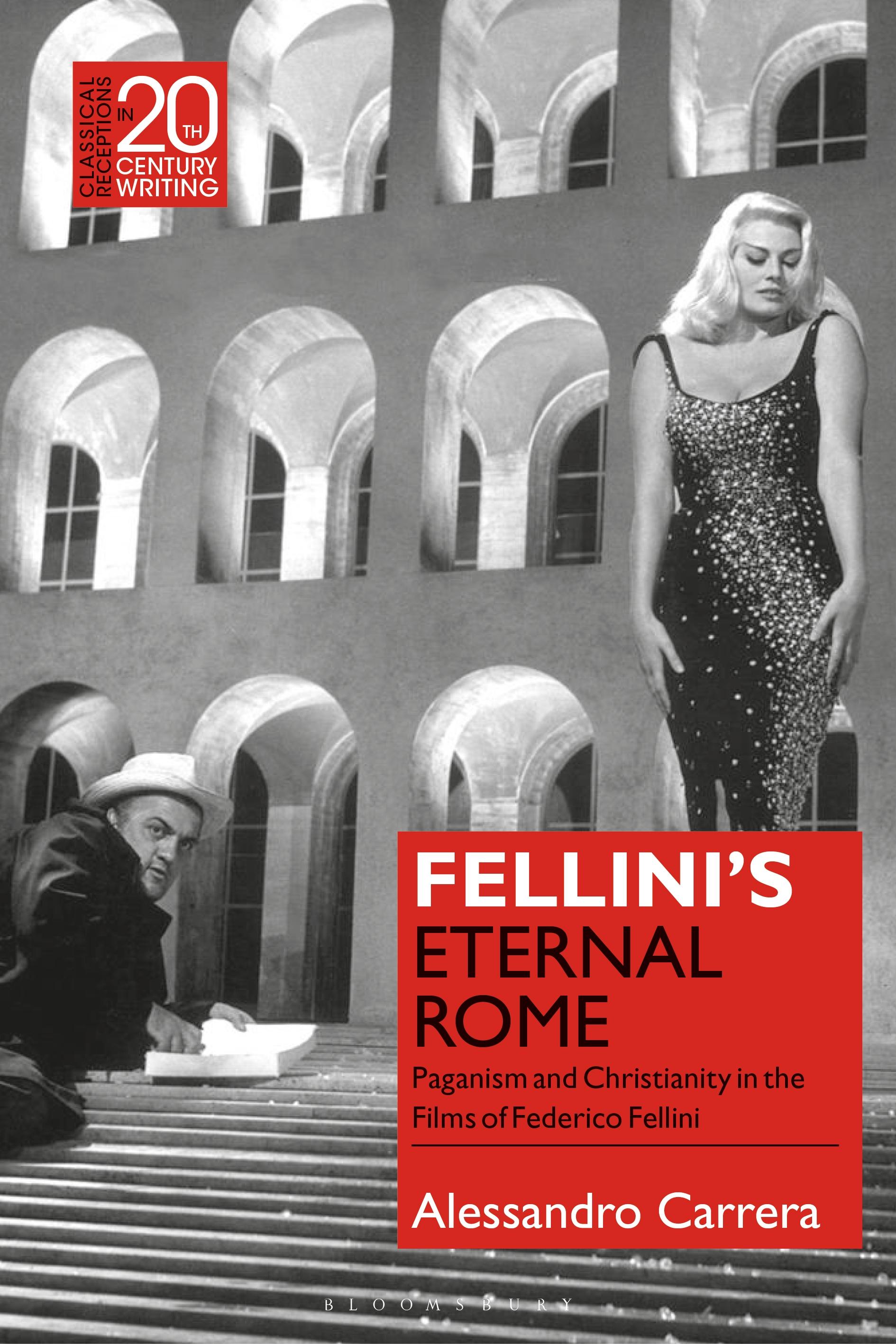
In Fellini's Eternal Rome, Alessandro Carrera explores the co-existence and conflict of paganism and Christianity in the works of Federico Fellini. By combining source analysis, cultural history and jargon-free psychoanalytic film theory, Carrera introduces the reader to a new appreciation of Fellini's work.
Life-affirming Franciscanism and repressive Counter-Reformation dogmatism live side by side in Fellini's films, although he clearly tends toward the former and resents the latter. The fascination with pre-Christian Rome shines through La Dolce Vita and finds its culmination in Fellini-Satyricon, the most audacious attempt to imagine what the West would be if Christianity had never replaced classical Rome. Minimal clues point toward a careful, extremely subtle use of classical texts and motifs.
Fellini's interest in the classics culminates in Olympus, a treatment of Hesiod's Theogony for a never-realized TV miniseries on Greek mythology, here introduced for the first time to an English-speaking readership. Fellini's recurrent dream of the Mediterranean Goddess is shaped by the phantasmatic projection of paganism that Christianity created as its convenient Other. His characters long for a “maternal space” where they will be protected from mortality and left free to roam. Yet Fellini shows how such maternal space constantly fails, not because the Church has erased it, but because the utopia of unlimited enjoyment is a self-defeating fantasy.
In Fellini's Eternal Rome, Alessandro Carrera explores the co-existence and conflict of paganism and Christianity in the works of Federico Fellini. By combining source analysis, cultural history and jargon-free psychoanalytic film theory, Carrera introduces the reader to a new appreciation of Fellini's work.
Life-affirming Franciscanism and repressive Counter-Reformation dogmatism live side by side in Fellini's films, although he clearly tends toward the former and resents the latter. The fascination with pre-Christian Rome shines through La Dolce Vita and finds its culmination in Fellini-Satyricon, the most audacious attempt to imagine what the West would be if Christianity had never replaced classical Rome. Minimal clues point toward a careful, extremely subtle use of classical texts and motifs.
Fellini's interest in the classics culminates in Olympus, a treatment of Hesiod's Theogony for a never-realized TV miniseries on Greek mythology, here introduced for the first time to an English-speaking readership. Fellini's recurrent dream of the Mediterranean Goddess is shaped by the phantasmatic projection of paganism that Christianity created as its convenient Other. His characters long for a “maternal space” where they will be protected from mortality and left free to roam. Yet Fellini shows how such maternal space constantly fails, not because the Church has erased it, but because the utopia of unlimited enjoyment is a self-defeating fantasy.
Pay easily by card, Klarna, Apple Pay or Google Pay. Not happy? You always have a 14-day money-back guarantee. Read more in our terms. If you have any questions, email us at hello@memmo.org.
Memmo makes studying easier – wherever you are in the world. We bring your course books and smart study tools together in one place: summaries, quizzes, podcasts and flashcards. Plus Ted, your study buddy who answers anything you wonder. Over 50,000 students already study here – built to help you learn faster and stress less.