
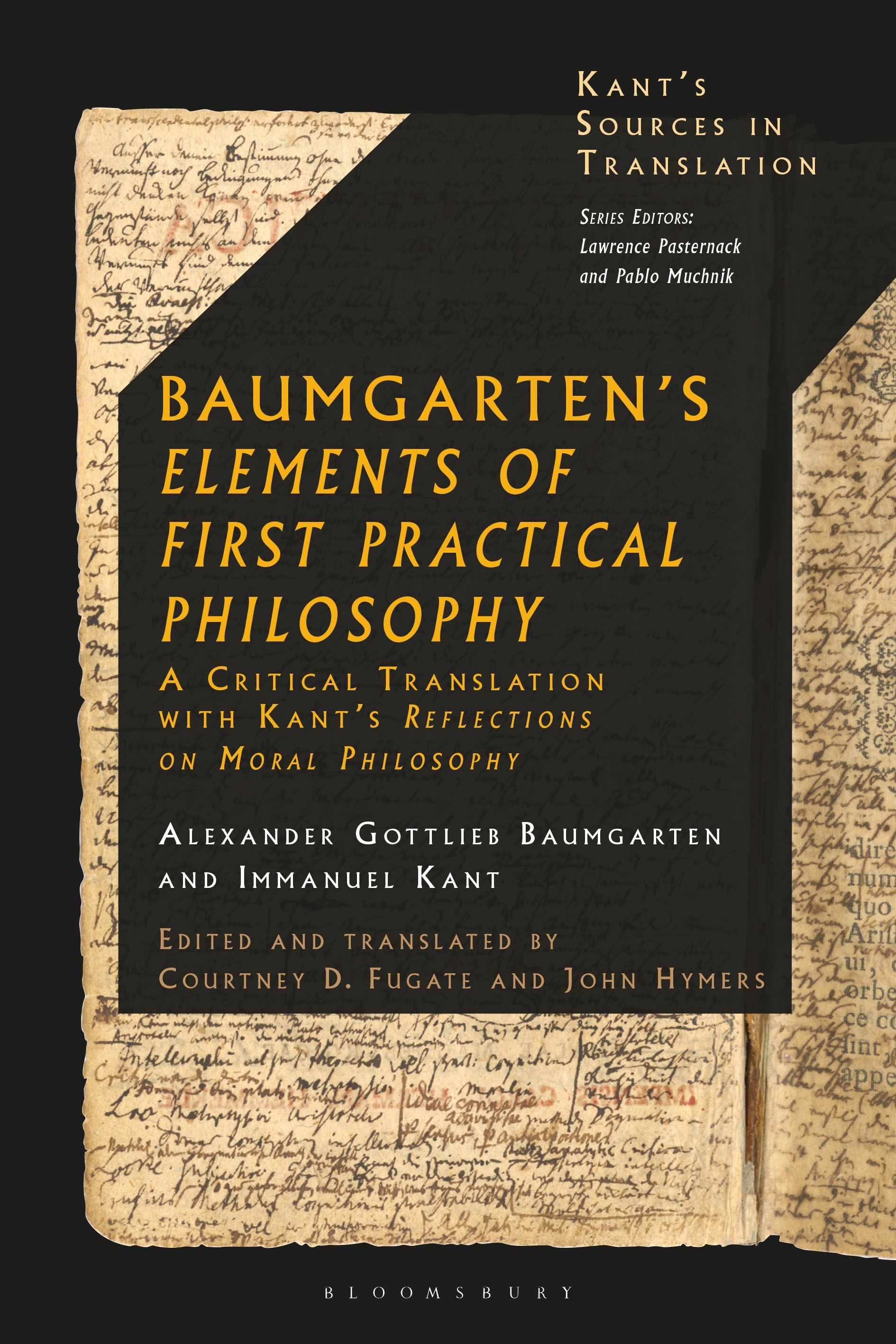
This book presents the first English translation of Alexander Baumgarten's Initia Philosophiae Practicae Primae, the textbook Kant used in his lectures on moral philosophy.
Originally published in Latin in 1760, the Initia contains a systematic, but original version of the universal practical philosophy first articulated by Christian Wolff. In his personal copy, Kant penned hundreds of pages of notes and sketches that document his relation to this earlier tradition. Translating these extensive elucidations into English, together with Kant's notes on the text, this translation offers a complete resource to Kant's reading of the Initia. To facilitate further study, first-time translations of elucidatory passages from G. F. Meier and Wolff are also included, alongside a German-English-Latin glossary. The translators' introduction provides a biography of Baumgarten, a discussion of the importance of the Initia, its relation to Wolff's and Meier's universal practical philosophy and its role in Kant's lectures.
By shedding new light on the arguments of Kant's mature works and offering insights into his pre-Critical moral thought, Elements of First Practical Philosophy reveals why Baumgarten's work is essential for understanding the background to Kant's philosophy.
Originally published in Latin in 1760, the Initia contains a systematic, but original version of the universal practical philosophy first articulated by Christian Wolff. In his personal copy, Kant penned hundreds of pages of notes and sketches that document his relation to this earlier tradition. Translating these extensive elucidations into English, together with Kant's notes on the text, this translation offers a complete resource to Kant's reading of the Initia. To facilitate further study, first-time translations of elucidatory passages from G. F. Meier and Wolff are also included, alongside a German-English-Latin glossary. The translators' introduction provides a biography of Baumgarten, a discussion of the importance of the Initia, its relation to Wolff's and Meier's universal practical philosophy and its role in Kant's lectures.
By shedding new light on the arguments of Kant's mature works and offering insights into his pre-Critical moral thought, Elements of First Practical Philosophy reveals why Baumgarten's work is essential for understanding the background to Kant's philosophy.
Pay easily by card, Klarna, Apple Pay or Google Pay. Not happy? You always have a 14-day money-back guarantee. Read more in our terms. If you have any questions, email us at hello@memmo.org.
Memmo makes studying easier – wherever you are in the world. We bring your course books and smart study tools together in one place: summaries, quizzes, podcasts and flashcards. Plus Ted, your study buddy who answers anything you wonder. Over 50,000 students already study here – built to help you learn faster and stress less.