
"Discussions about the contemporary online world are often in a one-dimensional manner shaped by moral panics about online trolling, cyberbullying, cybercrime, terrorists online, etc. The associated right-wing extremist agenda for Internet politics is about control, surveillance and censorship. Vince Miller’s book questions this agenda and is an excellent work for understanding how to use philosophical thought for the analysis of ethics, privacy and disclosure in this turbulent world of the Internet in the information society. It shows how to come to grips with the contested relationship between online freedom and control."
- Christian Fuchs, University of Westminster, Author of Social Media: A Critical Introduction
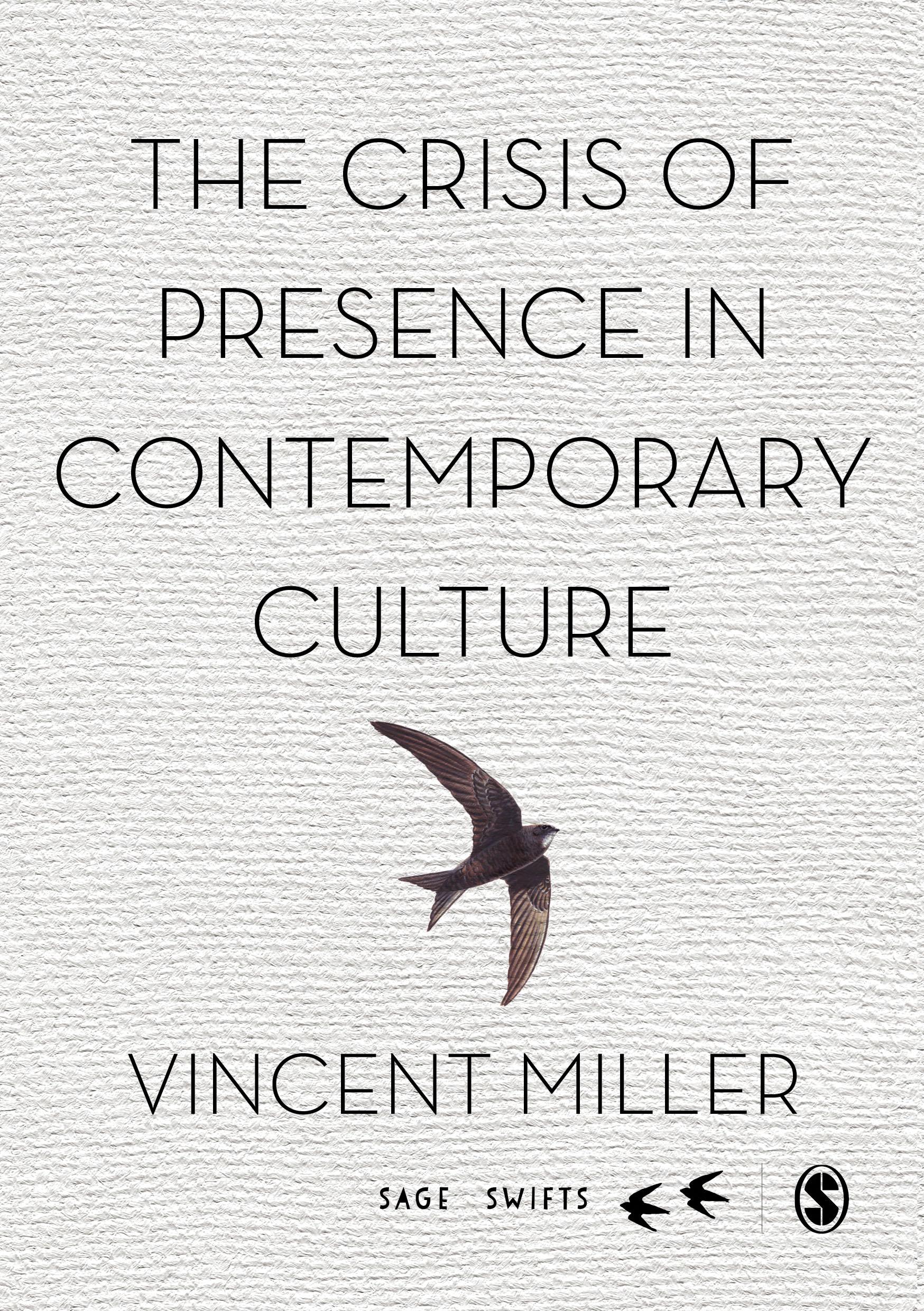
By investigating three issues which have captured the public imagination as ′problems′ emerging directly from the contemporary use of communications technology (anti-social behaviour, privacy and free speech online), Vincent Miller explores how the digital revolution is challenging our notion of ′self′ and ′presence′. Through a critical and philosophical examination of each of these cases, he argues that they have at their root the same phenomena: ‘a crisis of presence’.
Focussing on the concept of presence, and the challenges that our changing presence poses to our ethics, privacy and public discourse, Miller illustrates how ubiquitous communication technologies have created a disjuncture between how we think we exist in the world and how we actually do exist through our use of such devices.
The solution, he claims, is not to focus exclusively on ‘content’ and its regulation as much as it is to examine, understand and resist the alienating aspects of the media itself, such as the technological ordering, metaphysical abstraction and mediation which increasingly define our social encounters and presences. He suggests that such resistance involves several ambitious revisions in our ethical, legal and technological regimes.
- Christian Fuchs, University of Westminster, Author of Social Media: A Critical Introduction
By investigating three issues which have captured the public imagination as ′problems′ emerging directly from the contemporary use of communications technology (anti-social behaviour, privacy and free speech online), Vincent Miller explores how the digital revolution is challenging our notion of ′self′ and ′presence′. Through a critical and philosophical examination of each of these cases, he argues that they have at their root the same phenomena: ‘a crisis of presence’.
Focussing on the concept of presence, and the challenges that our changing presence poses to our ethics, privacy and public discourse, Miller illustrates how ubiquitous communication technologies have created a disjuncture between how we think we exist in the world and how we actually do exist through our use of such devices.
The solution, he claims, is not to focus exclusively on ‘content’ and its regulation as much as it is to examine, understand and resist the alienating aspects of the media itself, such as the technological ordering, metaphysical abstraction and mediation which increasingly define our social encounters and presences. He suggests that such resistance involves several ambitious revisions in our ethical, legal and technological regimes.
Pay easily by card, Klarna, Apple Pay or Google Pay. Not happy? You always have a 14-day money-back guarantee. Read more in our terms. If you have any questions, email us at hello@memmo.org.
Memmo makes studying easier – wherever you are in the world. We bring your course books and smart study tools together in one place: summaries, quizzes, podcasts and flashcards. Plus Ted, your study buddy who answers anything you wonder. Over 50,000 students already study here – built to help you learn faster and stress less.