
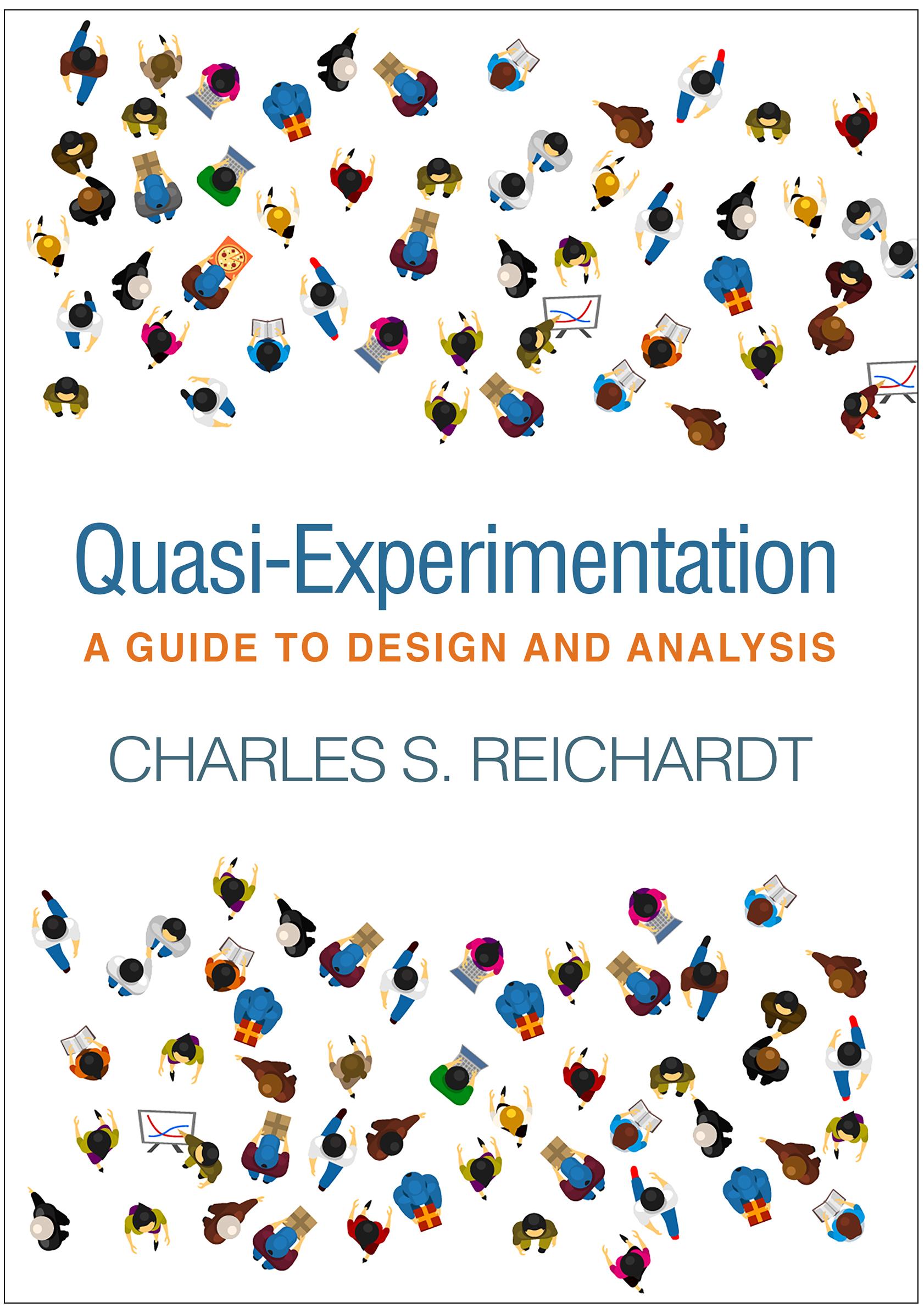
Featuring engaging examples from diverse disciplines, this book explains how to use modern approaches to quasi-experimentation to derive credible estimates of treatment effects under the demanding constraints of field settings. Foremost expert Charles S. Reichardt provides an in-depth examination of the design and statistical analysis of pretest–posttest, nonequivalent groups, regression discontinuity, and interrupted time-series designs. He details their relative strengths and weaknesses and offers practical advice about their use. Comparing quasi-experiments to randomized experiments, Reichardt discusses when and why the former might be a better choice than the latter in the face of the contingencies that are likely to arise in practice. Modern methods for elaborating a research design to remove bias from estimates of treatment effects are described, as are tactics for dealing with missing data and noncompliance with treatment assignment. Throughout, mathematical equations are translated into words to enhance accessibility. Adding to its discussion of prototypical quasi-experiments, the book also provides a complete typology of quasi-experimental design options to help the reader craft the best research design to fit the circumstances of a given study.
Pages: 361
Category: Vetenskapsteori och forskningsmetod
e-ISBN: 9781462540242
Shipping weight: 1.2 kg
Ships in: 1-2 days
Pay easily by card, Klarna, Apple Pay or Google Pay. Not happy? You always have a 14-day money-back guarantee. Read more in our terms. If you have any questions, email us at hello@memmo.org.
Memmo makes studying easier – wherever you are in the world. We bring your course books and smart study tools together in one place: summaries, quizzes, podcasts and flashcards. Plus Ted, your study buddy who answers anything you wonder. Over 50,000 students already study here – built to help you learn faster and stress less.
You might also like
Buy the book0