
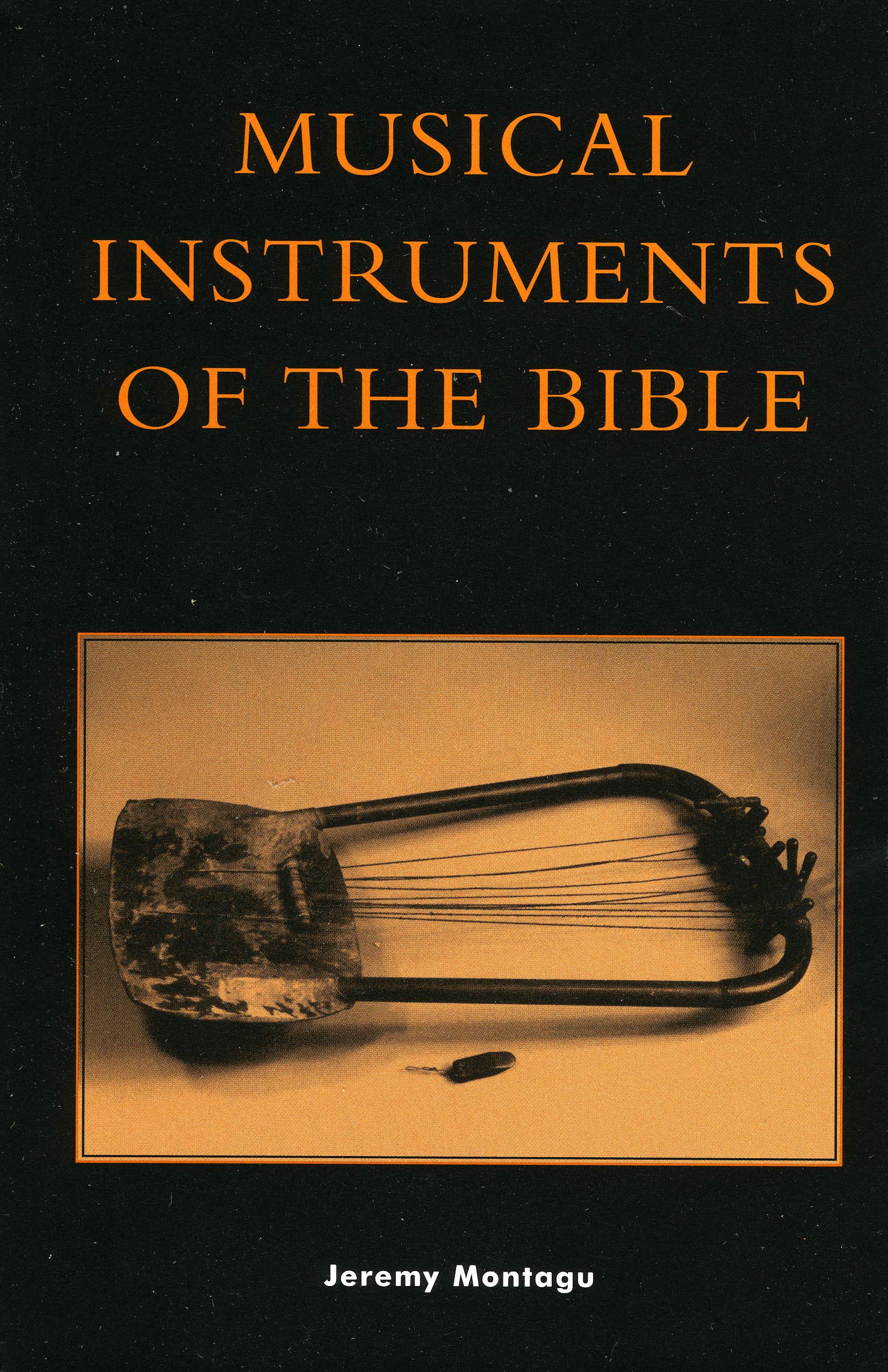
For everyone who's read the Bible and wondered what David's harp, or Nebuchadnezzar's sackbut and cornett really were, Jeremy Montagu, retired curator of Oxford's Bate Collection of Historical Instruments, has composed an astoundingly thorough investigation and explanation of the musical instruments that pepper the pages of Western Civilization's most holy book. This is a detailed study of all the musical instruments mentioned in the Bible, using the resources of linguistics, organology, and ethnomusicology to identify and describe them. Every reference to an instrument is noted and all the misconceptions of translation are corrected.
The Bible, as we know it in English, is a translation, and the history of biblical translations into Aramaic, Greek, Latin and other languages is one of guesswork. The substitution of the musical instruments from the translator's era for those of the original author is as common as it is overlooked. Jubal did not have an organ, nor David a harp. This book uses all the resources available to establish what each instrument really was, what it looked like, and how it was played and is arranged in the same order as the King James Bible, with explanation where this differs from other versions in English. As well as a full bibliography, there are three indexes. The first is of Biblical Citations so that readers may check every mention in the Bible from its chapter and verse. The second is a quadrilingual parallel citation in Hebrew, Greek, Latin, and English, so that each reference can be crosschecked. The third is a general index.
The four biblical languages, Hebrew, Aramaic, Greek, and Latin, are used to the full, and the original texts are cited frequently. There are 18 illustrations, some of which are archeological remains, some ethnographic parallels, and one is of the sole biblical instrument still in regular use: the ram's horn which brought down the walls of Jericho. Musical Instruments of the Bible is perfect for university theology and comparative religion depa
The Bible, as we know it in English, is a translation, and the history of biblical translations into Aramaic, Greek, Latin and other languages is one of guesswork. The substitution of the musical instruments from the translator's era for those of the original author is as common as it is overlooked. Jubal did not have an organ, nor David a harp. This book uses all the resources available to establish what each instrument really was, what it looked like, and how it was played and is arranged in the same order as the King James Bible, with explanation where this differs from other versions in English. As well as a full bibliography, there are three indexes. The first is of Biblical Citations so that readers may check every mention in the Bible from its chapter and verse. The second is a quadrilingual parallel citation in Hebrew, Greek, Latin, and English, so that each reference can be crosschecked. The third is a general index.
The four biblical languages, Hebrew, Aramaic, Greek, and Latin, are used to the full, and the original texts are cited frequently. There are 18 illustrations, some of which are archeological remains, some ethnographic parallels, and one is of the sole biblical instrument still in regular use: the ram's horn which brought down the walls of Jericho. Musical Instruments of the Bible is perfect for university theology and comparative religion depa
Pay easily by card, Klarna, Apple Pay or Google Pay. Not happy? You always have a 14-day money-back guarantee. Read more in our terms. If you have any questions, email us at hello@memmo.org.
Memmo makes studying easier – wherever you are in the world. We bring your course books and smart study tools together in one place: summaries, quizzes, podcasts and flashcards. Plus Ted, your study buddy who answers anything you wonder. Over 50,000 students already study here – built to help you learn faster and stress less.