
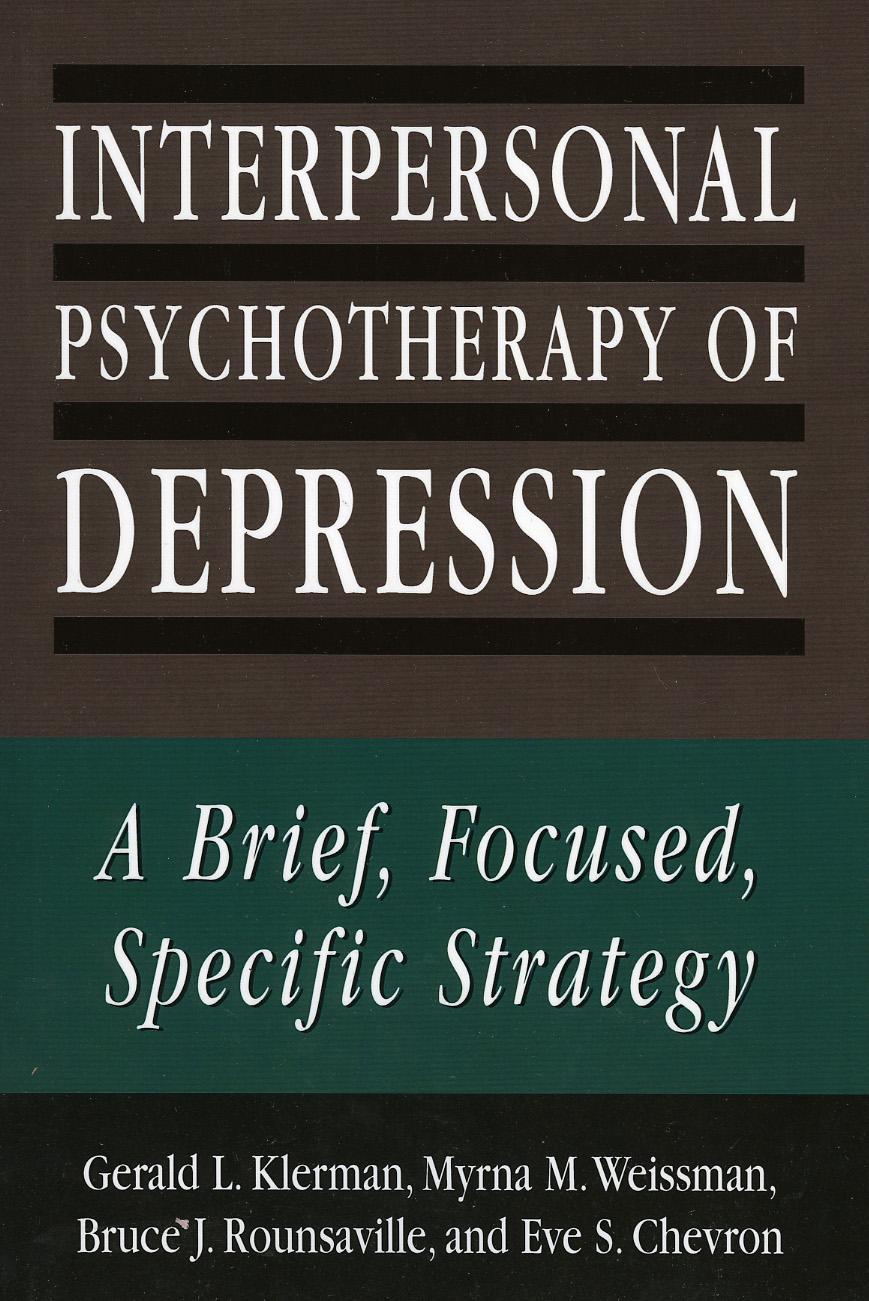
Reflecting the new and exciting trends in psychotherapy as well as responsive to the current emphasis on efficient, substantial therapeutic results, this book presents a model of interpersonal, short_term psychotherapy for clinically depressed patients. Gerald L. Klerman, whose research on depression has made him world renowned, and Myrna M. Weissman, who has written, with Eugene Paykel, an important book on women and depression, have worked with their colleagues to present the empirical basis for their new treatment method.
This theory builds on the heritage of Harry Stack Sullivan and John Bowlby and their focus on interpersonal issues and attachment on depression. Research shows that four categories of interpersonal difficulties predominate: grief, interpersonal disputes, role transitions. and interpersonal deficits. In this approach, the therapist focuses on the patient's primary problems and evaluates the need for medication in addition to interpersonal therapy. Acknowledging that these four areas are never mutually exclusive, the authors present a clear treatment strategy for each, augmenting their presentation with a discussion of common obstacles that arise during treatment.
As an overview, the book compares interpersonal psychotherapy with other psychotherapies for depression. Summaries of research documenting the efficacy of interpersonal psychotherapy are given.The authors outline the theoretical basis for an interpersonal approach, and apply it to depression. The following sections detail how to conduct interpersonal psychotherapy, supplying case vignettes to illustrate particular problems. Finally, the authors explore combining interpersonal psychotherapy with pharmacotherapy.
This theory builds on the heritage of Harry Stack Sullivan and John Bowlby and their focus on interpersonal issues and attachment on depression. Research shows that four categories of interpersonal difficulties predominate: grief, interpersonal disputes, role transitions. and interpersonal deficits. In this approach, the therapist focuses on the patient's primary problems and evaluates the need for medication in addition to interpersonal therapy. Acknowledging that these four areas are never mutually exclusive, the authors present a clear treatment strategy for each, augmenting their presentation with a discussion of common obstacles that arise during treatment.
As an overview, the book compares interpersonal psychotherapy with other psychotherapies for depression. Summaries of research documenting the efficacy of interpersonal psychotherapy are given.The authors outline the theoretical basis for an interpersonal approach, and apply it to depression. The following sections detail how to conduct interpersonal psychotherapy, supplying case vignettes to illustrate particular problems. Finally, the authors explore combining interpersonal psychotherapy with pharmacotherapy.
Pay easily by card, Klarna, Apple Pay or Google Pay. Not happy? You always have a 14-day money-back guarantee. Read more in our terms. If you have any questions, email us at hello@memmo.org.
Memmo makes studying easier – wherever you are in the world. We bring your course books and smart study tools together in one place: summaries, quizzes, podcasts and flashcards. Plus Ted, your study buddy who answers anything you wonder. Over 50,000 students already study here – built to help you learn faster and stress less.