
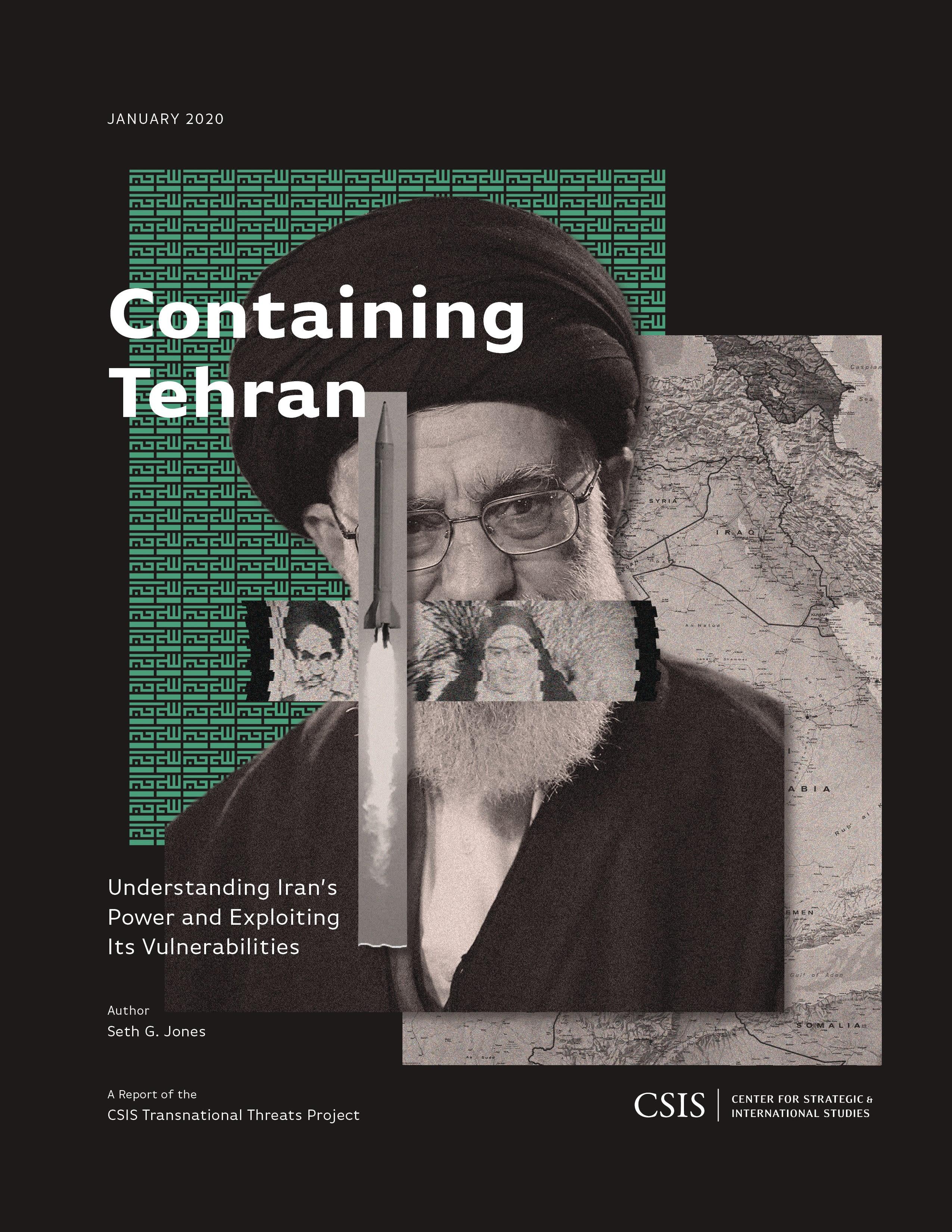
Following the U.S. killing of Qasem Soleimani, head of the Islamic Revolutionary Guard Corps-Quds Force (IRGC-QF), the United States and Iran are involved in an escalating conflict. What is badly needed now is a coherent long-term U.S. strategy to deal with Iran in ways that protect U.S. national security and leverage U.S. partners. The United States’ “maximum pressure” campaign has not led to a change in Iran’s behavior—at least not yet—though U.S. sanctions have severely damaged Iran’s economy.
As this CSIS report highlights with new data and analysis, the IRGC-QF has supported a growing number of non-state fighters in Yemen, Syria, Iraq, Lebanon, Afghanistan, and Pakistan—including nearly a 50 percent increase since 2016. Thanks to Iran, these forces are better equipped with more sophisticated weapons and systems. This report also uses satellite imagery to identify an expansion of IRGC-QF-linked bases in countries like Iran and Lebanon to train non-state fighters. Iran has constructed more sophisticated and longer-range ballistic and cruise missiles and conducted missile attacks against countries like Saudi Arabia. In addition, Iran has developed offensive cyber capabilities and used them against the United States and its partners. In the nuclear arena, Iran has ended commitments it made to limit uranium enrichment, production, research, and expansion—raising the prospect of Iranian nuclear weapons.
Moving forward, the United States should implement a containment strategy against Iran that attempts to de-escalate the current military situation and work toward achieving several goals:
Prevent Iran from becoming a regional hegemon capable of dominating other states in the Middle East.Stop nuclear proliferation in the region and prevent Iran from developing nuclear weapons, including thwarting Iran from pursuing weapons-grade uranium enrichment, warhead development, and plutonium reprocessing.Curb significant Iranian military, political, and ideological expansion in the region, including the export of Iran’s revolutionary ideology.Encourage a process of change inside Iran toward a more pluralistic political and economic system in which the power of the clerical establishment is gradually reduced.
This report highlights a range of weaknesses that make Iran vulnerable to containment and lays out the political, military, economic, and informational components of such a strategy. The United States needs to credibly demonstrate that its policy toward Iran is not a blueprint for an endless struggle, but instead an effort to encourage Iran to be more democratic and open, as political and economic change must be driven by Iranians themselves.
As this CSIS report highlights with new data and analysis, the IRGC-QF has supported a growing number of non-state fighters in Yemen, Syria, Iraq, Lebanon, Afghanistan, and Pakistan—including nearly a 50 percent increase since 2016. Thanks to Iran, these forces are better equipped with more sophisticated weapons and systems. This report also uses satellite imagery to identify an expansion of IRGC-QF-linked bases in countries like Iran and Lebanon to train non-state fighters. Iran has constructed more sophisticated and longer-range ballistic and cruise missiles and conducted missile attacks against countries like Saudi Arabia. In addition, Iran has developed offensive cyber capabilities and used them against the United States and its partners. In the nuclear arena, Iran has ended commitments it made to limit uranium enrichment, production, research, and expansion—raising the prospect of Iranian nuclear weapons.
Moving forward, the United States should implement a containment strategy against Iran that attempts to de-escalate the current military situation and work toward achieving several goals:
Prevent Iran from becoming a regional hegemon capable of dominating other states in the Middle East.Stop nuclear proliferation in the region and prevent Iran from developing nuclear weapons, including thwarting Iran from pursuing weapons-grade uranium enrichment, warhead development, and plutonium reprocessing.Curb significant Iranian military, political, and ideological expansion in the region, including the export of Iran’s revolutionary ideology.Encourage a process of change inside Iran toward a more pluralistic political and economic system in which the power of the clerical establishment is gradually reduced.
This report highlights a range of weaknesses that make Iran vulnerable to containment and lays out the political, military, economic, and informational components of such a strategy. The United States needs to credibly demonstrate that its policy toward Iran is not a blueprint for an endless struggle, but instead an effort to encourage Iran to be more democratic and open, as political and economic change must be driven by Iranians themselves.
Pages: 109
Category: Statsvetenskap & Politik
e-ISBN: 9781442281509
Shipping weight: 1.2 kg
Ships in: 1-2 days
Pay easily by card, Klarna, Apple Pay or Google Pay. Not happy? You always have a 14-day money-back guarantee. Read more in our terms. If you have any questions, email us at hello@memmo.org.
Memmo makes studying easier – wherever you are in the world. We bring your course books and smart study tools together in one place: summaries, quizzes, podcasts and flashcards. Plus Ted, your study buddy who answers anything you wonder. Over 50,000 students already study here – built to help you learn faster and stress less.