
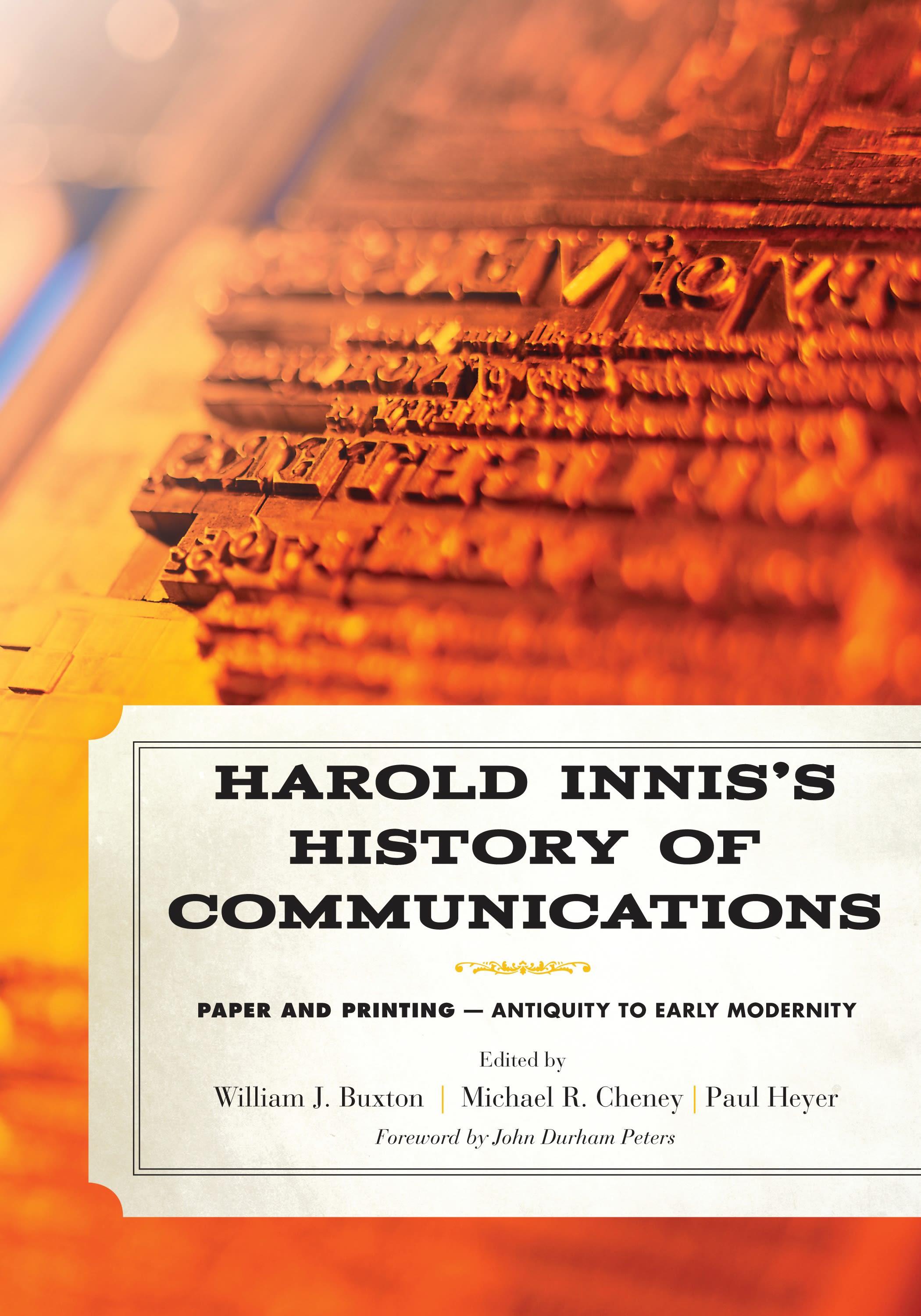
For decades, media historians have heard of Harold Innis’s unpublished manuscript exploring the history of communications—but very few have had an opportunity to see it. In this volume, editors and Innis scholars William J. Buxton, Michael R. Cheney, and Paul Heyer make widely accessible, for the first time, three core chapters from the legendary Innis manuscript.
Here, Innis (1894-1952) examines the development of paper and printing from antiquity in Asia through to 16th century Europe. He demonstrates how the paper/printing nexus intersected with a broad range of other phenomena, including administrative structures, geopolitics, militarism, public opinion, aesthetics, cultural diffusion, religion, education, reception, production processes, technology, labor relations, and commerce, as well as the lives of visionary figures.
Buxton, Cheney, and Heyer knit the chapters into a cohesive narrative and help readers navigate Innis’s observations by summarizing the heavily detailed factual material that peppered the unpublished manuscript. They provide further context for Innis’s arguments by adding annotations, references, and pertinent citations to his other writings. The end result is both a testament to Innis’s status as a canonical figure in the study of communication and a surprisingly relevant contribution to how we might think about the current sea change in all aspects of social, cultural, political, and economic life stemming from the global shift to digital communication.
Here, Innis (1894-1952) examines the development of paper and printing from antiquity in Asia through to 16th century Europe. He demonstrates how the paper/printing nexus intersected with a broad range of other phenomena, including administrative structures, geopolitics, militarism, public opinion, aesthetics, cultural diffusion, religion, education, reception, production processes, technology, labor relations, and commerce, as well as the lives of visionary figures.
Buxton, Cheney, and Heyer knit the chapters into a cohesive narrative and help readers navigate Innis’s observations by summarizing the heavily detailed factual material that peppered the unpublished manuscript. They provide further context for Innis’s arguments by adding annotations, references, and pertinent citations to his other writings. The end result is both a testament to Innis’s status as a canonical figure in the study of communication and a surprisingly relevant contribution to how we might think about the current sea change in all aspects of social, cultural, political, and economic life stemming from the global shift to digital communication.
Pay easily by card, Klarna, Apple Pay or Google Pay. Not happy? You always have a 14-day money-back guarantee. Read more in our terms. If you have any questions, email us at hello@memmo.org.
Memmo makes studying easier – wherever you are in the world. We bring your course books and smart study tools together in one place: summaries, quizzes, podcasts and flashcards. Plus Ted, your study buddy who answers anything you wonder. Over 75,000 students already study here – built to help you learn faster and stress less.