
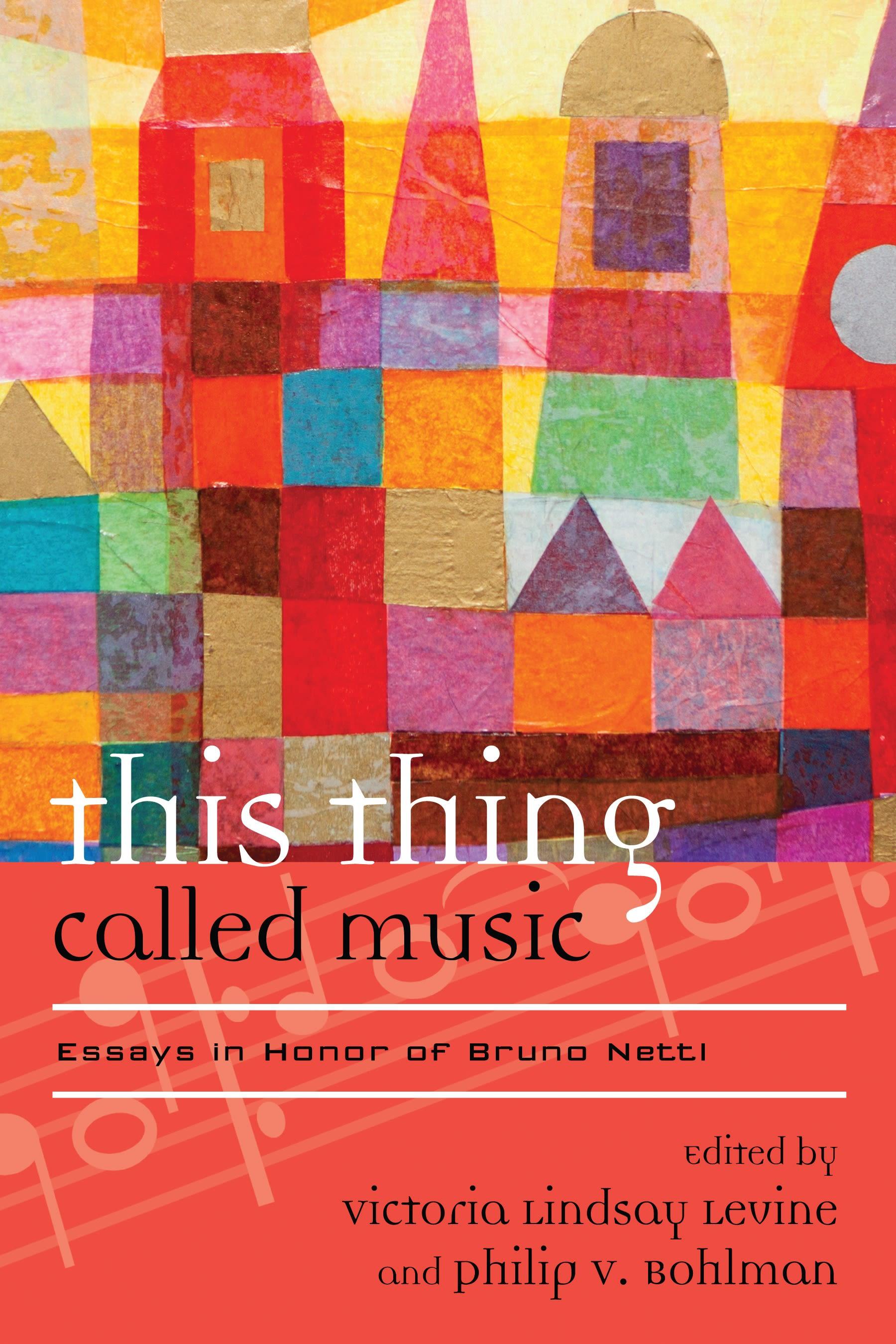
The most fundamental subject of music scholarship provides the common focus of this volume of essays: music itself. For the distinguished scholars from the field of musicology and related areas of the humanities and social sciences, the search for music itself—in its vastly complex and diverse forms throughout the world—characterizes the lifetime of reflection and writing by Bruno Nettl, the leading ethnomusicologist of the past generation. This Thing Called Music: Essays in Honor of Bruno Nettl salutes not only a great scholar and beloved teacher, but also a thinker whose search for the meaning and ontology of music has exerted a global influence.
Editors Victoria Lindsay Levine and Philip V. Bohlman have gathered essays that represent the many dimensions of musical meaning, addressing some of the most critically important areas of music scholarship today. The social formations of musical communities play counterpoint to analytical studies; investigations into musical change and survival connect ethnography to history, offering a collection of essays that can serve as an invaluable resource for the intellectual history of ethnomusicology. Each chapter explores music and its meanings in specific geographic areas—North and South America, Europe, Asia, and the Middle East—crossing the boundaries of genre, repertory, and style to provide insight into the aesthetic zones of contact between and among the folk, classical, and popular musics of the world.
Readers from all disciplines of music scholarship will find in this collection a proper companion in an era of globalization, when the connections that draw musicians and musical practices together are more sweeping than ever. Chapters offer models for detailed analysis of specific musical practices, while at the same time they make possible new methods of comparative study in the twenty-first century, together posing a challenge crucial to all musicians and scholars in search of “this thing called music.”
Editors Victoria Lindsay Levine and Philip V. Bohlman have gathered essays that represent the many dimensions of musical meaning, addressing some of the most critically important areas of music scholarship today. The social formations of musical communities play counterpoint to analytical studies; investigations into musical change and survival connect ethnography to history, offering a collection of essays that can serve as an invaluable resource for the intellectual history of ethnomusicology. Each chapter explores music and its meanings in specific geographic areas—North and South America, Europe, Asia, and the Middle East—crossing the boundaries of genre, repertory, and style to provide insight into the aesthetic zones of contact between and among the folk, classical, and popular musics of the world.
Readers from all disciplines of music scholarship will find in this collection a proper companion in an era of globalization, when the connections that draw musicians and musical practices together are more sweeping than ever. Chapters offer models for detailed analysis of specific musical practices, while at the same time they make possible new methods of comparative study in the twenty-first century, together posing a challenge crucial to all musicians and scholars in search of “this thing called music.”
Pay easily by card, Klarna, Apple Pay or Google Pay. Not happy? You always have a 14-day money-back guarantee. Read more in our terms. If you have any questions, email us at hello@memmo.org.
Memmo makes studying easier – wherever you are in the world. We bring your course books and smart study tools together in one place: summaries, quizzes, podcasts and flashcards. Plus Ted, your study buddy who answers anything you wonder. Over 50,000 students already study here – built to help you learn faster and stress less.