
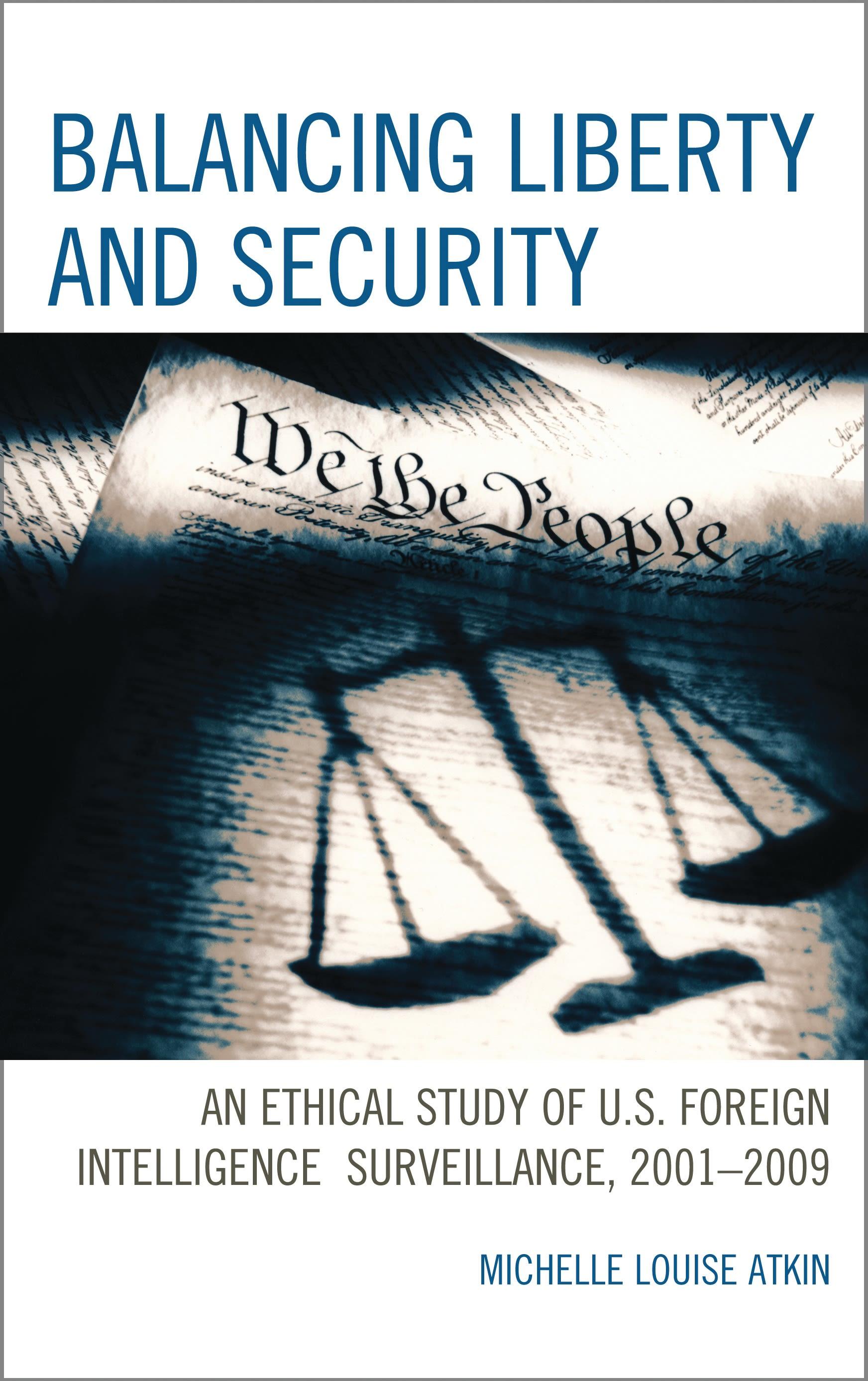
This work examines the philosophical foundations of information ethics and their potential for application to contemporary problems in U.S. foreign intelligence surveillance. Questions concerning the limits of government intrusion on protected Fourth Amendment rights are examined against the backdrop of the post-9/11 period. Changes to U.S. foreign intelligence surveillance law and policy are analyzed by applying the traditional ethical theories commonly used to support or discount these changes, namely utilitarian and contractarian ethical theories. The resulting research combines both theoretical elements, through its use of analytic philosophy, and qualitative research methods, through its use of legislation, court cases, news media, and scholarship surrounding U.S. foreign intelligence surveillance. Using the U.S.A. PATRIOT Act, the Foreign Intelligence Surveillance Act (FISA) and the Terrorist Surveillance Program as case examples, the author develops and applies a normative ethical framework based on a legal proportionality test that can be applied to future cases involving U.S. foreign intelligence surveillance.
The proportionality test developed in this research, which is based on a modified version of the Canadian Oakes Test, seeks to balance legitimate concerns about collective security against the rights of the individual. As a new synthesis of utilitarian and contractarian ethical principles, the proportionality test laid out in this book has potential for application beyond U.S. foreign intelligence surveillance. It could act as a guide to future research in other applied areas in information policy research where there is a clear tension between individual civil liberties and the collective good of society. Problems such as passenger screening, racial and ethnic profiling, data mining, and access to information could be examined using the framework developed in this study.
The proportionality test developed in this research, which is based on a modified version of the Canadian Oakes Test, seeks to balance legitimate concerns about collective security against the rights of the individual. As a new synthesis of utilitarian and contractarian ethical principles, the proportionality test laid out in this book has potential for application beyond U.S. foreign intelligence surveillance. It could act as a guide to future research in other applied areas in information policy research where there is a clear tension between individual civil liberties and the collective good of society. Problems such as passenger screening, racial and ethnic profiling, data mining, and access to information could be examined using the framework developed in this study.
Pages: 156
Category: Statsvetenskap & Politik
e-ISBN: 9781442219106
Shipping weight: 1.2 kg
Ships in: 1-2 days
Pay easily by card, Klarna, Apple Pay or Google Pay. Not happy? You always have a 14-day money-back guarantee. Read more in our terms. If you have any questions, email us at hello@memmo.org.
Memmo makes studying easier – wherever you are in the world. We bring your course books and smart study tools together in one place: summaries, quizzes, podcasts and flashcards. Plus Ted, your study buddy who answers anything you wonder. Over 50,000 students already study here – built to help you learn faster and stress less.