
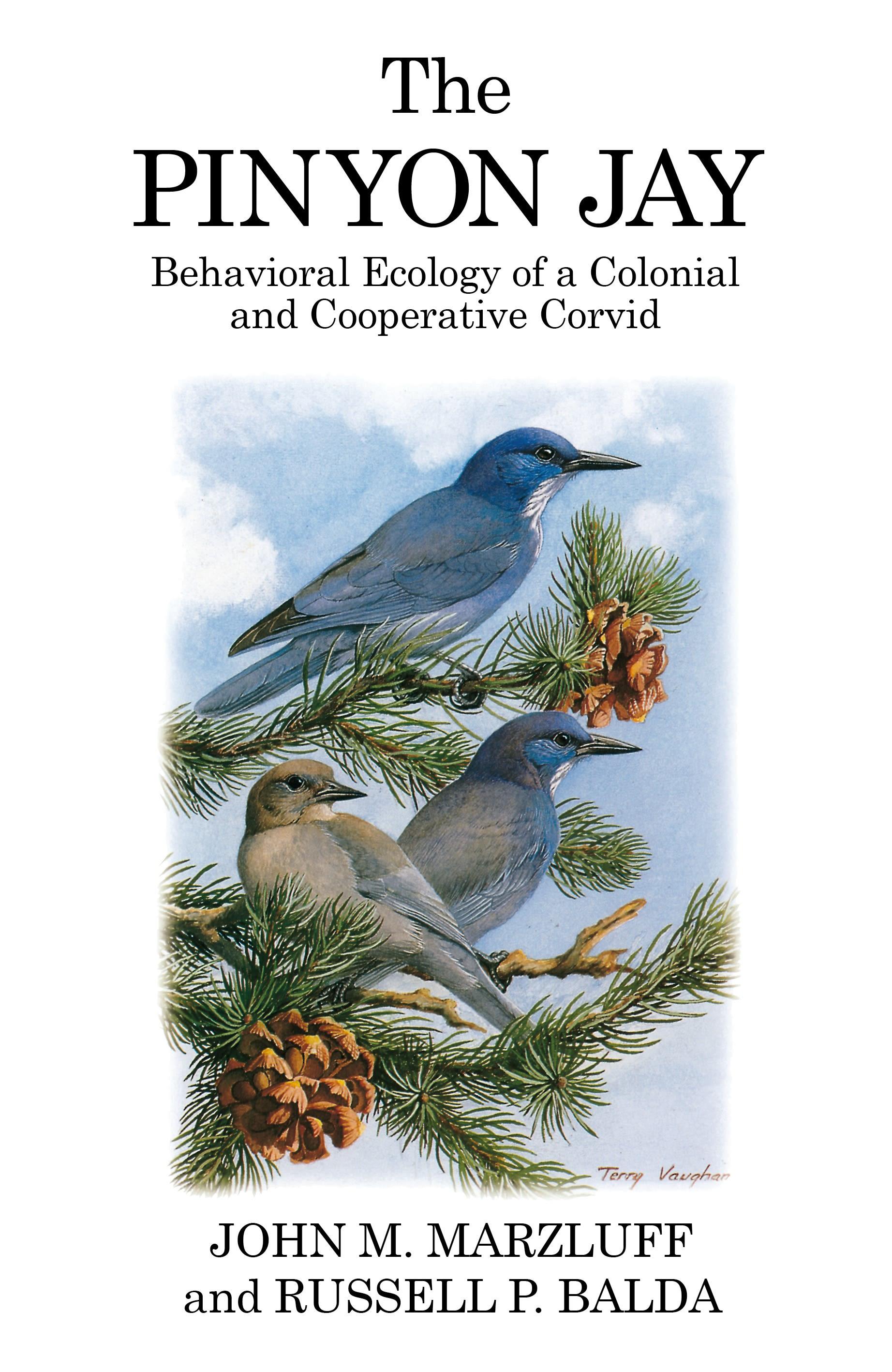
A flock of Pinyon Jays arrive in a flash of blue, and leave again just as suddenly.
This once mysterious bird is now the subject of over 20 years of intensive research involving over one thousand colour-marked jays by Russell Balda, John Marzluff and their colleagues and helpers. This plain blue bird has turned out to be anything but plain in its biology and behaviour.
Uniquely dependent on the seeds of the Pinyon Pine for food, they have developed a number of behavioural and morphological adaptations to best utilise this resource, above all caching enough seeds each autumn to supply their needs throughout the winter and fuel their unusual habit of nesting in late winter.
Fluctuations in pine-seed supply, both by season and between years, poses special problems for these birds and has led to their extremely flexible and complex social system in which learning and memory play an unusually large part. They store pine seeds and retrieve them with uncanny accuracy; they form lifelong pair bonds and nest colonially, occasionally involving younger birds to help established pairs rear the young; and they use their large vocabulary to coordinate activities within one of the largest known avian societies.
This intriguing story will fascinate both the enthusiastic amateur birder and the professional alike. Packed with information, it presents Pinyon Jay biology in a readable form and places them into the wider context of studies on bird ecology and evolution.
Fine illustrations by Tony Angell, with additional pictures by Caroline Bauder, complete this attractive addition to any birder's bookshelf.
This once mysterious bird is now the subject of over 20 years of intensive research involving over one thousand colour-marked jays by Russell Balda, John Marzluff and their colleagues and helpers. This plain blue bird has turned out to be anything but plain in its biology and behaviour.
Uniquely dependent on the seeds of the Pinyon Pine for food, they have developed a number of behavioural and morphological adaptations to best utilise this resource, above all caching enough seeds each autumn to supply their needs throughout the winter and fuel their unusual habit of nesting in late winter.
Fluctuations in pine-seed supply, both by season and between years, poses special problems for these birds and has led to their extremely flexible and complex social system in which learning and memory play an unusually large part. They store pine seeds and retrieve them with uncanny accuracy; they form lifelong pair bonds and nest colonially, occasionally involving younger birds to help established pairs rear the young; and they use their large vocabulary to coordinate activities within one of the largest known avian societies.
This intriguing story will fascinate both the enthusiastic amateur birder and the professional alike. Packed with information, it presents Pinyon Jay biology in a readable form and places them into the wider context of studies on bird ecology and evolution.
Fine illustrations by Tony Angell, with additional pictures by Caroline Bauder, complete this attractive addition to any birder's bookshelf.
Pay easily by card, Klarna, Apple Pay or Google Pay. Not happy? You always have a 14-day money-back guarantee. Read more in our terms. If you have any questions, email us at hello@memmo.org.
Memmo makes studying easier – wherever you are in the world. We bring your course books and smart study tools together in one place: summaries, quizzes, podcasts and flashcards. Plus Ted, your study buddy who answers anything you wonder. Over 50,000 students already study here – built to help you learn faster and stress less.